
Nonprofit Board Coverage: Protecting Directors and Officers

Nonprofit board members face real legal and financial risks that many organizations overlook. Lawsuits against directors and officers have increased, with claims ranging from financial mismanagement to employment disputes.

At Heaton Bennett Insurance, we believe nonprofit board coverage isn’t optional-it’s a necessity. This guide walks you through the risks your board faces and how to protect your leadership team with the right insurance.

Directors and Officers Liability Risks

Common Claims Against Nonprofit Board Members

Nonprofit directors and officers face exposure from multiple directions, and the claims are far more concrete than many leaders realize. According to the National Center for Charitable Statistics, about 63% of nonprofits reported a D&O liability claim in the past decade-roughly twice the claim rate of the for-profit sector. The most common triggers are mismanaged funds and violations of donor restrictions, followed closely by fiduciary duty breaches tied to inadequate financial records or mishandling donations.

Percentages on nonprofit D&O claims and cyber preparedness in the United States - nonprofit board coverage

Employment practices allegations represent the largest share of actual D&O claim dollars. Accusations of discrimination, harassment, retaliation, and wrongful termination appear regularly across nonprofit boards. Compliance failures also generate lawsuits: boards that ignore bylaws or violate federal, state, or local regulations face legal action and removal. Conflicts of interest and self-dealing expose individual directors to personal liability.

How Claims Damage Your Organization

A single claim can drain an organization’s reserves through defense costs, settlements, and judgments. Beyond the financial hit, D&O incidents damage reputation, erode stakeholder trust, depress donations, and disrupt mission delivery. The Volunteer Protection Act provides only limited immunity and does not shield the organization or cover defense costs, making insurance essential rather than optional.

The Financial and Reputational Fallout

Defense costs alone can reach tens of thousands of dollars before any settlement or judgment occurs. Social inflation is driving higher litigation costs and jury awards, eroding the outdated perception that nonprofits are softer targets in court. A nonprofit with 1.5 million organizations operating across the United States and generating roughly 2.4 trillion dollars in revenue collectively represents enormous exposure for individual boards.

Without D&O protection, a single claim threatens the personal finances of directors and officers while straining organizational resources at the moment when leadership is most needed. Prevention through written policies, board training, and strong governance helps reduce risk, but even well-managed organizations face claims from donors, beneficiaries, regulators, state attorneys general, vendors, and current or former employees. The reality is that governance decisions, fundraising activities, budget oversight, and HR policies all create potential liability.

Why Insurance Matters More Than Prevention Alone

Securing proper D&O coverage with adequate limits and defense cost protection is not about pessimism-it is about protecting your board’s ability to lead and your organization’s ability to survive a legal challenge. The question is not whether your nonprofit will face a claim, but when. Understanding what D&O insurance actually covers helps you make informed decisions about the protection your board needs.

What D&O Insurance Actually Covers

Employment Practices Liability

D&O insurance protects your board in three distinct ways that most nonprofit leaders misunderstand. First, it covers employment practices liability-the single largest source of D&O claim dollars. When a staff member or volunteer alleges discrimination, harassment, retaliation, or wrongful termination, your organization faces defense costs that can exceed $50,000 before any settlement. D&O coverage pays these legal fees and any resulting judgment or settlement. This matters because employment claims are rising in frequency and severity for nonprofits, approaching levels seen in the for-profit sector.

Fiduciary Liability and Financial Protection

Second, D&O insurance covers fiduciary liability, which protects against claims of fraud, mismanagement, or improper financial oversight. This includes ERISA violations if your nonprofit sponsors an employee benefit plan. Fiduciary breaches tied to inadequate financial records or mishandled donations represent a primary claim source, and coverage typically includes an ERISA sublimit of $250,000 with an optional $500,000 increase available. Your board members gain protection when financial decisions come under scrutiny from donors, regulators, or beneficiaries.

Defense Costs Outside Policy Limits

Third, the policy covers defense costs separately in many cases, meaning legal fees are paid outside your policy limits rather than reducing your available coverage for settlements or judgments. This distinction matters enormously-your organization preserves its full coverage amount for actual liability while the insurer handles attorney fees and court costs independently.

Who the Policy Actually Protects

The scope of who is protected matters significantly. D&O coverage extends beyond just the executive director and board chair-it covers directors, trustees, officers, employees, volunteers, committee members, interns, and students-in-training. This broad member-insured definition is critical because claims often arise from mid-level staff decisions or volunteer actions. The policy also covers third-party harassment claims, protecting your organization when someone outside your nonprofit alleges harassment by your board or staff.

Additional Coverage Features That Matter

Prior Acts Coverage is available, meaning claims arising from events before your policy period can still be covered, subject to underwriting. This protects your board during transitions and leadership changes when historical decisions may surface as disputes. Deductible options range as low as $0, allowing you to eliminate out-of-pocket costs entirely if your organization prioritizes comprehensive protection. These three coverage pillars-employment practices, fiduciary protection, and defense costs-form the foundation of what D&O insurance provides. Evaluating whether your current policy truly protects your leadership team or leaves gaps when claims actually occur requires understanding exactly what your carrier will and will not pay for. The next step is assessing your specific organization’s risk profile to determine what limits and features your nonprofit actually needs.

What Size Coverage Limits Does Your Nonprofit Actually Need

Assess Your Organization’s Real Exposure

Selecting D&O coverage requires moving past generic policy templates and honestly assessing what your nonprofit would face if a claim hit today. Start by examining your organization’s revenue, employee count, and operational complexity. A nonprofit with $500,000 in annual revenue and five staff members faces fundamentally different exposures than a $5 million organization with forty employees and multiple program locations. Nonprofits with government contracts or complex grant requirements carry heightened compliance risk, while those dependent on a single major donor face concentrated financial vulnerability if that relationship sours into litigation.

Concise checklist to evaluate a nonprofit’s D&O exposure - nonprofit board coverage

The Travelers Risk Index 2025 found that 60% of nonprofits lack a post-breach response team and 53% lack an incident response plan entirely, meaning cyber-related D&O claims are far more likely in your sector than most boards acknowledge. Your risk assessment should inventory specific threats: Do your staff handle sensitive donor or beneficiary data? Does your board include members with limited nonprofit governance experience? Have you had employment disputes in the past three years? Are your financial controls documented and regularly reviewed, or do decisions flow informally through leadership? This honest inventory prevents you from purchasing coverage that sounds impressive but misses your actual exposure.

Understand Standard Policy Limits and What They Mean

Policy limits and deductibles demand equally practical thinking. Standard D&O policies typically start with $1 million per claim and $3 million aggregate limits, with umbrella options reaching $3 to $5 million depending on the plan selected. However, these numbers only matter if they match your organization’s realistic worst-case scenario. A wrongful termination lawsuit in a competitive urban market can easily exceed $200,000 in defense costs alone before settlement; employment practices claims involving multiple accusers or public allegations often run substantially higher.

Choose Deductibles That Fit Your Cash Position

Deductibles ranging from $0 to several thousand dollars shift the financial burden between your organization and the insurer. A $0 deductible eliminates out-of-pocket costs when claims arise, preserving your operational budget during crisis periods when you need reserves most. If your nonprofit operates with tight cash flow or limited reserves, the $0 deductible option is worth the premium increase because a single claim with a $10,000 deductible could force difficult program cuts. Conversely, organizations with substantial reserves and strong cash flow may accept higher deductibles to reduce annual premiums.

Work With an Insurance Professional

The critical step is consulting with an insurance professional who understands nonprofit operations, not accepting whatever coverage a carrier’s standard form offers. An experienced advisor can review your specific operations, leadership structure, and historical claims patterns rather than relying on what competitors market as standard solutions.

Final Thoughts

D&O claims strike nonprofits regularly, and prevention alone cannot stop them. The financial and reputational damage from an uninsured claim can cripple your organization at the moment when strong leadership matters most. The right nonprofit board coverage is affordable and available once you understand what your organization actually needs.

Mismanaged funds, employment disputes, fiduciary breaches, and compliance failures occur across nonprofits of all sizes, and your board members face personal liability exposure that extends beyond the organization itself. A single lawsuit can drain your reserves, damage your reputation with donors and beneficiaries, and force difficult decisions about program cuts when you should focus on your mission. Without proper protection, your leadership team carries unnecessary personal financial risk.

Assess your organization’s real risk profile, select policy limits that match your worst-case exposure, and work with an insurance professional who understands nonprofit operations. Connect with us at Heaton Bennett Insurance to review your specific operations and recommend tailored nonprofit board coverage that fits your unique exposures and budgets.

The information provided in this blog is for general informational purposes only and does not constitute legal, financial, or insurance advice. Coverage options, terms, and availability may vary. Please consult with a licensed professional for advice specific to your situation.

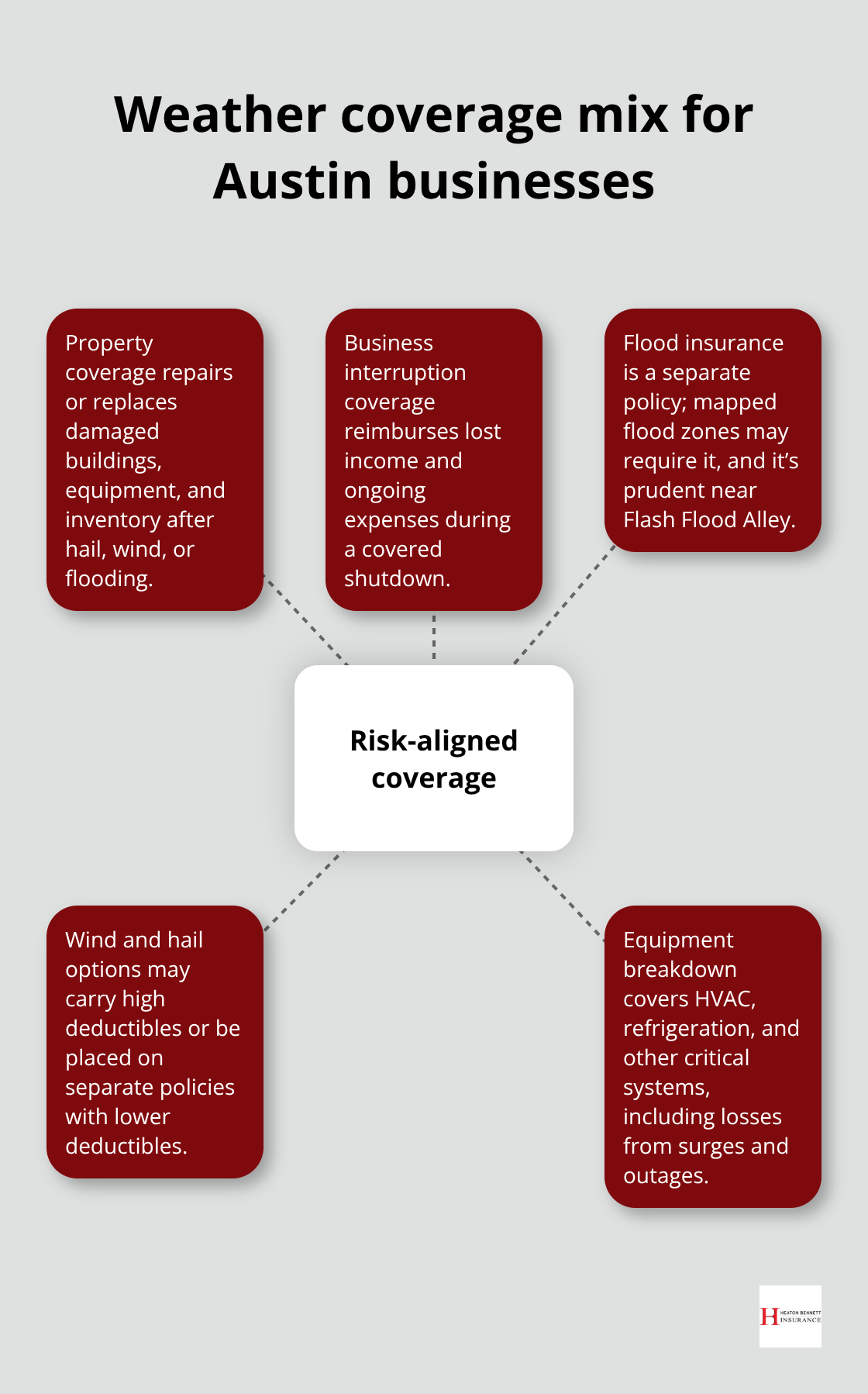
Contractor Insurance Coverage Texas: Ensure Your Projects Are Protected

Running a contracting business in Texas means navigating complex insurance requirements. Without proper contractor insurance coverage in Texas, you’re exposing your business to serious financial and legal risks.

We at Heaton Bennett Insurance know that choosing the right coverage can feel overwhelming. This guide breaks down what you actually need to protect your projects and your bottom line.

What Insurance Coverage Do Texas Contractors Actually Need

General Liability Insurance Protects Your Bottom Line

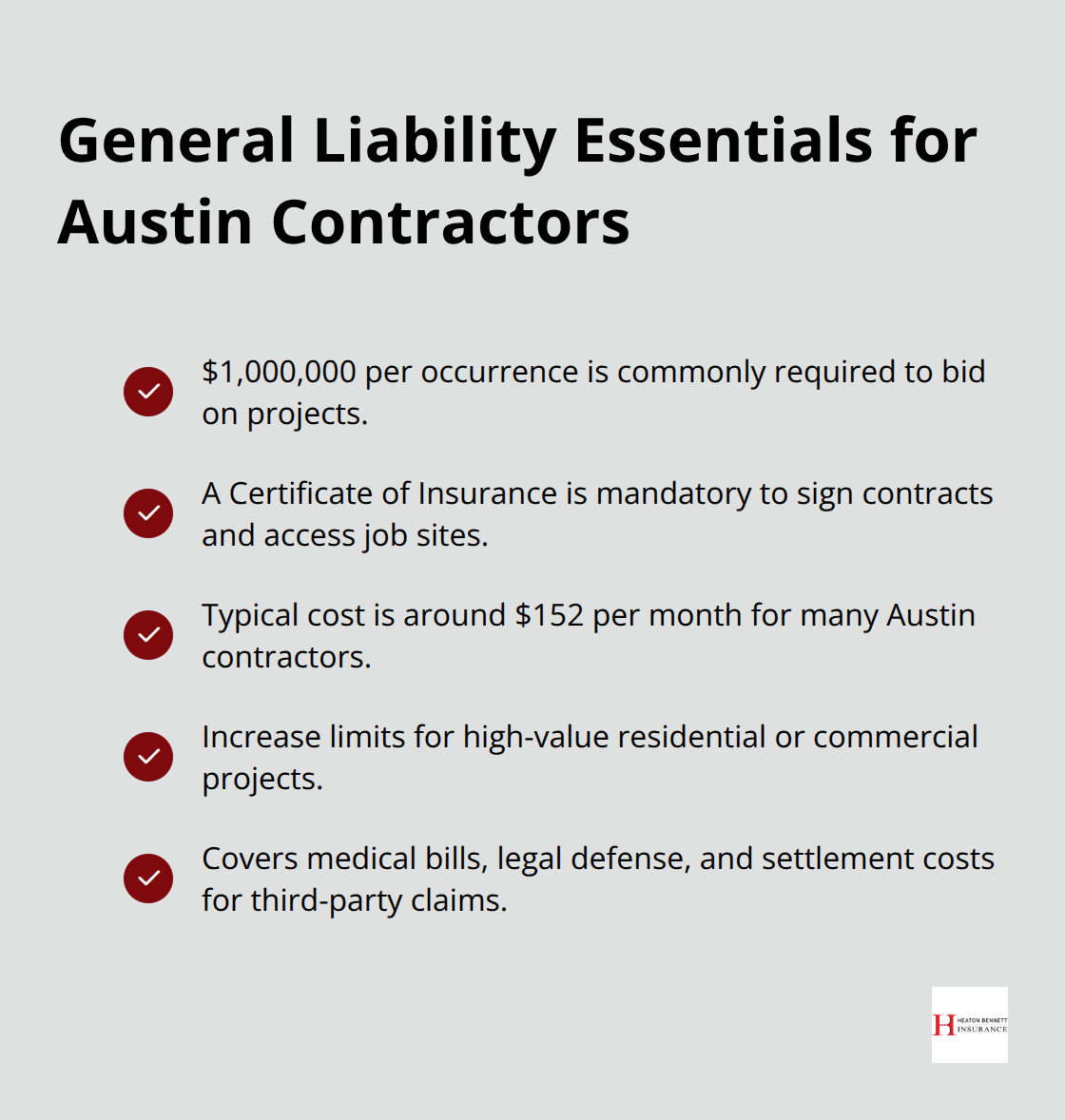
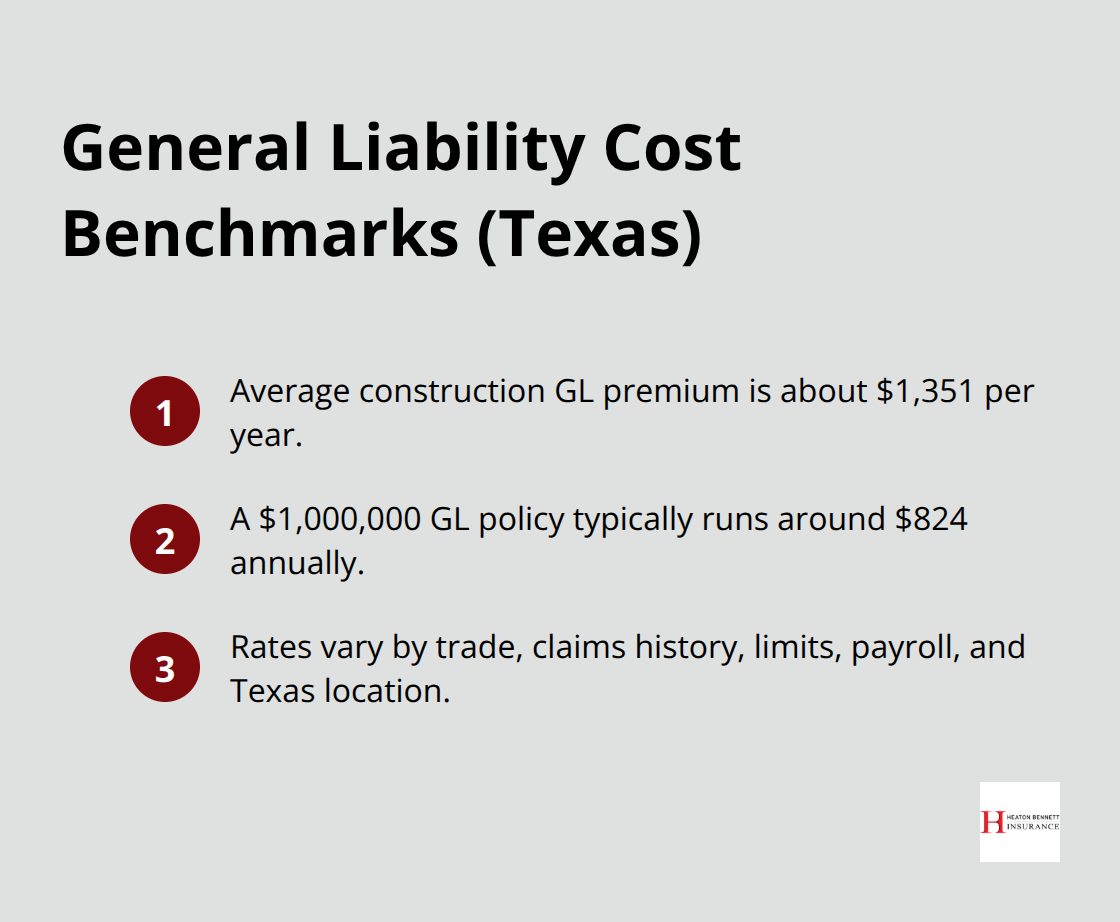
General liability insurance is your first line of defense, and it’s non-negotiable if you want to win contracts in Texas. This coverage protects you when someone gets injured on your job site or you accidentally damage a client’s property. Most project owners won’t even let you bid without proof of active general liability coverage, and many contracts demand a Certificate of Insurance before work begins. According to Insureon, Texas general contractors pay an average of around $152 monthly for general liability insurance, though this varies based on your construction type, the value of properties you work on, and your claims history. The standard minimum coverage limit sits around $1 million per occurrence, but larger projects often demand higher limits. You’ll want to add the general contractor as an additional insured on your policy and maintain clear documentation showing your policy limits and effective dates. Without a valid Certificate of Insurance, a general contractor can withhold payment or cancel your contract entirely, so this coverage directly affects your cash flow and bid eligibility.

Workers’ Compensation Protects Your Team and Your Business

Workers’ compensation insurance in Texas isn’t mandatory for all private employers, but it’s essential if you have employees, and many general contractors won’t hire subcontractors without proof of coverage. According to Insureon, average monthly premiums run around $306 for workers’ compensation. This coverage pays medical costs and lost wages when an employee gets injured on the job, and it protects your business from lawsuits by injured workers seeking damages. If you work on public projects or government contracts, workers’ compensation becomes legally required regardless of your employee count.

Commercial Auto Insurance Covers Your Fleet and Your Liability

Commercial auto insurance is equally critical because your personal auto policy won’t cover business use of vehicles. Texas requires minimum limits of 30/60/25 for company vehicles, and Insureon data shows average monthly premiums around $254. You need this coverage for any vehicle transporting tools, equipment, or employees to job sites. If your crew drives personal vehicles for work, add hired and non-owned auto coverage to fill the gaps your employees’ personal policies won’t touch.

Three core insurance coverages Texas contractors rely on with typical monthly costs.

These three coverages form the foundation of contractor protection in Texas. Your next step involves understanding which additional protections your specific projects demand, from builder’s risk to inland marine coverage.

What Texas Actually Requires From Contractor Insurance

Texas Licensing Takes a Hands-Off Approach

Texas takes a hands-off approach to contractor licensing compared to other states, but that doesn’t mean you’re free from insurance obligations. Texas has no statewide general contractor license requirement, which sounds like freedom until you realize that individual cities and counties impose their own rules.

Hub-and-spoke showing key drivers of contractor insurance requirements in Texas. - contractor insurance coverage Texas

Many municipalities require proof of general liability insurance before issuing building permits, so you can’t simply skip coverage because the state doesn’t mandate it. The real pressure comes from project owners and clients who won’t sign contracts without a Certificate of Insurance showing active coverage.

Workers’ Compensation: Legal Gray Area, Practical Requirement

Workers’ compensation sits in a gray area that trips up many contractors. Texas doesn’t require private employers to carry workers’ comp, but the moment you work on public projects or government contracts, it becomes legally mandatory regardless of your company size. Most general contractors and project owners demand proof of workers’ compensation from subcontractors before allowing them on site, making it a practical requirement even when it’s not a legal one. According to Insureon, contractors pay around $306 monthly for workers’ comp on average, but skipping it when clients require it means losing bids entirely.

Coverage Limits Vary by Project Type and Client

Liability coverage minimums vary dramatically by project type and client, which is why a one-size-fits-all approach fails in Texas contracting. Residential projects often demand $1 million per occurrence, while commercial or government work frequently requires $2 million or higher. Some municipalities specify exact limits in their permit applications, so you need to review each project’s requirements upfront rather than assuming your existing policy covers everything. The Texas Department of Licensing and Regulation handles licensing for specific trades like electrical, plumbing, and HVAC work, and many of these trades require proof of insurance as part of their licensing renewal.

Professional Certifications and Bonding Demands

Professional certifications through the National Association of Home Builders also require documented insurance coverage, giving you another reason to maintain active policies beyond just legal compliance. Bonding requirements typically apply to government projects and larger contracts, guaranteeing project completion and payment to suppliers. These aren’t insurance policies but financial guarantees that protect your clients, and they become essential when bidding on public work in Texas cities.

Align Your Coverage With Each Project’s Specific Demands

Don’t assume Texas requirements end at the state level. Review your specific project’s contract language for insurance demands, confirm coverage limits with clients before submitting bids, and maintain current Certificates of Insurance accessible for immediate delivery. Larger projects scale up your coverage needs significantly, so a policy adequate for a $50,000 residential job won’t protect you on a $500,000 commercial renovation. Document every project’s insurance requirements in writing and verify your coverage aligns with those demands before work begins, preventing payment holds and contract cancellations that drain cash flow. With your Texas requirements mapped out, the next step involves selecting the right coverage limits and deductibles that match your business’s actual risk profile.

How to Choose the Right Contractor Insurance for Your Business

Map Your Actual Projects to Coverage Needs

Start with your last twelve months of projects instead of imagining worst-case scenarios. Pull your contracts and identify the coverage limits clients demanded, then examine the dollar values of properties you worked on and the number of employees on typical job sites. A roofing contractor working residential projects worth $75,000 to $150,000 per job with five employees has vastly different insurance needs than a commercial general contractor managing $2 million office renovations with fifty workers. Your claims history matters enormously-contractors with zero claims over five years often qualify for lower premiums and better terms than those with recent losses. Insureon data shows Texas contractors pay around $152 monthly for general liability on average, but this fluctuates based on construction type and your specific risk profile.

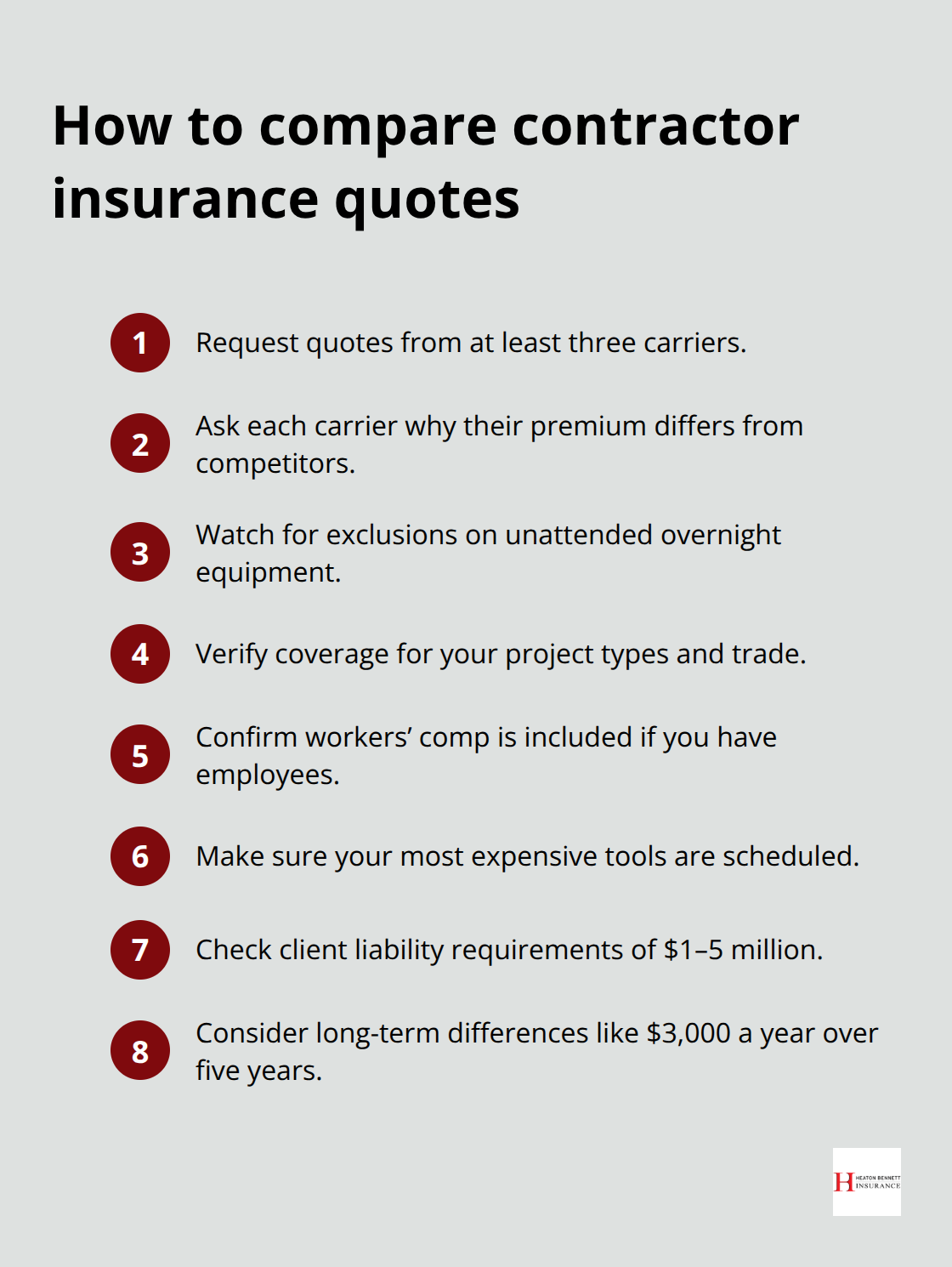
Compare Quotes With Identical Coverage Limits

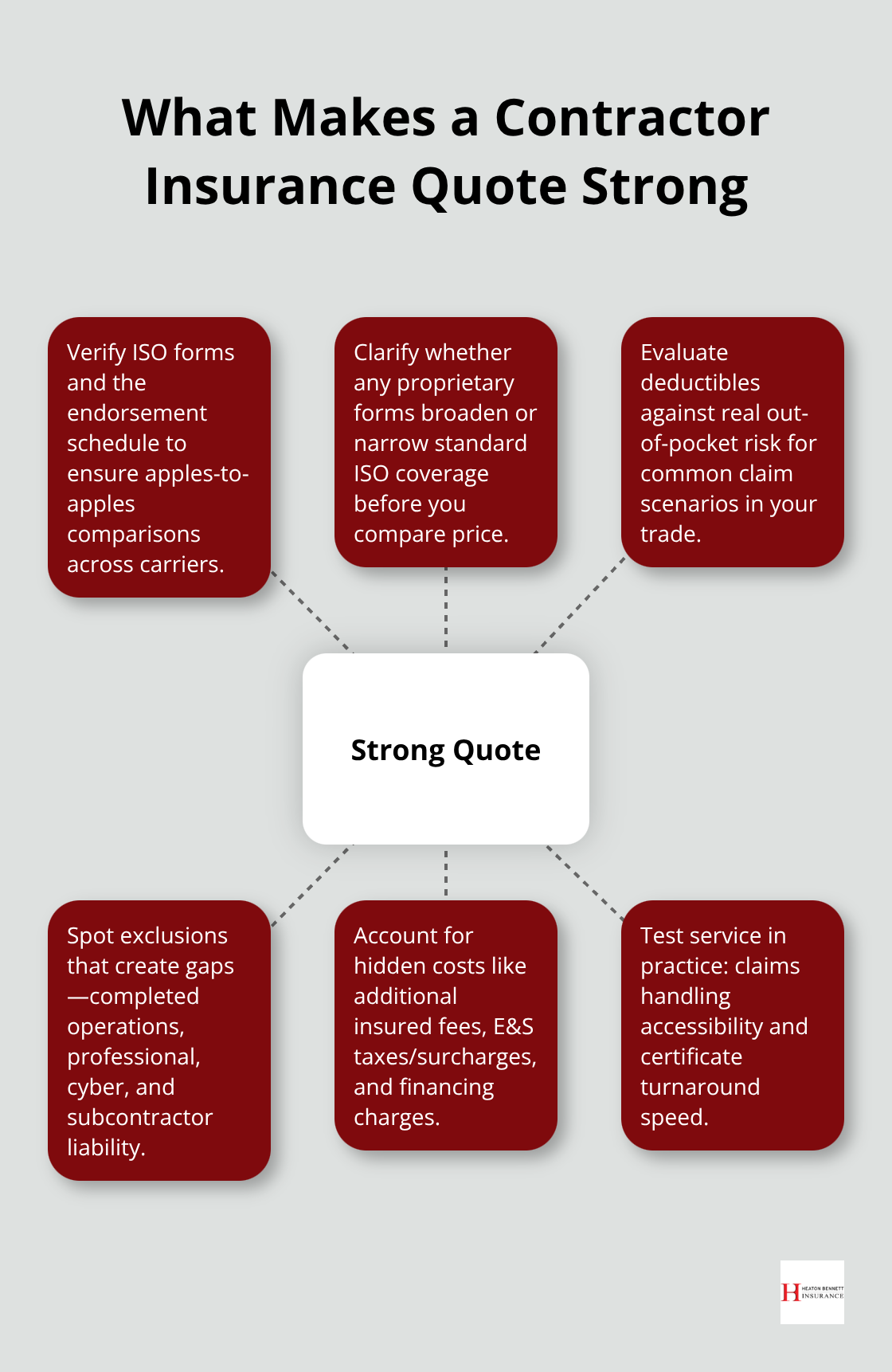
Obtain quotes from at least three carriers and request identical coverage limits across all quotes so you’re comparing apples to apples. Many contractors select the cheapest option without verifying that deductibles and coverage limits actually meet their project requirements, then discover mid-project that their policy won’t cover a claim because limits fell short. Higher deductibles lower your monthly premium but increase what you pay out-of-pocket when claims happen-a $2,500 deductible works fine if your cash flow can absorb that hit, but a $10,000 deductible strangles businesses operating on thin margins.

Work With an Independent Agent for Your Trade

An independent agent who specializes in contractor insurance understands which carriers write aggressive policies for your specific trade and which ones shy away from your work type. Agents at independent agencies can often issue a Certificate of Insurance the same day you’re approved, which matters when you’ve got a bid deadline or need to start work immediately.

Checklist of steps to compare and secure contractor insurance effectively. - contractor insurance coverage Texas

Ask your agent whether bundling your general liability, workers’ compensation, and commercial auto policies together saves money-many carriers offer bundle discounts that rival shopping policies individually.

Request a Risk Assessment Specific to Your Business

Request a risk assessment that identifies coverage gaps specific to your business, not generic contractor advice that applies to everyone. Some agents will review your actual project contracts and flag insurance requirements you might otherwise miss, preventing costly coverage disputes later. When you receive quotes, verify that additional insured endorsements are included at no extra charge, since project owners almost always demand this protection.

Understand Subcontractor Coverage and Documentation

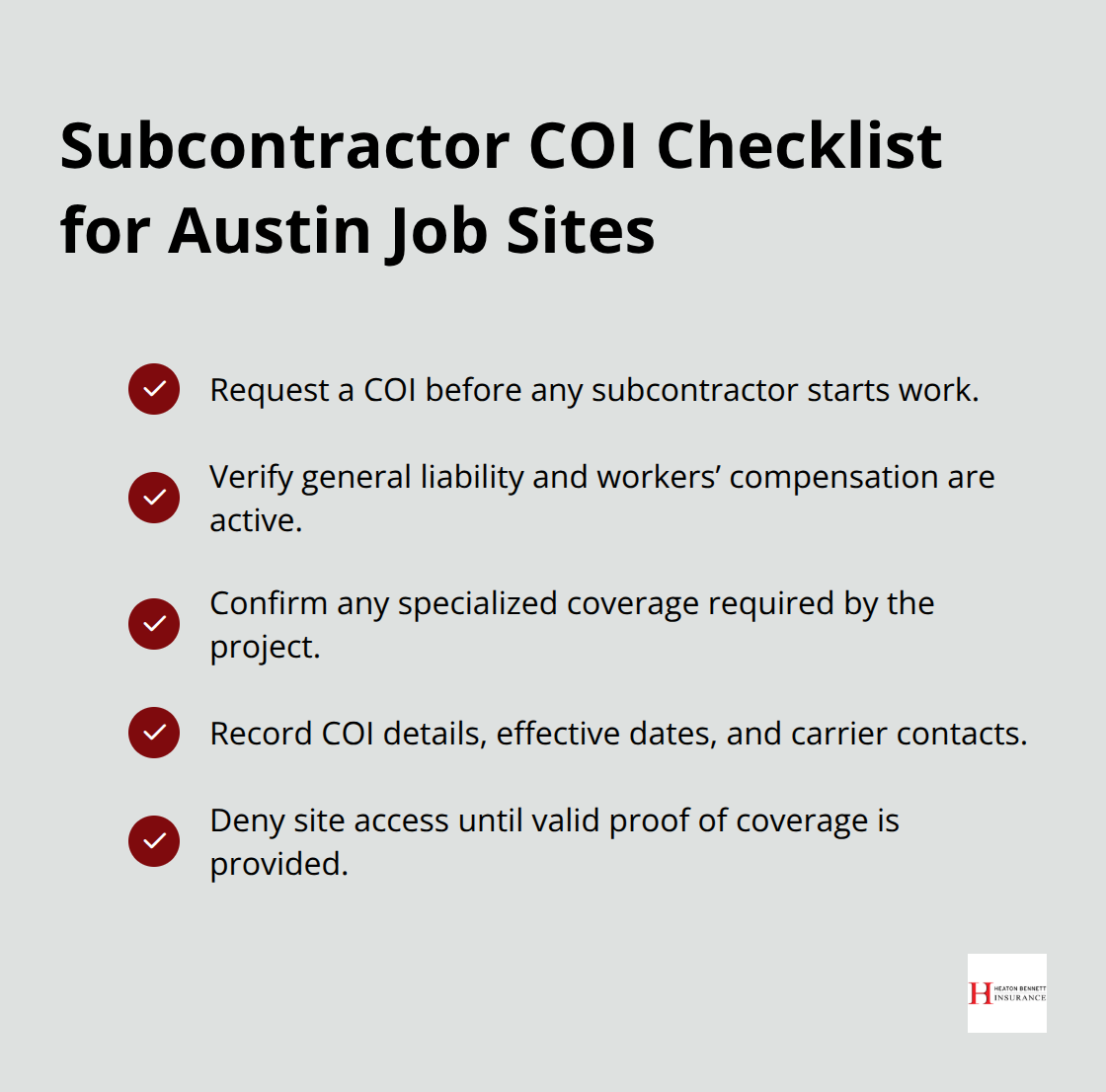
Texas contractors frequently work with subcontractors, and your agent should help you understand what your policy covers regarding sub liability and what documentation you need from subs before they step on a job site. Your policy rarely covers subcontractors fully, so each sub must carry their own insurance and provide a Certificate of Insurance to you before starting work. Verify that your agent explains which endorsements protect you when subs work under your name and what happens if a sub causes damage or injury on your project.

Final Thoughts

Contractor insurance coverage in Texas protects your business from financial disaster and positions you to win contracts that competitors without proper coverage can’t touch. General liability shields you from third-party injury and property damage claims, workers’ compensation protects your employees while keeping lawsuits at bay, and commercial auto coverage keeps your fleet legally compliant as your crew transports tools and equipment between job sites. Texas municipalities, project owners, and government agencies all impose different insurance demands, so your coverage strategy must adapt to each contract rather than relying on a single policy year after year.

Cities demand proof of coverage before issuing permits, clients specify exact limits before signing contracts, and government work triggers mandatory workers’ compensation regardless of your company size. Ignoring these variations costs you bids, delays projects, and exposes you to payment holds when clients discover your coverage falls short of their requirements. Your actual business operations-your trade, project values, employee count, and claims history-determine what protection you truly need.

Contact Heaton Bennett Insurance to discuss your specific contractor insurance needs and receive quotes that match your actual risk profile rather than generic contractor assumptions. Our team works with multiple carriers to find coverage that protects your projects, your team, and your bottom line without forcing unnecessary extras or leaving dangerous gaps.

The information provided in this blog is for general informational purposes only and does not constitute legal, financial, or insurance advice. Coverage options, terms, and availability may vary. Please consult with a licensed professional for advice specific to your situation.
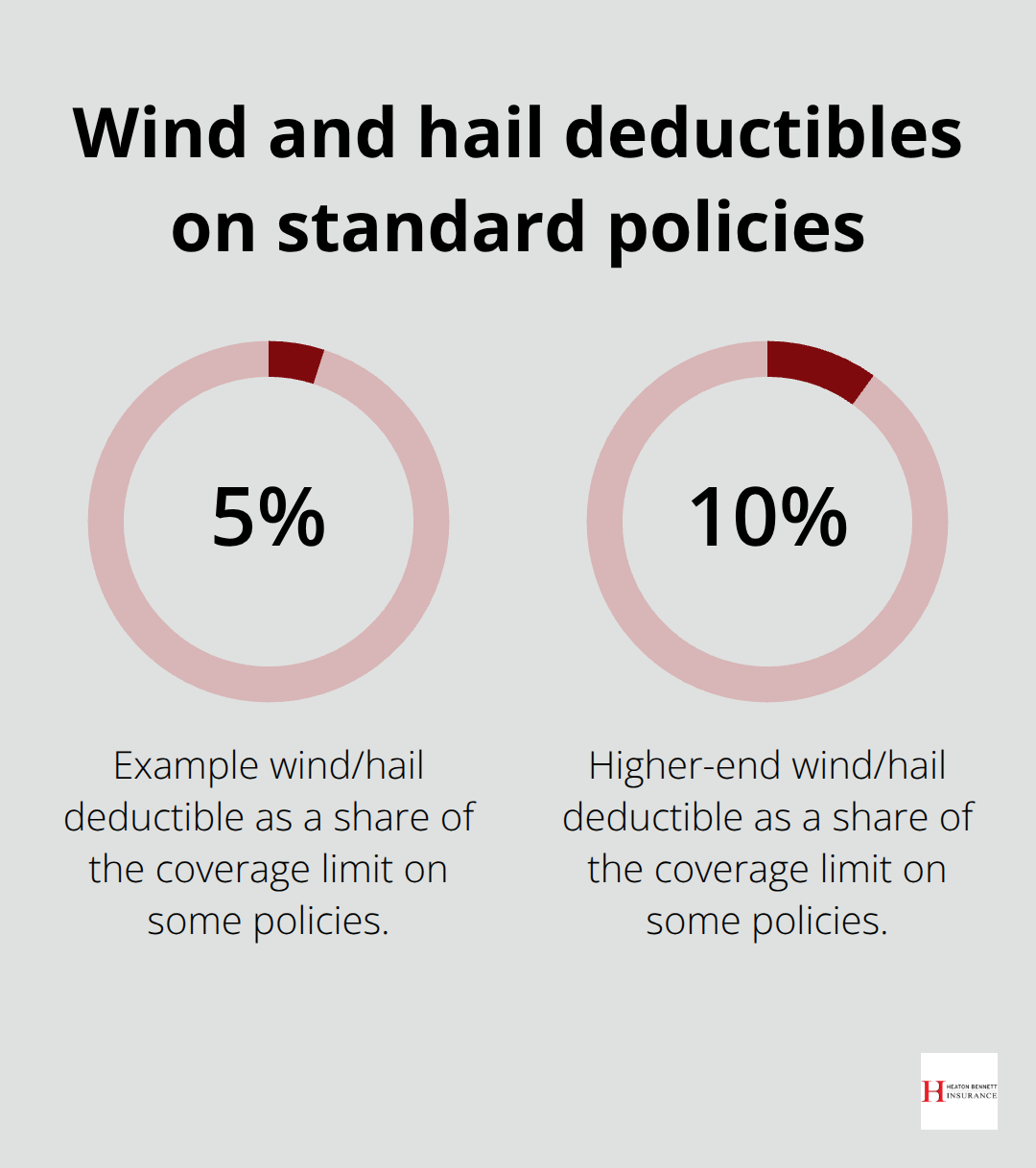
Restaurant Equipment Coverage: Keeping Kitchens Running

A broken oven or failed refrigerator doesn’t just mean a repair bill-it means lost revenue, frustrated customers, and staff standing idle. Restaurant equipment failures happen without warning, and the costs add up fast.

Restaurant equipment coverage protects your kitchen’s most critical assets when breakdowns occur. We at Heaton Bennett Insurance help restaurant owners understand what’s covered, what it costs to go without protection, and how to choose the right policy for your operation.

What Equipment Breakdown Coverage Actually Includes

The Gap Between Property Insurance and Equipment Protection

Restaurant equipment breakdown coverage protects against internal mechanical and electrical failures that your standard commercial property insurance won’t touch. Commercial property insurance covers theft, fire, and vandalism, but it stops there. When a power surge fries your point-of-sale system, when a compressor motor burns out in your walk-in cooler, or when an electrical short disables your convection oven, property coverage leaves you exposed. Equipment breakdown coverage fills that gap by paying for repairs or replacements when internal malfunctions occur.

Quick comparison of coverage gaps for U.S. restaurants between property insurance and equipment breakdown coverage - restaurant equipment coverage

What Your Coverage Actually Protects

The National Restaurant Association projects US foodservice sales to exceed $1 trillion in 2025, which means restaurants invest heavily in equipment to capture that revenue. Most kitchens carry between $40,000 and $200,000 in equipment value, making breakdown protection a financial necessity rather than an optional add-on. Coverage typically applies to boilers and pressurized equipment, HVAC systems, refrigeration units, food processing equipment, computers, point-of-sale devices, and security systems. Some policies even include business income coverage, which reimburses lost profits during downtime, and food spoilage coverage, which replaces perishable inventory destroyed after a breakdown. Without these protections, a single equipment failure can force temporary closure and erode customer loyalty.

Why Equipment Fails When You Need It Most

Equipment failures strike when you’re busiest. A failed dishwasher during dinner service means dishes pile up, staff falls behind, and customers wait longer. A refrigeration breakdown puts your entire inventory at risk and can trigger health code violations. Fryer thermostat failures, oven heating element burnouts, and mixer motor seizures happen regularly in high-volume kitchens because constant heat, mechanical stress, and grease buildup accelerate wear.

Understanding Limits, Deductibles, and Exclusions

Coverage limits matter significantly-you need enough protection to cover the actual replacement cost of your highest-value equipment. Deductibles typically range from $250 to $2,500, and choosing a higher deductible lowers your premium but increases your out-of-pocket expense when a claim occurs. Some carriers offer rush repair options that prioritize rapid technician dispatch, minimizing downtime on critical equipment. Understanding what your policy excludes is equally important: most coverage excludes breakdowns caused by neglect, improper maintenance, normal wear and tear, and unauthorized repairs. This means regular preventive maintenance isn’t optional-it’s a requirement to keep your coverage valid. You must purchase equipment breakdown insurance before a loss occurs; retroactive coverage doesn’t exist, so waiting until after a failure leaves you unprotected.

The specific equipment you operate and your kitchen’s age determine which coverage options make the most sense for your operation.

What Equipment Breakdowns Actually Cost Your Restaurant

The Price Tag of Common Kitchen Failures

Refrigeration failures top the list of expensive kitchen disasters. A walk-in cooler compressor burnout runs $3,000 to $8,000 in repairs, and that’s before you factor in the food spoilage. A single breakdown destroys $2,000 to $5,000 in perishable inventory within hours. Commercial dishwashers fail regularly in high-volume operations-spray arm clogs, pump malfunctions, and heating element failures cost $1,500 to $4,000 to repair. Convection ovens and ranges malfunction from thermostat failures, broken ignition systems, and damaged heating elements, with repairs ranging from $800 to $3,500 depending on severity. Fryer thermostat and heating element problems cost $1,200 to $2,800 to fix. Food processors, mixers, and steam tables round out the common failures, each carrying repair bills between $600 and $2,000.

The National Restaurant Association data shows kitchens carry $40,000 to $200,000 in total equipment value, meaning a single major breakdown represents a meaningful percentage of your equipment investment. Repair timelines stretch from 24 to 72 hours for parts ordering and technician availability, leaving your kitchen partially or fully non-operational during that window.

How Downtime Destroys Revenue

The revenue impact of equipment downtime dwarfs the repair cost itself. A full-service restaurant loses $1,500 to $3,000 per day in gross revenue when a major piece of equipment fails during operating hours. A quick-service operation loses $800 to $2,000 daily. A failed dishwasher during dinner service forces hand-washing of plates and glasses, which slows service by 30 to 50 percent and frustrates both staff and customers. A fryer breakdown eliminates an entire category of menu items, forcing customers to order alternatives or leave for a competitor. Refrigeration failure prevents safe ingredient storage, which forces temporary closure and potential health code violations that damage reputation long after the equipment is fixed.

The True Cost of Going Unprotected

A three-day refrigeration breakdown costs most restaurants $3,000 to $9,000 in lost sales alone, plus the $4,000 to $6,000 in spoiled food and repair expenses. Equipment breakdown coverage pays for the repair or replacement and covers lost business income during downtime, turning a $10,000 to $15,000 disaster into a covered loss. Without this protection, equipment failures become financial emergencies that damage cash flow and force difficult decisions about staffing and operations.

Understanding what these failures cost sets the stage for evaluating whether your current coverage actually protects your bottom line-or leaves you exposed when equipment fails.

Choosing Coverage That Matches What Your Kitchen Actually Needs

Inventory Your Equipment and Identify Critical Failures

Start by listing your kitchen equipment and determining which pieces would cost the most to repair or replace and cause the greatest revenue loss if they failed. A walk-in refrigerator, commercial dishwasher, and convection oven typically top this list because failures in these units shut down entire service lines. A fryer breakdown eliminates fried items from your menu, but a refrigeration failure forces complete closure and health code violations. Calculate the replacement cost for each critical piece-refrigeration units run $8,000 to $15,000, commercial dishwashers cost $5,000 to $12,000, and convection ovens range from $4,000 to $10,000. Your coverage limit should match or exceed these replacement costs, not fall short. Many restaurants underestimate equipment value and choose limits that cover only 60 to 70 percent of actual replacement costs, leaving them exposed to significant out-of-pocket expenses when major failures occur.

Visualization of restaurants covering only 60% to 70% of actual replacement costs

Match Your Coverage Limits to Actual Replacement Costs

Equipment breakdown coverage protects your kitchen only when your policy limits reflect what you actually own. A walk-in cooler that costs $12,000 to replace requires a coverage limit of at least $12,000-anything less leaves you paying the difference out of pocket. Most restaurants carry $40,000 to $200,000 in total equipment value, so your aggregate coverage limit should account for multiple simultaneous failures. Request quotes that show coverage limits at $50,000, $75,000, $100,000, and $150,000 to understand how premium costs scale with protection levels. Higher limits cost more, but they prevent the financial shock of a major breakdown that exceeds your policy cap.

Select a Deductible That Fits Your Cash Flow

Deductibles directly impact your premium cost and your risk tolerance. A $500 deductible means you pay $500 out of pocket when a claim occurs, while a $2,000 or $2,500 deductible substantially lowers your monthly premium but shifts more financial burden to your business when equipment fails. If your restaurant operates with thin margins, a lower deductible protects cash flow during unexpected breakdowns. If you maintain substantial reserves and want to minimize premium costs, a higher deductible makes financial sense. Request quotes at multiple deductible levels-$500, $1,000, $1,500, and $2,500-to understand the premium difference and decide what your business can absorb.

Evaluate Rush Repair Options and Additional Coverages

Beyond deductibles, assess whether rush repair options matter for your operation. Some carriers offer expedited technician dispatch that reduces downtime from 48 to 72 hours down to 24 hours, which justifies the premium increase for high-revenue restaurants. Food spoilage coverage and business income coverage are not always included by default, so explicitly ask carriers whether these protections are part of the base policy or available as add-ons. A three-day refrigeration failure costs $4,000 to $6,000 in spoiled inventory alone, making food spoilage coverage essential for restaurants with significant perishable inventory.

Hub-and-spoke view of rush repair, food spoilage, and business income coverage for U.S. restaurants - restaurant equipment coverage

Business income coverage reimburses lost profits during downtime, which typically costs more than the repair itself. Request quotes that include both protections so you understand the true cost of comprehensive coverage versus limited plans.

Final Thoughts

Equipment breakdowns strike without warning, and the financial damage extends far beyond repair bills. Restaurant equipment coverage protects your kitchen’s most valuable assets and keeps your operation running when failures occur. The difference between having comprehensive protection and going unprotected often means the difference between absorbing a manageable loss and facing a financial crisis that disrupts service and damages customer relationships.

Your restaurant’s equipment represents a significant investment, typically ranging from $40,000 to $200,000 in total value. A single major breakdown can cost thousands in repairs, destroy perishable inventory, and eliminate revenue for days. Equipment breakdown coverage addresses these internal mechanical and electrical failures that standard property insurance ignores, covering repair costs, replacement expenses, lost business income, and food spoilage.

We at Heaton Bennett Insurance work with restaurant owners to build customized policies that protect against the specific equipment failures most likely to disrupt your operation. Contact Heaton Bennett Insurance to discuss your restaurant’s equipment protection needs and get a customized quote that reflects your actual kitchen value and operational risks.

The information provided in this blog is for general informational purposes only and does not constitute legal, financial, or insurance advice. Coverage options, terms, and availability may vary. Please consult with a licensed professional for advice specific to your situation.
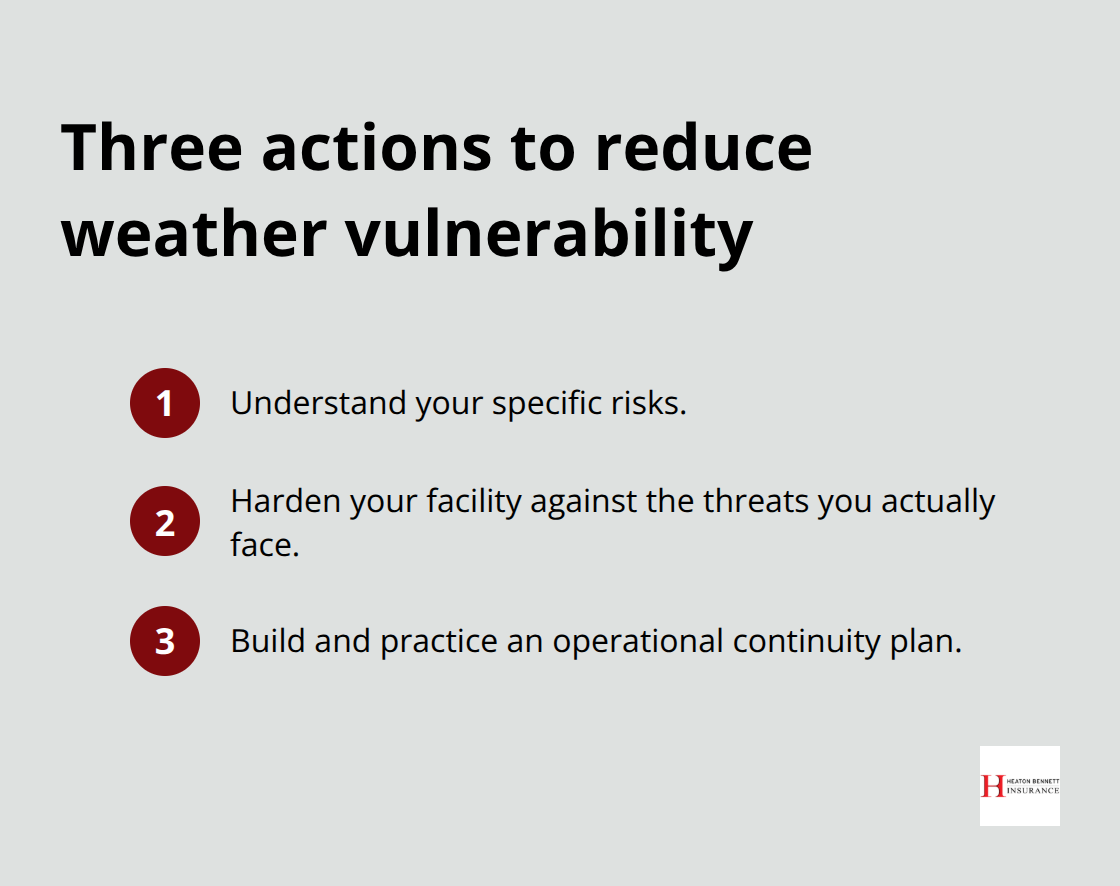
Nonprofit Director Insurance: Protecting Leadership and Mission

Nonprofit board members make decisions that shape organizations and communities. Yet many leaders operate without understanding the legal and financial risks they face personally.

Nonprofit director insurance protects you from claims that can drain personal assets and distract from your mission. We at Heaton Bennett Insurance help nonprofit leaders get the coverage they need to lead with confidence.

What Coverage Do Nonprofit Leaders Actually Need?

The Three Liability Exposures Every Nonprofit Faces

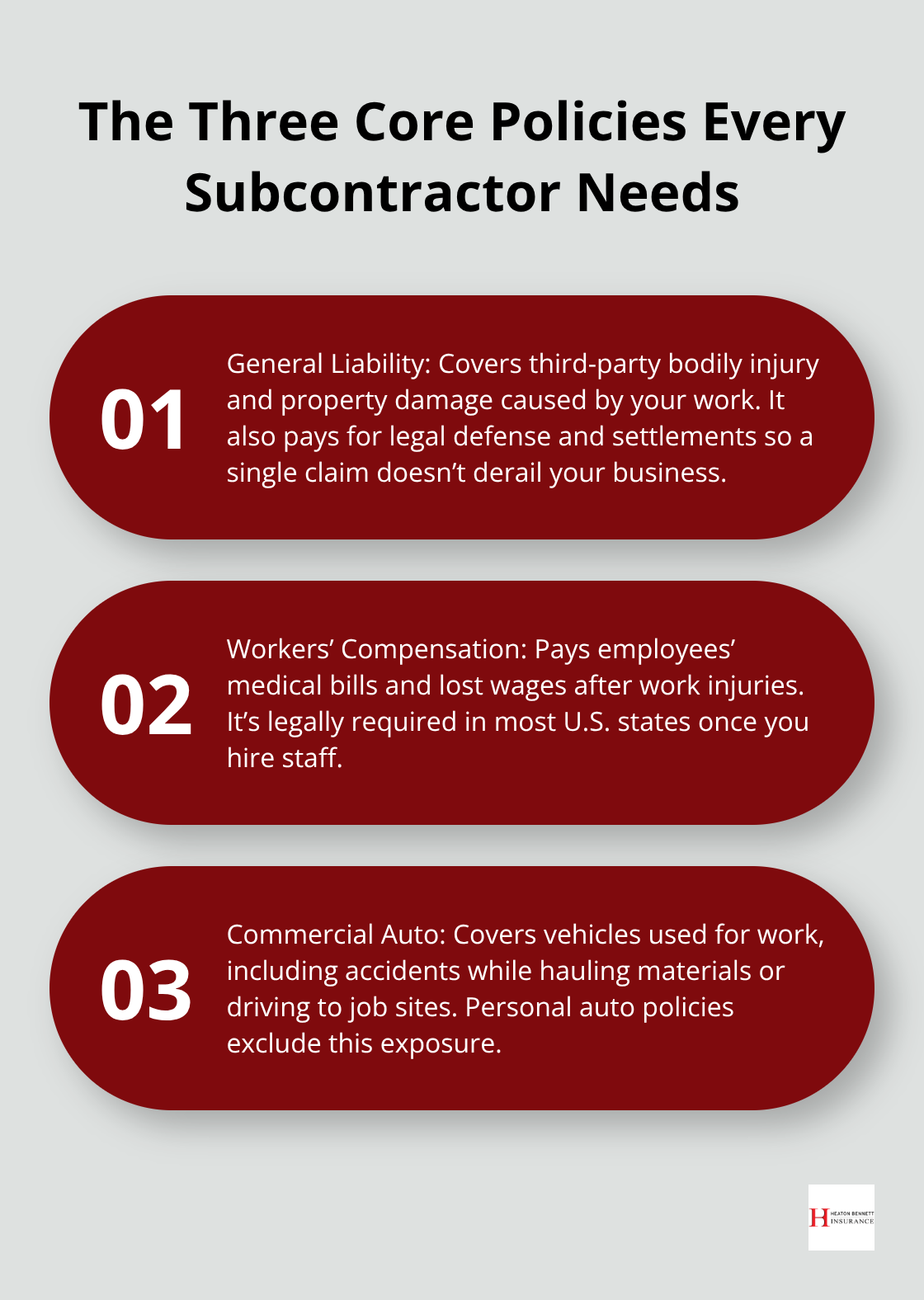
Nonprofit directors face three distinct liability exposures, and each demands separate protection. Directors and Officers Liability covers governance decisions-board votes, policy changes, strategic choices-where leaders face personal lawsuits for alleged negligence or breach of duty. This forms the foundation. Employment Practices Liability covers employment-related claims: discrimination, harassment, wrongful termination, retaliation. According to Insurance Business America, employment practices rank among the most frequent nonprofit liability exposures, making this coverage essential if your organization has staff. Fiduciary Liability protects financial oversight, particularly for ERISA-related decisions involving employee benefit plans. Many nonprofits bundle these three, but that approach creates a false sense of security. The real issue is that policy limits are shared across all three coverage types and between the organization and individual directors.

Infographic summarizing D&O Liability, Employment Practices Liability, and Fiduciary Liability for nonprofit boards in the United States. - nonprofit director insurance

Why Shared Limits Create Hidden Gaps

A $1 million combined limit sounds substantial until defense costs mount in a contested claim. That limit depletes rapidly, leaving directors personally exposed. Defense costs alone can consume half the policy limit before any settlement or judgment occurs. This reality means your organization must understand exactly how much protection remains for individual directors after the organization claims its share. High-net-worth directors face particular risk because their personal assets become targets once policy limits exhaust.

Assess Your Organization’s Actual Risk Profile

Start with honest assessment: How many employees do you have? Do you manage retirement or health plans? Have you faced employment disputes in the past five years? The answers determine which coverages matter most. A small volunteer-led nonprofit with no staff has different priorities than a mid-sized social service agency with 30 employees and a 403(b) plan. According to the National Center for Charitable Statistics, there are over 1.5 million nonprofits in the U.S., yet about 63% reported a D&O claim in the past decade-higher than the for-profit sector. That statistic means your organization is statistically more likely to face a claim than you might assume.

Percentage chart showing the share of U.S. nonprofits reporting a D&O claim in the past decade.

Coverage Limits and Deductibles Shape Your Real Protection

Coverage limits matter enormously. Many nonprofits start at $1 million, but high-net-worth directors should ask whether that limit-shared with the organization-adequately covers personal defense costs if allegations arise. Deductibles typically range from $0 to $10,000; a $0 deductible costs more but eliminates out-of-pocket defense expenses when claims hit. Review what your policy actually excludes: prior acts, cyber incidents, or specific employment practices. Exclusions are where coverage fails when you need it most. Your policy document should clearly state which employment practices it covers and which it does not.

What Happens When You Face an Actual Claim

The gap between what nonprofit leaders think they have and what their policies actually cover often emerges only after a claim arrives. A director accused of discrimination discovers the policy excludes certain employment practices. Another leader learns that the organization’s indemnification agreement does not extend to personal defense costs. These gaps force directors to choose between personal bankruptcy and fighting claims without legal representation. The solution is not to hope claims never happen-the statistics show they do-but to understand your coverage now, before allegations surface.

What Claims Actually Hit Nonprofit Boards

Governance Decisions Trigger Real Lawsuits

Nonprofit board decisions spark real lawsuits, and they arrive faster than most leaders expect. According to Insurance Business America, mismanagement of funds ranks as a major liability exposure for nonprofits, yet many directors underestimate how quickly governance decisions become legal disputes. A board votes to restructure programs without adequate stakeholder consultation, and a major donor sues for breach of fiduciary duty. Another board fails to properly vet a new executive director who later embezzles funds, and state regulators investigate board oversight. These scenarios happen regularly, not hypothetically.

The Volunteer Protection Act Falls Short

The Volunteer Protection Act provides limited immunity for volunteers, but it does not shield directors or officers from personal liability, nor does it protect the organization itself. This gap means board members remain personally exposed even when acting in good faith. Financial mismanagement allegations particularly sting because they often involve multiple defendants-the organization, individual directors, and sometimes officers. Defense costs alone can reach $50,000 to $150,000 before any settlement occurs, and those costs come directly from the organization’s resources unless D&O insurance covers them.

Employment Disputes Escalate Rapidly in Nonprofit Settings

Employment disputes represent the second major liability vector, and they escalate faster in nonprofit environments where staff often wear multiple roles and reporting lines blur. A staff member claims discrimination based on race or gender, or alleges retaliation after reporting a compliance concern. A volunteer accuses a supervisor of harassment, and the organization faces both the original claim and potential regulatory investigation. Insurance Business America identifies employment practices as among the most frequent nonprofit liability exposures, yet many boards assume their D&O policy covers these claims automatically. It does not.

Employment Practices Liability Requires Separate Coverage

Employment Practices Liability must be purchased separately or as a bundled endorsement, and many nonprofits discover this gap only after a claim arrives. Disputes with employees and volunteers also trigger indirect costs-lost productivity, damaged reputation, difficulty recruiting future staff-that insurance cannot recover. What insurance does cover is the legal defense, settlements, and judgments that protect both the organization and individual directors from personal bankruptcy. The practical reality is that nonprofits with staff cannot operate safely without explicit employment practices coverage, and that coverage must be reviewed annually to match your actual workforce composition and risk exposure.

How Your Coverage Gaps Determine Your Next Steps

The gap between what nonprofit leaders think they have and what their policies actually cover often emerges only after a claim arrives. A director accused of discrimination discovers the policy excludes certain employment practices. Another leader learns that the organization’s indemnification agreement does not extend to personal defense costs. These gaps force directors to choose between personal financial ruin and fighting claims without legal representation. Understanding your actual coverage now-before allegations surface-determines whether your organization can respond effectively when claims hit.

Choosing the Right Coverage Limits for Your Nonprofit

Start With Your Organization’s Financial Reality

Start with your organization’s financial reality, not industry averages. A $1 million policy limit sounds adequate until you calculate actual exposure. If your nonprofit has 20 employees, manages a 403(b) retirement plan, and operates multiple programs, you face simultaneous risk across governance, employment, and fiduciary domains. That $1 million limit covers the organization and all directors combined, which means a single employment discrimination claim consuming $200,000 in defense costs leaves only $800,000 for all other exposures and individual director protection.

About 63% of nonprofits reported a D&O claim in the past decade, yet most started with insufficient limits that forced difficult choices between organizational defense and individual director protection. High-net-worth directors should push for $2 million to $3 million combined limits, with consideration of Side A coverage that protects individual directors above the organization’s policy.

Deductibles and Cash Flow Protection

Deductibles matter less than many boards assume. A $0 deductible costs 15% to 25% more in premium but eliminates out-of-pocket expenses when claims arrive, which protects cash flow during investigations.

Hub-and-spoke infographic outlining key nonprofit insurance coverage decisions for U.S. boards. - nonprofit director insurance

A $5,000 or $10,000 deductible saves premium dollars but forces your organization to fund initial defense costs from operations.

Most nonprofits choose $2,500 to $5,000 as the practical middle ground, but organizations with weak cash reserves should prioritize the $0 deductible option. This choice directly impacts whether your organization can afford quality legal representation when claims hit.

Employment Practices Coverage Requires Explicit Detail

Request a detailed policy comparison that shows exactly which employment practices the policy covers and which it excludes. Discrimination and harassment claims typically receive coverage, but retaliation, wage and hour disputes, and wrongful termination exclusions vary significantly between carriers. Your policy document should explicitly list covered employment practices rather than using vague language about employment-related claims.

Your next step involves requesting loss runs and claims history from your current insurer, then sharing that information with competing carriers for accurate quotes. Carriers price nonprofits based on prior claims, employee count, revenue, and governance structure, so incomplete information produces inflated quotes.

Test Coverage Against Real Scenarios

When comparing policies, require carriers to address three specific scenarios relevant to your organization: a board member accused of misappropriating funds, a staff member filing a discrimination claim, and a volunteer alleging harassment by a supervisor. Ask how much of the policy limit each scenario would consume, whether defense costs are covered separately or deplete the limit, and what exclusions might apply. This exercise reveals gaps that generic policy summaries hide.

Nonprofit insurance policies also vary on who qualifies as an insured person. Some policies cover only directors and officers, while others extend to employees, volunteers, committee members, and even interns. If your organization relies heavily on volunteers or has significant staff involvement in governance, confirm that your policy covers these groups explicitly.

Prior Acts and Defense Cost Structure

Prior acts coverage deserves attention if your organization has changed leadership or faced past employment disputes. Prior acts coverage protects claims arising from acts committed before the policy period, which shields new directors from inheriting exposure for decisions made by predecessors. Standard policies exclude prior acts unless purchased as an endorsement with additional premium. For nonprofits with recent leadership transitions, prior acts coverage typically costs 10% to 20% more but prevents gaps in protection.

Finally, verify that your policy includes defense cost coverage that operates outside the policy limit, not as a deductible against it. Some carriers include defense costs within the limit, which means a $1 million policy that pays $300,000 in legal defense leaves only $700,000 for settlements and judgments. Other carriers pay defense costs separately, preserving the full limit for indemnification. This distinction determines whether your organization can afford quality legal representation when claims hit.

Final Thoughts

Nonprofit director insurance protects your leadership from claims that statistics show will likely arrive. About 63% of nonprofits reported a D&O claim in the past decade, yet most boards operate with coverage gaps they never understand until allegations surface and personal assets face risk. A single employment discrimination claim or governance dispute consumes months of leadership attention, damages your reputation with donors and staff, and drains operational resources that should fund your mission. The real protection starts when you request your current policy documents and loss runs from your existing carrier, then schedule a detailed review with an insurance professional who understands nonprofit exposures.

Test your coverage against realistic scenarios specific to your organization: a board member accused of misappropriating funds, an employment discrimination claim, a volunteer harassment allegation. Ask carriers directly how much of your policy limit each scenario would consume and what exclusions might apply. Most nonprofits discover their coverage is either inadequate or misaligned with their actual operations, which means your organization needs to assess whether your current limits, deductibles, and coverage types actually match your risk profile.

We at Heaton Bennett Insurance help nonprofit leaders understand protection that actually works. Contact Heaton Bennett Insurance to discuss how nonprofit director insurance can protect your leadership and mission.

The information provided in this blog is for general informational purposes only and does not constitute legal, financial, or insurance advice. Coverage options, terms, and availability may vary. Please consult with a licensed professional for advice specific to your situation.

Contractor Insurance Rates Texas: Budgeting for Risk

Contractor insurance rates in Texas vary wildly depending on your experience, the work you do, and your claims history. Getting this wrong means overpaying or worse-being underinsured when something goes wrong.

At Heaton Bennett Insurance, we help contractors understand exactly what drives their premiums and how to budget smartly. This guide walks you through the real factors that impact your costs and concrete ways to reduce them.

What Drives Your Contractor Insurance Costs in Texas

Experience and Safety Record Shape Your Premiums

Your experience level and safety record are the first things insurers examine when pricing your policy. A contractor with 10+ years of clean operations pays significantly less than someone fresh to the trade. Insureon data shows that experience directly correlates with lower premiums because insurers see fewer claims from seasoned operators. If you’ve maintained zero incidents over five years, you’re in a strong negotiating position. Multiple claims or safety violations spike your rates dramatically. Texas contractors working in high-hazard trades like roofing, electrical, and HVAC face steeper premiums than general carpentry because injury risk is objectively higher. An electrician with a spotless safety record might pay around $3,020 annually for general liability coverage, while someone with claims on file could pay 40-60% more for the same limits.

Trade Classification Determines Your Risk Profile

Your specific trade classification determines which underwriting rules apply to you. Licensed trades in Texas fall under Texas Department of Licensing and Regulation oversight, which mandates minimum coverage limits. Electrical contractors must carry $300,000 per occurrence and $600,000 aggregate coverage, while HVAC Class A contractors need the same minimums but Class B requires only $100,000 per occurrence. Plumbing contractors need at least $300,000 in general liability. These aren’t suggestions-they’re legal requirements to maintain your license and perform work. Beyond statutory minimums, your actual premium depends on the scope of work you perform. A contractor handling only residential framing pays less than one performing commercial high-rise work because the property values and injury exposure differ substantially. Insureon data indicates estimated annual costs for a $1 million revenue contractor run about $30,706 for electricians, $36,170 for plumbers, and $30,800 for HVAC contractors when you bundle general liability, workers’ compensation, commercial auto, and inland marine coverage. These figures reflect the real cost structure across Texas and show why trade classification matters more than many contractors realize.

Claims History Predicts Your Future Rates

Your past claims history is the single strongest predictor of future premiums. One legitimate claim can increase your rates by 20-35% for the next three to five years. Two claims within five years makes you hard to insure at any reasonable rate. Insurers use loss ratios-the total amount you’ve claimed divided by premiums paid-to calculate your risk score. A contractor who’s claimed $15,000 over ten years while paying $60,000 in premiums has a 25% loss ratio, which is manageable. One who’s claimed $40,000 over the same period has a 67% loss ratio and looks like a liability to underwriters. The type of claim matters too. A property damage claim from a fire caused by faulty wiring looks worse than a minor slip-and-fall incident. Workers’ compensation claims carry particular weight because they signal workplace safety problems. If your business has filed multiple workers’ comp claims, underwriters assume your safety protocols are weak and price accordingly. Understanding these three factors-experience, trade classification, and claims history-puts you in control when you shop for coverage and negotiate rates with carriers.

Hub-and-spoke showing experience, trade classification, and claims history as the main cost drivers. - contractor insurance rates Texas

How to Budget for Contractor Insurance in Texas

List Every Coverage Type You Actually Need

Start by listing every coverage type you actually need, not what you think sounds good. General liability is non-negotiable in Texas-most clients and permit offices require it before you step on a job site. Workers’ compensation is required if you have employees, and even if Texas law doesn’t mandate it for private employers, opting out exposes you to lawsuits that dwarf any premium savings. Commercial auto insurance is legally required for company vehicles.

Compact list of core insurance coverages and add-ons Texas contractors should budget for. - contractor insurance rates Texas

Beyond these essentials, your budget depends on what you do. An electrician needs inland marine coverage for tools and equipment; a general contractor handling new builds needs builder’s risk insurance. A plumber installing high-value fixtures might need an installation floater. Write down your payroll, equipment value, annual revenue, and the specific trades you perform. Your insurance agent uses these numbers to calculate exposure.

Know Your Real Costs by Trade

According to Insureon data, a $1 million revenue electrician should budget roughly $30,706 annually across general liability ($3,020), workers’ compensation ($8,230), commercial auto ($18,256), and inland marine ($1,200). A plumber runs about $36,170, and an HVAC contractor about $30,800. These aren’t guesses-they’re median costs from actual Texas contractor data.

Underestimate your payroll or equipment value, and your policy won’t cover the full loss when something happens. Overstate it, and you pay for coverage you don’t need. Accuracy here determines whether your insurance actually protects you.

Compare Quotes from Multiple Carriers

General liability alone ranges from roughly $19 to $60 per month depending on your trade and history. That’s a significant difference over a year for the same coverage. Shop at least three carriers before committing. Many underwriters offer same-day quotes online-you answer questions about your business, crew size, and claims history, then compare.

When comparing quotes, check the details: per-occurrence limits, aggregate limits, deductibles, and exclusions. A low monthly quote with a $5,000 deductible and $300,000 per-occurrence limit looks cheap until you realize it won’t cover most commercial contracts requiring $1 million per occurrence.

Bundle Policies to Cut Costs

Bundling policies cuts costs significantly. A business owner’s policy combining general liability and commercial property averages about $121 per month according to Insureon, versus buying them separately. Add workers’ compensation and commercial auto to that bundle, and you lock in volume discounts that single-policy quotes won’t match.

Premiums typically rise 3–5% annually even with a clean claims record, simply because of inflation and increased payroll. If you budget today for next year, add at least 5% to your current premium estimate. This prevents sticker shock when your renewal notice arrives and helps you plan cash flow accurately.

Percentage chart highlighting claim-driven increases and annual budgeting guidance for Texas contractors.

Plan for Premium Growth and Contract Requirements

Your contract obligations often dictate coverage limits that exceed statutory minimums. A municipal project might require $2 million aggregate coverage, while a commercial lease could demand $1 million per occurrence with you named as additional insured. These contract-driven requirements shape your actual budget more than base rates do.

Once you’ve identified your coverage needs and compared quotes across carriers, the next step involves protecting those rates through the decisions you make on the job site. How you operate directly impacts whether your premiums stay stable or climb sharply at renewal.

How to Actually Lower Your Premiums

Invest in Safety Programs That Underwriters Reward

Safety programs directly reduce your premiums when you document them properly. Carriers track your safety record closely, and contractors who implement formal training programs see measurable premium reductions. OSHA 30-hour certifications for supervisors, job-site-specific safety plans, and documented incident prevention protocols all signal to underwriters that you operate a tight ship. Licensed trades under Texas Department of Licensing and Regulation rules should document safety compliance meticulously because regulators scrutinize these trades more heavily.

One Texas electrical contractor reduced their workers’ compensation premium by 18% over two years through weekly toolbox talks, job-site safety checklists, and mandatory OSHA training for all crew members. That represents real money returning to your business. Underwriters ask detailed questions about your safety practices during underwriting, so prepare documentation in advance. A contractor without documented safety measures pays significantly more-sometimes 40% or higher premiums for identical coverage.

Bundle Policies to Unlock Substantial Discounts

Bundling policies remains the single most effective cost reduction strategy available to you. General liability alone costs roughly $19 to $60 monthly depending on your trade, but combining general liability with commercial property, workers’ compensation, and commercial auto through a business owner’s policy cuts your overall cost substantially. Insureon data shows bundled coverage averages about $121 monthly compared to purchasing policies separately, which costs considerably more. The discount compounds when you add inland marine coverage for tools and equipment or professional liability for specialized work.

Carriers reward contractors who consolidate their insurance needs with one provider. You lock in volume discounts that single-policy quotes simply won’t match. This approach also simplifies your administrative burden-one renewal date, one point of contact, one consolidated bill instead of juggling multiple carriers and payment schedules.

Protect Your Claims History Above All Else

Your claims history shapes everything from this point forward, which is why protecting it matters more than any other decision you make. A single claim increases your rates 20 to 35 percent for the next three to five years, making prevention your most powerful cost control tool. Contractors who maintain clean records for five years build negotiating leverage at renewal time-some carriers offer loyalty discounts or rate freezes to long-term customers with zero claims.

Prevention protocols cost far less than the premium increases that follow a claim. Invest in safety equipment, proper training, and quality workmanship now rather than absorbing higher premiums later. That approach guarantees lower costs long-term and protects your ability to bid competitively on future projects.

Conclusion

Contractor insurance rates in Texas hinge on three factors you control: your experience and safety record, your trade classification and its regulatory requirements, and your claims history. Understanding these drivers lets you budget accurately instead of guessing at costs or discovering coverage gaps mid-project. The contractors who pay the least aren’t those with the cheapest initial quotes-they’re the ones who invest in documented safety programs, consolidate their insurance with one provider, and treat claims prevention as a business priority.

Proper budgeting starts with listing every coverage type your business actually needs, then comparing quotes across multiple carriers to find real savings. A $1 million revenue electrician budgets roughly $30,706 annually; a plumber around $36,170 (these reflect what Texas contractors actually pay, not theoretical numbers). Bundling policies cuts costs substantially, and maintaining a clean claims record protects your rates from climbing 20 to 35 percent after a single incident.

We at Heaton Bennett Insurance help Texas contractors navigate these decisions without guesswork. Contact Heaton Bennett Insurance to get quotes from top carriers and find the right coverage for your contracting business.

The information provided in this blog is for general informational purposes only and does not constitute legal, financial, or insurance advice. Coverage options, terms, and availability may vary. Please consult with a licensed professional for advice specific to your situation.
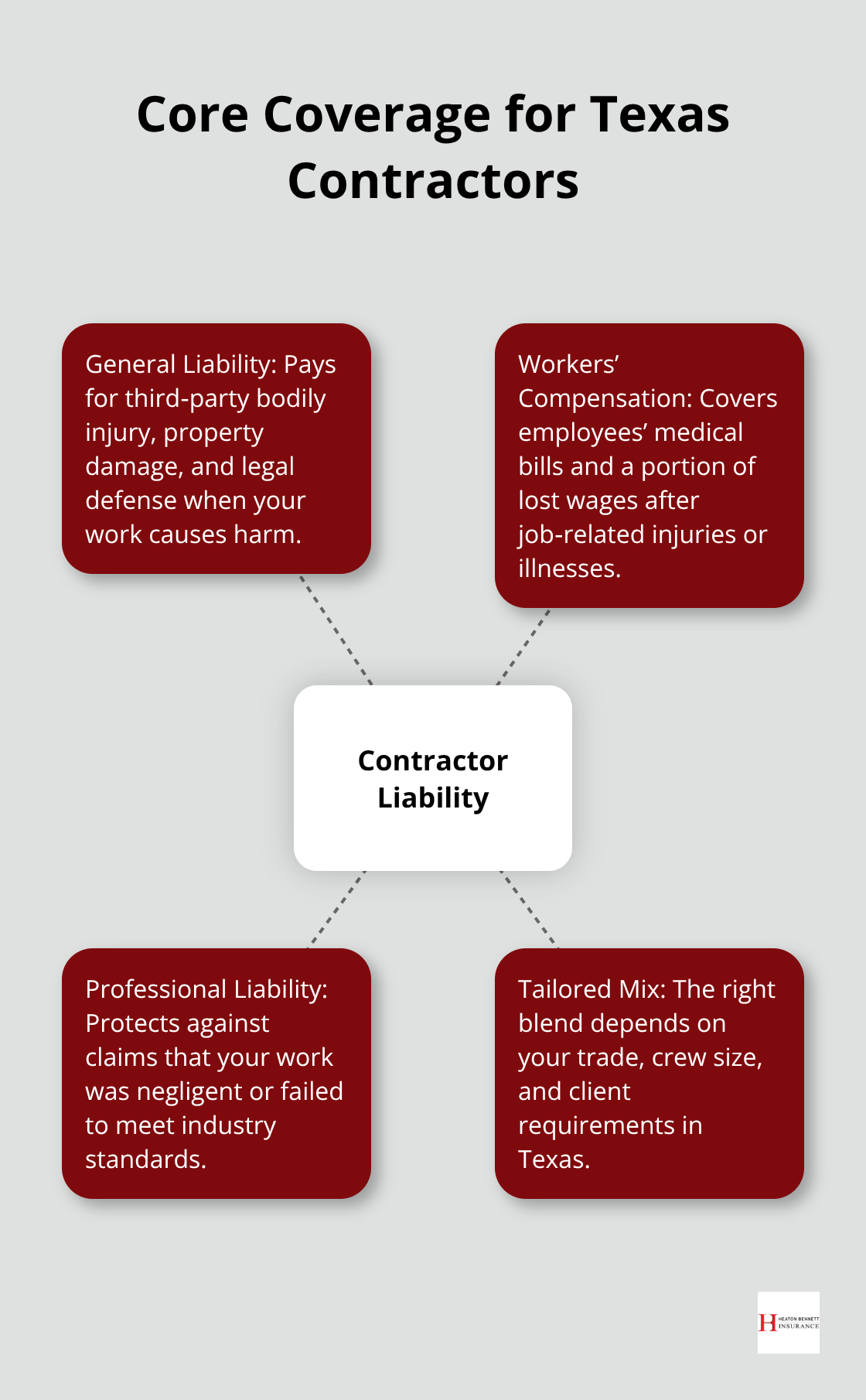
Construction Contractor Insurance: Coverage for Building Projects

Construction projects face real financial risks. One accident, weather delay, or property damage claim can derail your entire operation and drain your budget.

At Heaton Bennett Insurance, we know that construction contractor insurance isn’t optional-it’s the foundation of a sustainable business. The right coverage protects your assets, your team, and your bottom line.

Essential Coverage Types for Contractors

General Liability: Your First Line of Defense

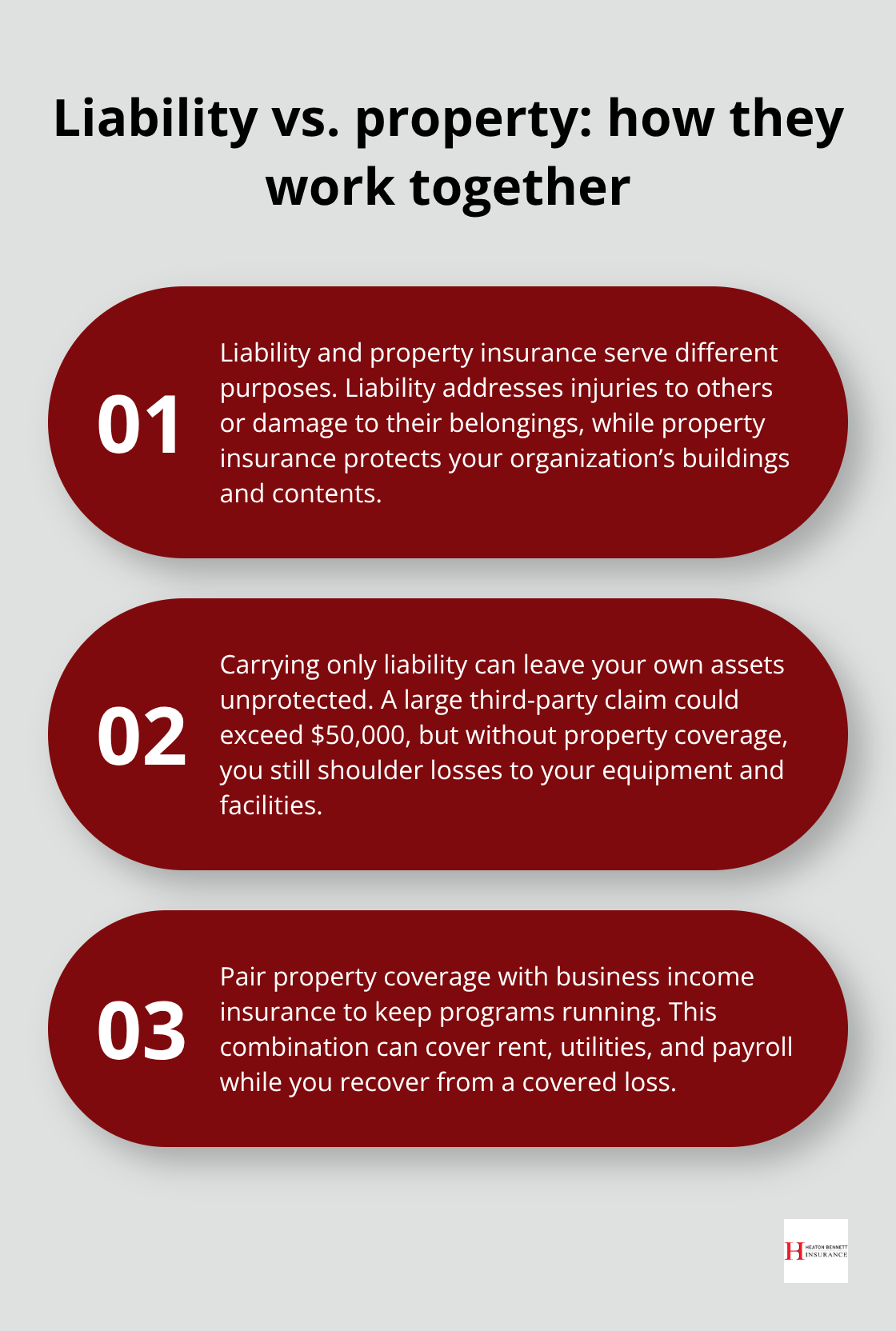
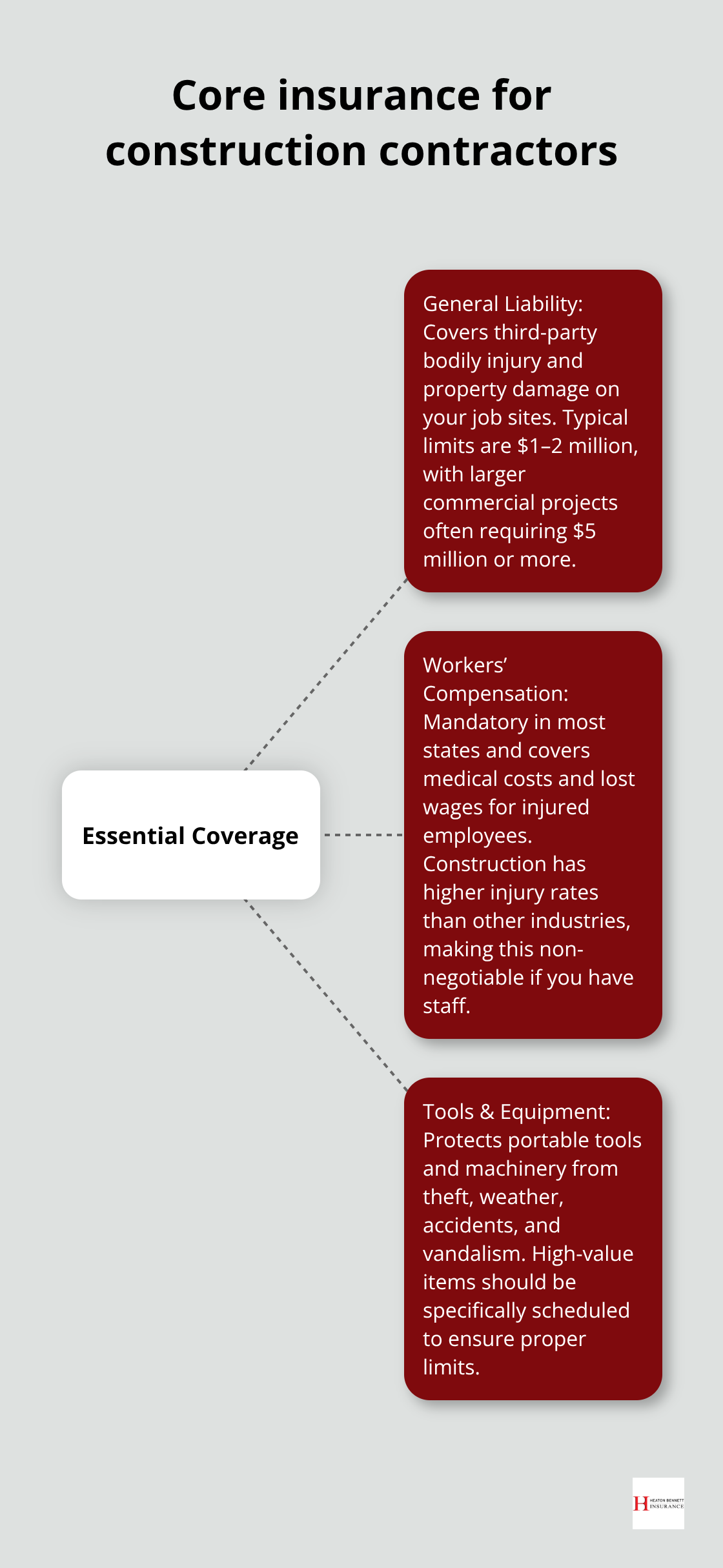
General liability insurance stands as the most fundamental protection you need, and it’s non-negotiable. This coverage protects you when a third party claims bodily injury or property damage from your work. According to the National Safety Council, the average cost of a workplace injury claim in 2022 was $40,000-a figure that shows why third-party liability exposure matters tremendously. Most states require minimum general liability limits around $1 million per occurrence before you can bid on projects. Median monthly costs run about $80, making this one of your cheapest defenses against catastrophic financial loss.

The policy covers injuries from falling debris, damage to nearby properties, and personal injury claims from your operations. Without it, a single accident drains your business reserves and potentially forces closure.

Workers’ Compensation: Protecting Your Team and Your Business

Workers’ compensation coverage is legally mandatory in Massachusetts if you have employees, and it’s your second critical layer of protection. This coverage pays medical expenses, lost wages, disability benefits, and employer liability claims when your team gets injured on the job. Median monthly costs sit around $254, though high-risk trades like roofing pay substantially more. The policy protects both your workers and your business from the financial impact of on-site injuries.

Builder’s Risk and Additional Property Coverage

Builder’s risk insurance protects the actual structure, materials, temporary structures, and debris removal during construction. This policy typically costs between 1% and 5% of total project value, with basic policies starting around $375. It covers soft costs like additional loan interest and legal fees when weather or other events delay your project. Many project owners or lenders require builder’s risk before work begins, making it essential for winning bids.

Inland marine coverage insures tools, equipment, and materials in transit or stored off-site, costing roughly $14 per month and filling critical gaps that builder’s risk alone cannot cover. Commercial auto insurance protects company vehicles used to transport supplies and equipment, running about $173 monthly and providing essential liability protection for accidents. Professional liability insurance shields you from design errors and omissions claims, costing around $74 monthly depending on your service scope.

Compact summary of typical contractor insurance costs in the United States - construction contractor insurance

These coverages work together to address the real risks that destroy construction businesses every year. The next section examines the specific claims and risk factors that make this protection indispensable.

What Really Causes Construction Claims

On-Site Injuries: The Silent Profit Killer

On-site injuries represent the single largest claim driver in construction, and the numbers are brutal. The National Safety Council reported that the average workplace injury claim cost $40,000 in 2022, but that figure masks the true financial damage. A serious injury spikes your workers’ compensation premiums by 10 to 20 percent for years, destroys your safety record with insurance carriers, and forces you to turn down profitable projects because underwriters won’t touch your account.

Range of workers’ compensation premium increases after a serious injury

Falls, electrocution, and caught-between incidents dominate OSHA’s Focus Four hazards, yet many contractors treat safety as a compliance checkbox rather than a profit protector.

The reality cuts sharper: contractors with documented safety programs and regular training reduce injury frequency and qualify for better premium rates. If you don’t track near-misses, conduct daily toolbox talks, or maintain detailed safety records, you leave money on the table and expose your business to preventable claims that follow you for years.

Third-Party Liability: When Your Work Damages Others’ Property

Third-party property damage and liability claims strike differently but hit just as hard. A falling beam that damages a neighboring structure, a concrete truck that tears up a client’s driveway, or debris that injures a passerby creates immediate legal exposure and exhausts your general liability limits fast. These incidents happen without warning and demand immediate legal defense, which your general liability policy covers-but only if your limits match the severity of the claim.

Weather Delays and Material Loss: Hidden Margin Destroyers

Weather-related delays compound this risk in ways many contractors underestimate. The construction industry in 2023 faced roughly $12 billion in material theft and damage, and severe weather accounts for a substantial portion of that loss. When a spring storm delays your project by three weeks, builder’s risk coverage pays those soft costs like additional loan interest and extended financing fees that drain profits silently. Without it, weather delays become pure losses absorbed directly from your margin.

Location and Trade-Specific Risks Shape Your Coverage Needs

Coastal projects face higher wind and hail exposure, urban sites attract more theft and vandalism, and winter projects in cold climates demand different risk strategies than summer work. The contractors who win bids consistently and protect their margins don’t just buy insurance-they map project-specific risks upfront, identify which coverage gaps matter most for their location and trade, and structure their policies to address the exact exposures their work creates. Understanding these location-based and trade-specific exposures positions you to select the right coverage limits and endorsements before you bid on your next project.

Selecting Insurance That Matches Your Project Reality

Map Your Actual Project Exposures First

Start with your next project site and identify the specific exposures that will actually cost you money. A residential renovation in an urban neighborhood faces theft and vandalism risks that a rural commercial project never touches. A coastal project demands higher wind coverage limits than inland work. A roofing job creates different liability exposures than concrete finishing. Too many contractors purchase generic coverage packages designed for every project and overpay for protection they don’t need while leaving critical gaps uncovered. The National Safety Council data showing $40,000 average injury claims and the construction industry’s $12 billion in 2023 material theft and damage losses prove that one-size-fits-all insurance fails when real claims arrive.

Key inputs to assess before choosing construction contractor insurance

Document the site conditions, the trades involved, the timeline, the neighboring properties at risk, and the materials you’ll store on-site. This assessment takes two hours and drives every coverage decision that follows. A builder’s risk policy written for a six-month project costs far less than one covering eighteen months, and the premium difference matters when you’re bidding tight margins.

Tailor Coverage Limits to Your Trade and Project Type

Professional liability limits that work for design-build contractors won’t protect architects handling complex specifications. Workers’ compensation rates spike dramatically for roofing and fall-protection trades compared to office-based work. Your project profile determines what you actually need to purchase. A $1 million general liability limit sounds standard until a third-party claim reaches $1.5 million and your business absorbs the excess.

Higher deductibles lower your monthly premiums substantially, but only if you can actually cover those deductibles when a claim arrives. Commercial auto coverage should include hired and non-owned vehicle protection if your team drives client vehicles or rents equipment transport trucks, exposing you to liability gaps without proper endorsements. Inland marine coverage for tools and equipment in transit prevents devastating losses when a truck carrying $50,000 in specialized equipment gets stolen between job sites.

Compare Multiple Quotes and Scrutinize Policy Details

Comparing quotes from multiple carriers reveals how dramatically coverage scope and price vary across insurers. Most contractors stop after requesting three quotes when they should push to five or six. AM Best ratings of A- or better signal financial strength and reliable claims handling when you need it most, yet many agents never mention this metric.

Request specific limits that match your project risk rather than accepting default minimums, and scrutinize what each policy excludes because those gaps become your financial responsibility. An independent agent who works with construction contractors understands these nuances far better than a generalist agent selling auto insurance to residential customers.

Start the Insurance Conversation Early in Your Project Timeline

Timing matters significantly: builder’s risk coverage becomes difficult and expensive to obtain after a project reaches 30 percent completion. Start the insurance conversation during the permitting phase rather than waiting until you break ground. The right agent asks hard questions about your operations, your claims history, your safety programs, and your growth plans before recommending limits and deductibles. This approach prevents costly coverage gaps and ensures your protection matches the real risks your projects face.

Final Thoughts

Construction contractor insurance protects your business from the financial devastation that follows a single accident, weather delay, or property damage claim. General liability, workers’ compensation, and builder’s risk coverage form the foundation of a sustainable operation, but the real protection comes from matching your coverage to the specific risks your projects face. A $40,000 average injury claim, $12 billion in annual material theft and damage, and the constant threat of weather delays prove that generic insurance packages fail when claims arrive.

The contractors who win bids consistently and protect their margins do not treat construction contractor insurance as a compliance requirement. They map project-specific exposures upfront, tailor coverage limits to their trade and location, and start the insurance conversation during the permitting phase rather than scrambling at the last minute. They understand that higher deductibles lower premiums, that AM Best ratings signal financial strength, and that inland marine coverage prevents devastating losses when equipment disappears between job sites.

Your next project starts with a conversation about the real exposures you face. Contact Heaton Bennett Insurance to discuss how construction contractor insurance protects your business and positions you to bid confidently on larger, more profitable work.

The information provided in this blog is for general informational purposes only and does not constitute legal, financial, or insurance advice. Coverage options, terms, and availability may vary. Please consult with a licensed professional for advice specific to your situation.
Nonprofit Insurance Texas: Tailored Solutions for NGOs

Running a nonprofit in Texas comes with unique insurance challenges that standard business policies simply don’t address. Your organization faces liability risks, property concerns, and employment issues that demand specialized coverage.

At Heaton Bennett Insurance, we’ve helped countless Texas nonprofits find affordable nonprofit insurance solutions that actually fit their operations. This guide walks you through the coverage types you need, cost-saving strategies, and how to pick the right insurance partner for your mission.

What Coverage Do Texas Nonprofits Actually Need

Directors and Officers Liability Protects Your Leadership

Directors and officers liability coverage protects your board members and senior staff from personal liability when they make decisions in their official capacity. Nonprofits account for 58% of organizations that file D&O claims, with the average claim reaching around $35,000. Ten percent of nonprofit D&O claims exceed $100,000, which can devastate an organization’s finances if leadership lacks protection. Texas nonprofits face particular exposure because board members often volunteer their time without understanding their personal liability.

Two key D&O claim statistics nonprofits should know - nonprofit insurance Texas

This coverage becomes essential when donors sue over mismanagement, grant funds face questions, or employment decisions attract legal challenges. Many Texas nonprofits skip this coverage thinking it’s unnecessary until a claim arrives and leadership faces legal bills from their own pockets.

General Liability and Property Insurance Form Your Foundation

General liability and property insurance form the foundation of nonprofit protection. General liability covers bodily injury and property damage claims from third parties-a volunteer gets injured during a community event, someone slips at your facility, or damage occurs at a client’s home during a service visit. Property insurance protects your building, equipment, computers, furniture, and supplies from fire, theft, and weather damage. The Hartford reports that the average nonprofit Business Owner’s Policy costs around $141 per month, though your actual premium depends on your location, staff size, and specific activities. Many Texas nonprofits underestimate property coverage by insuring buildings at depreciated value rather than replacement cost, meaning after a fire they receive far less than needed to rebuild.

Employment Practices Liability Covers Workplace Claims

Employment practices liability insurance shields your organization from workplace claims including harassment, discrimination, and wrongful termination. With volunteer-heavy operations common in Texas nonprofits, EPLI becomes increasingly important since volunteers can file claims just like employees. These three coverage types work together to address the specific operational realities of Texas nonprofits rather than treating your organization like a standard business. Understanding what each policy covers helps you avoid gaps that could expose your mission to serious financial risk. The next section explores how Texas nonprofits can access these protections without straining already tight budgets.

How Texas Nonprofits Cut Insurance Costs Without Cutting Coverage

Align Your Premiums with Your Actual Operations

Texas nonprofits operate on margins that leave no room for waste. Your insurance budget competes directly with program funding, making every premium dollar count. The good news is that specialized nonprofit insurance carriers structure their pricing around your actual operations rather than applying one-size-fits-all business formulas. Nonprofit Insurance Alliance bases pricing on each organization’s specific operations instead of market rates, which means your premiums reflect your real risk profile rather than industry averages. This approach has generated a 94% annual renewal rate among their members, suggesting nonprofits see genuine value in their coverage costs.

Many Texas nonprofits pay for coverage they don’t need or miss coverage they do. A nonprofit that doesn’t operate vehicles shouldn’t carry commercial auto insurance at full rates, yet many do because they never reviewed their policies. Similarly, organizations conducting major fundraising events often lack event liability coverage despite the specific risks their activities create.

Review Your Policies Annually to Identify Savings

Annual policy reviews with your insurance partner should examine three critical areas: whether your coverage limits have kept pace with asset growth, whether your activities have changed in ways that affect risk, and whether new carriers or programs offer better rates for identical protection. This process takes time but typically reveals opportunities to reduce premiums without sacrificing protection.

The most effective cost reduction strategy involves working with an insurer who understands nonprofit operations deeply enough to customize coverage rather than default to standard packages. When you describe your volunteer programs, your fundraising activities, your facility use, and your service delivery model, a nonprofit-focused carrier can design policies that eliminate unnecessary overlap while closing dangerous gaps. Documentation and consistent processes cut your employment practices liability costs without cutting coverage, with insurers reducing premiums by 15 to 25% for organizations with written HR policies and procedures.

Customize Coverage for Your Specific Exposures

Texas nonprofits serving rural areas face different property risks than urban organizations, yet generic policies ignore these distinctions. A nonprofit that operates multiple locations across Texas needs coverage tailored to each site’s specific exposures, not a blanket policy that overinsures low-risk properties and underinsures high-risk ones. Request quotes from carriers with demonstrated nonprofit expertise rather than general commercial carriers adapting their standard products.

Data compromises have increased 68% since 2020, making cyber liability increasingly relevant for nonprofits managing donor databases and online fundraising platforms, yet many smaller organizations skip this coverage entirely without understanding their actual exposure. Your insurance partner should help you quantify real risks in your operations and price accordingly, ensuring you invest in protection where it matters most for your mission. With your coverage customized and costs optimized, the next step involves selecting the right insurance partner to implement and maintain these protections.

Finding the Right Insurance Partner for Texas Nonprofits

Understand Why Generic Carriers Fall Short

Choosing an insurance partner ranks among the most important decisions your nonprofit makes because the wrong carrier leaves gaps in coverage or charges premiums that drain resources from your mission. Generic commercial insurers treat nonprofits like standard businesses, missing the operational nuances that define your risk profile. A nonprofit running volunteer programs, managing multiple locations, or hosting fundraising events operates under completely different exposures than a for-profit company, yet most carriers apply identical underwriting standards to both. You need a partner who understands that your board members volunteer without compensation, that your facilities serve community purposes, and that your revenue fluctuates seasonally around fundraising cycles.

Nonprofit Insurance Alliance’s 94% renewal rate among their 27,000+ insured nonprofits reflects what happens when carriers actually understand the sector. Organizations stay because their coverage costs reflect reality rather than inflated assumptions. When you interview potential partners, ask specifically about their nonprofit experience measured in years and number of organizations served, not vague claims about sector expertise.

Evaluate Carriers Through Detailed Questions

Request references from Texas nonprofits similar in size and mission to yours, then contact those references and ask whether the carrier customized their policies or applied standard commercial templates. An insurer worth your time should ask detailed questions about your volunteer programs, event activities, service delivery model, and facility usage before quoting anything. If they quote quickly without understanding your operations, they’re pricing based on assumptions rather than your actual risk.

The questions a carrier asks reveal whether they truly understand nonprofit operations. Legitimate nonprofit specialists want to know how many volunteers you manage, what training they receive, which activities carry the highest liability exposure, and whether your board has written governance policies. These details matter because they directly affect your premium and coverage structure.

Compare Multiple Quotes With Precision

Comparing multiple carriers before selecting a partner prevents the common mistake of accepting the first quote that seems reasonable. Get quotes from at least three carriers, but ensure you’re comparing identical coverage limits and deductibles across all proposals. The Hartford’s average nonprofit Business Owner’s Policy of $141 monthly provides a baseline, but your actual cost depends entirely on your specific operations and the carrier’s underwriting approach.

When evaluating proposals, examine not just premium cost but also what each carrier includes in their package and what requires additional riders. One carrier might bundle Directors and Officers coverage while another charges it separately, making direct price comparison impossible without careful analysis. More importantly, assess each carrier’s claims process by asking current policyholders how quickly they receive payments and whether adjusters understand nonprofit operations. A carrier that denies claims because they misunderstand your volunteer structure or event operations costs far more than any premium savings.

Verify Financial Strength and Texas Expertise

Texas nonprofits should verify that any potential partner carries AM Best’s A- or higher financial strength rating, confirming they can actually pay claims when needed. Before finalizing your selection, confirm the carrier holds appropriate licensing in Texas and understands state-specific requirements affecting nonprofits, including workers’ compensation rules and volunteer protection laws. A carrier with deep Texas experience knows how state regulations shape nonprofit insurance needs in ways that national carriers often miss.

Final Thoughts

Texas nonprofits face insurance challenges that demand more than generic commercial policies. Directors and Officers coverage protects your board from personal liability when claims reach $35,000 on average, while general liability and property insurance form your operational foundation with replacement-cost coverage that lets you rebuild after disasters. Employment practices liability shields your organization from workplace claims that volunteers and staff can file, addressing the specific operational realities of nonprofit work in Texas.

Specialized insurance partners deliver measurable advantages over generic carriers because they customize coverage around your actual risk profile rather than applying standard business formulas. Nonprofit Insurance Alliance’s 94% renewal rate among their members demonstrates that organizations recognize genuine value when carriers price based on reality instead of assumptions. Your insurance partner should ask detailed questions about your volunteer programs, fundraising activities, and service delivery model before quoting anything, revealing whether they truly understand nonprofit insurance Texas requirements.

Contact us at Heaton Bennett Insurance to compare quotes and discover how nonprofit insurance solutions can work harder for your organization’s specific needs and budget constraints. Our team guides you through identifying the coverage your nonprofit actually needs, then sources competitive rates from carriers who specialize in nonprofit operations. We understand that your insurance budget competes directly with program funding, which is why we work with multiple carriers to find tailored solutions that protect your mission without straining resources.

The information provided in this blog is for general informational purposes only and does not constitute legal, financial, or insurance advice. Coverage options, terms, and availability may vary. Please consult with a licensed professional for advice specific to your situation.
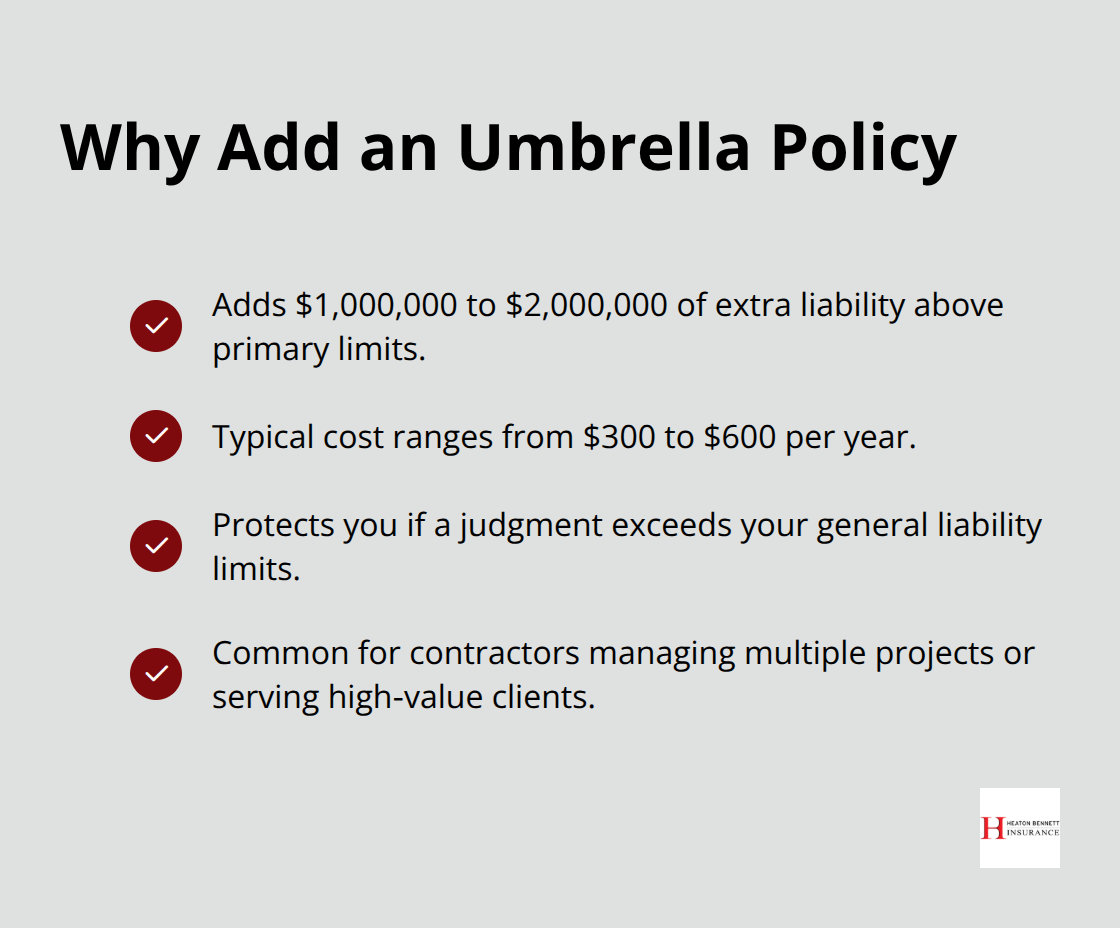
How to Find the Cheapest Business Liability Insurance

Business liability insurance protects your company from costly lawsuits and claims, but premiums can strain your budget. Finding the cheapest business liability insurance doesn’t mean sacrificing coverage-it means being strategic about where you shop and how you structure your policy.

We at Heaton Bennett Insurance have helped countless businesses cut their insurance costs without compromising protection. This guide walks you through proven strategies to lower your premiums and find coverage that fits your needs.

What Business Liability Insurance Actually Covers

The Three Core Protection Areas

Business liability insurance protects you against three main categories of claims that can devastate small businesses. First, bodily injury claims cover medical expenses and legal costs when someone is injured on your property or due to your business operations. Second, property damage liability covers repairs or replacement when your business damages a client’s or third party’s belongings. Third, advertising injury protection covers claims of libel, slander, or privacy violations in your marketing and social media-a growing concern as more businesses operate online.

Visual summary of bodily injury, property damage, and advertising injury coverage

Understanding Your Premium Costs

General liability premiums start as low as $19 to $21 per month for low-risk professions, though the national average sits around $42 to $60 monthly depending on your industry and coverage limits. The Hartford and Chubb report that four main cost drivers determine your rate: your industry type, business location, whether you rent or own your workspace, and your claims history. A photographer or IT consultant typically pays less than a contractor or janitor because professional services carry lower injury and property damage risk. Your policy limits matter significantly-a $1 million per-occurrence limit costs less than $2 million, but many contracts now require the $1 million minimum as standard protection.

How Policy Structure Impacts Your Bottom Line

Policy structure directly impacts both your costs and protection level. A $500 deductible instead of $250 lowers your premium, but you must be able to afford that out-of-pocket if a claim occurs. Bundling general liability with property coverage into a Business Owner’s Policy (BOP) typically saves $57 monthly or more compared to separate policies, making this the smartest move for most small businesses. Progressive’s 2024 data shows BOPs average $67 monthly for new commercial customers, while standalone general liability averages $85.

Industry-Specific Coverage Requirements

Your industry determines specific exclusions you’ll face. Restaurants need product liability coverage for food-related claims, contractors need hired and non-owned auto coverage if employees use personal vehicles for work, and service providers handling client property need coverage for belongings in their care. Location matters too; Maryland, Minnesota, and Iowa have lower average rates around $35 to $38 monthly, while New York and California run $42 monthly.

Avoiding Overpayment and Underinsurance

Many businesses overpay for coverage they don’t need while underinsuring against their actual risks. Review what your contracts actually require before you buy, since this simple step prevents both wasted spending and dangerous gaps in protection. Your specific business operations and client requirements should drive your coverage decisions, not generic industry standards.

How to Actually Cut Your Business Liability Insurance Costs

Get Multiple Quotes and Compare Aggressively

Getting multiple quotes is non-negotiable if you want the cheapest rate. Most businesses accept the first quote they receive, which is a costly mistake. When you compare quotes from different carriers, you’ll see price variations of 30 to 50 percent for identical coverage. The Hartford and Chubb often price the same risk differently based on their underwriting models, so one carrier’s $60 monthly premium might be another’s $35. Set up quotes through online brokers or directly with carriers, but stay consistent about coverage limits and deductibles when comparing. Requesting quotes takes 15 minutes per carrier, and getting three to five quotes typically reveals your cheapest options within an hour.

Bundle Policies to Unlock Real Savings

Bundling is where real savings happen, and the numbers prove it. Progressive reports that bundling general liability with property coverage into a Business Owner’s Policy saves approximately $57 monthly compared to buying policies separately. That’s $684 annually for combining two policies you already need. If you also add commercial auto to your bundle, Progressive data shows an average 12 percent discount on auto coverage when added to property. For a business with $50,000 in annual auto premiums, that discount alone saves $6,000 per year.

Average discount when adding commercial auto to a property bundle - cheapest business liability insurance

Most carriers reward bundling because it reduces their administrative costs and makes you less likely to shop around once you’re locked into multiple policies. The catch is that bundling only works if you need multiple coverages, so don’t bundle just for the discount if property coverage doesn’t match your actual risk profile.

Reduce Risk and Watch Your Premiums Drop

Insurance companies charge less when you demonstrably reduce your exposure to claims. Install fire suppression systems, maintain well-lit entrances, repair hazards immediately, and document everything. Contractors who maintain OSHA safety certifications and conduct regular job site inspections pay 10 to 15 percent less than competitors who skip these steps. Restaurants that implement food safety protocols and track temperature logs reduce their premiums compared to those without documentation. Your claims history influences your rate for three to five years, so investing in safety programs now pays dividends for years. When you request a quote, mention specific risk-reduction measures you’ve implemented, as some carriers offer explicit discounts for documented safety practices.

Raise Your Deductible Strategically

Raising your deductible from $250 to $1,000 typically reduces your general liability premium by 15 to 25 percent. The math is straightforward: if your annual premium is $600, moving to a $1,000 deductible might save $90 to $150 yearly. But this strategy only works if you can actually afford that deductible without financial strain. Many small business owners choose a $500 deductible as a middle ground, reducing premiums while keeping out-of-pocket risk manageable. Higher deductibles make sense for established businesses with healthy cash reserves and low claims frequency. Startups and businesses with tight cash flow should stick with lower deductibles, since one unexpected claim could create financial hardship if you can’t cover the deductible. Understanding what factors actually drive your rates helps you make smarter decisions about which cost-cutting strategies will work for your specific situation.
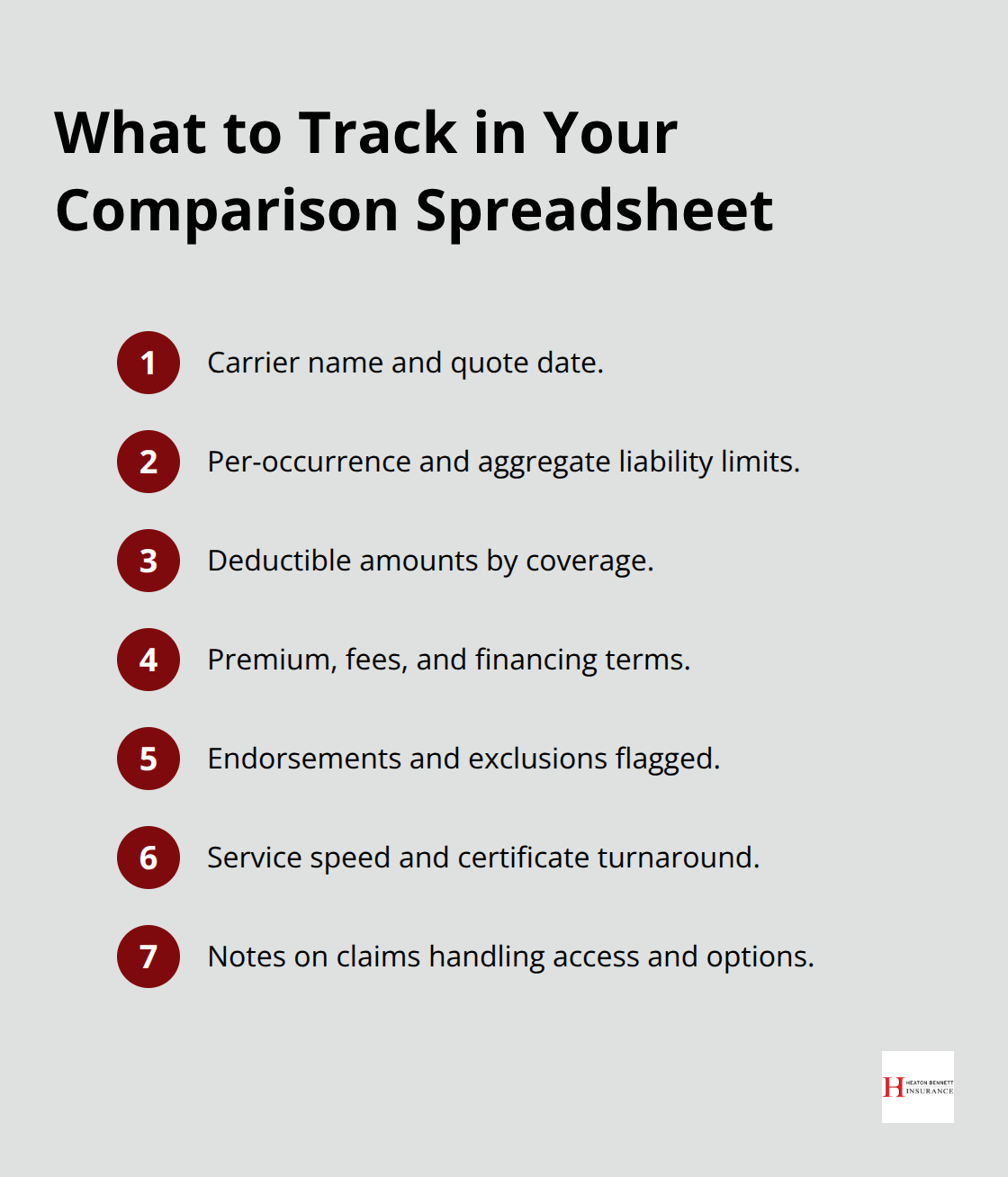
What Really Drives Your Insurance Rates

Your industry type determines more of your premium than almost any other factor, and the difference between low-risk and high-risk professions is dramatic. IT consultants and real estate professionals pay around $30 to $40 monthly for general liability, while tree trimmers, janitors, and general contractors pay $100 to $200 monthly for identical coverage limits. The gap exists because contractors face daily exposure to bodily injury claims from falls, equipment accidents, and property damage from their work, while a consultant sitting in an office creates almost no third-party injury risk.

Hub-and-spoke of key cost drivers for U.S. business liability insurance - cheapest business liability insurance

Progressive’s 2024 data confirms this: professional liability for consultants averages $42 monthly, while workers’ compensation for higher-risk trades averages $80 to $125 monthly. When you request quotes, carriers immediately place you in a risk category based on your specific work activities, not just your job title. A handyman who occasionally repairs drywall pays less than one who performs electrical work, even though both call themselves handymen. Your industry determines a pricing floor that no amount of shopping around will eliminate, so understand where your profession sits on the risk spectrum before you negotiate.

How Your Location and Property Setup Shape Costs

Location matters more than many business owners realize, and it operates on two levels. First, your state and city influence rates based on local litigation costs and claim frequency. Maryland, Minnesota, and Iowa average $35 to $38 monthly for general liability, while New York and California run $42 monthly for the same coverage. Second, whether you rent or own your workspace directly impacts your premium. A restaurant that rents space pays higher property premiums than one that owns the building, because renting means you insure only your equipment and inventory while the landlord covers the structure. Owning the building means you insure the entire structure plus contents, which costs significantly more. The Hartford and Chubb both factor in whether you operate in a flood zone, wildfire-prone area, or high-crime neighborhood, since these locations generate more claims. If your business operates in a high-hazard area, you cannot eliminate this cost driver through shopping, but you can mitigate it through fire suppression systems, security cameras, and detailed hazard inspection records. Claims history follows you for three to five years, so one lawsuit from five years ago still raises your current premium even if you have since implemented safety improvements. This is why documenting risk reduction efforts matters: when your quote expires and rates reset, you want evidence that your business profile improved since your last claim.

Why Your Claims History Shapes Your Future Costs

Your claims history is the most unfair cost driver because it penalizes you for events beyond your control, yet carriers weight it heavily in their underwriting decisions. One product liability claim from a faulty item you sold three years ago will still increase your premium today, even if you have since implemented quality control processes. Multiple claims within a three-year period signal to carriers that your business generates claims at above-average rates, which justifies higher premiums. This reality means that startups with no claims history sometimes pay higher rates than established businesses because carriers cannot predict your risk profile. A business that has operated for ten years without claims demonstrates reliability, which carriers reward with lower rates. The strategy here is straightforward: avoid claims through documented risk management, because the cost of one claim extends far beyond the settlement amount. A contractor who invests $2,000 annually in OSHA training and job site safety inspections will save far more than $2,000 over the next three years through avoiding a single claim that would spike premiums. When you apply for quotes, disclose your full claims history honestly, as carriers will discover it during underwriting anyway. If you have prior claims, emphasize the specific changes you have made to prevent recurrence, because some carriers offer modest premium reductions for demonstrated improvement.

Final Thoughts

Finding the cheapest business liability insurance requires three concrete actions that deliver measurable results. First, obtain quotes from at least three carriers and compare them side-by-side using identical coverage limits and deductibles, since price variations of 30 to 50 percent for the same protection are common. Second, bundle general liability with property coverage into a Business Owner’s Policy, which saves approximately $57 monthly compared to separate policies. Third, implement documented risk management practices like safety training, hazard inspections, and maintenance records, because carriers reward demonstrable risk reduction with lower premiums.

After you select a policy, review it thoroughly before your coverage starts to confirm that your policy limits match your contract requirements and actual business operations. Check your deductible against your cash reserves to verify you can afford an out-of-pocket claim without financial strain. Read the exclusions section carefully, since gaps in coverage often emerge only when you file a claim.

Your next step is working with an insurance professional who understands your specific industry and risk profile. We at Heaton Bennett Insurance provide tailored coverage solutions that help you find the cheapest business liability insurance without sacrificing protection, and as an independent agency, we have access to multiple carriers so we can find you the best rates available rather than locking you into a single company’s pricing. Contact Heaton Bennett Insurance to review your current coverage or get quotes for new policies.

How Much Does Small Business General Liability Insurance Cost?

Small business general liability insurance cost varies dramatically depending on your industry, location, and coverage choices. At Heaton Bennett Insurance, we’ve seen premiums range from under $500 annually for low-risk service businesses to several thousand dollars for contractors and manufacturers.

Understanding what drives these costs helps you make smarter decisions about your coverage and budget.

What Actually Drives Your General Liability Insurance Cost

Industry type creates the biggest price gap

Your industry type creates the biggest price difference in general liability premiums. Construction businesses pay roughly $108 per month on average, while accountants pay around $25 per month according to Next Insurance data. This gap exists because construction work exposes you to serious injury and property damage claims constantly. A painter working at heights faces different risks than a consultant working from an office. Electricians average $63 monthly, landscapers $50 monthly, and restaurants $108 monthly. The Hartford’s data shows restaurants paying approximately $2,408 annually while accounting firms pay around $675 per year.

Business size and revenue shape your premium

Your business size and revenue directly affect premiums because larger operations create more exposure to potential claims. A one-person consulting firm with $50,000 in annual revenue pays substantially less than a 15-person construction company with $1.2 million in revenue. Insureon’s analysis of 40,000 small business customers shows 53 percent operate with less than $100,000 in annual revenue, and these smaller operations typically secure lower premiums. Each additional employee increases your premium across all policy types because more staff means more client interactions and higher accident potential.

Coverage limits and deductibles set your baseline cost

The standard $1 million per occurrence and $2 million aggregate structure costs roughly $42 to $59 monthly nationally based on Insureon and Progressive data. Doubling your limits to $2 million per occurrence and $4 million aggregate adds approximately $5 to $20 monthly depending on your industry and location. Choosing a $500 deductible versus $1,000 cuts your premium by roughly 10 to 15 percent, though you must actually afford that deductible when a claim happens.

Location and claims history round out the picture

Location influences your costs through state-specific medical expenses, litigation costs, and crime rates. Colorado businesses average $49 to $52 monthly while Indiana averages $43 monthly. Dense urban areas and disaster-prone regions push premiums higher than rural locations. Your claims history matters for years afterward-past claims increase rates for 3 to 5 years, while maintaining zero claims for five years can reduce your premium by roughly 12 percent according to industry benchmarks. Understanding these four factors positions you to evaluate quotes accurately and identify where you can control costs most effectively.

Infographic showing four key factors that drive general liability insurance cost for U.S. small businesses - small business general liability insurance cost

What You’ll Actually Pay by Industry and Location

Industry type creates massive cost differences

General liability premiums swing wildly depending on what you do for work. Insureon’s analysis of 40,000 small business customers reveals accountants pay around $25 monthly while general contractors hit $108 monthly-a four-fold difference driven purely by industry risk. Next Insurance data confirms this pattern, showing electricians at $63 monthly, landscapers at $50 monthly, and restaurants at $108 monthly. The Hartford’s annual benchmarks paint the same picture: restaurants average $2,408 yearly, retail stores $696, and accounting firms $675. These aren’t theoretical ranges-they represent actual median costs paid by real businesses. Your specific premium within these ranges depends on your exact location and how you structure your coverage limits and deductibles.

Geography pushes your costs up or down

Location matters far more than most business owners realize. Colorado businesses average $49 to $52 monthly while Indiana averages $43 monthly, reflecting different state medical costs and litigation environments. Virginia sits around $36 monthly while California reaches $42 monthly according to state-level data. Dense urban areas consistently cost more than rural locations because higher population density means more foot traffic, more potential claims, and steeper medical costs when injuries occur. A restaurant in downtown Austin faces different pricing than one in a small Hill Country town.

Payment timing affects your annual expense

The annual payment versus monthly payment decision directly impacts your bottom line. Paying your full premium upfront typically saves 10 to 15 percent compared to monthly installments. If your annual premium runs $804, paying monthly costs around $67 to $70 monthly, but paying annually costs roughly $67 monthly on average. That difference compounds across years. Most small businesses find that committing to annual payment forces better budgeting discipline anyway.

Now that you understand what drives your costs and what you’ll actually pay, the real opportunity lies in identifying which cost-reduction strategies work best for your specific situation.
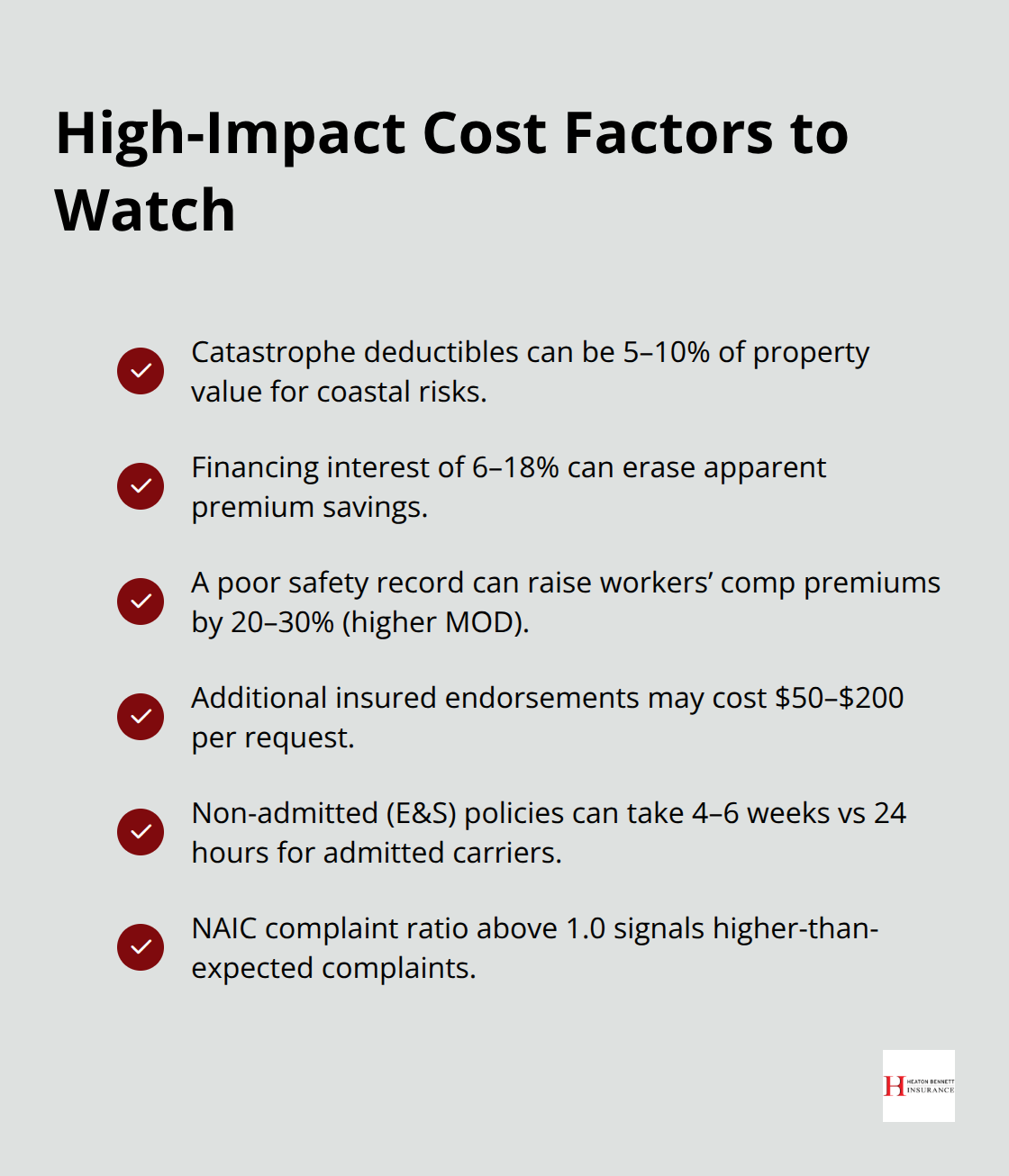
How to Cut Your General Liability Insurance Costs

Bundle policies to capture immediate savings

Combining your general liability policy with other coverage types delivers the most immediate savings. A Business Owner’s Policy that merges general liability with commercial property insurance costs around $57 monthly according to Insureon’s data from 40,000 customers, compared to purchasing those policies separately. That bundling discount ranges from 10 to 15 percent in most cases, and some insurers offer even steeper reductions when you add three or more policies together. If you also carry workers’ compensation, commercial auto, or cyber insurance, consolidating everything with one carrier often produces additional discounts that stack on top of your bundled rate. Request bundle quotes specifically rather than accepting individual policy quotes. Many business owners leave thousands of dollars on the table simply because they never asked about multi-policy discounts.

Invest in safety programs to reduce your premium

Documented risk management practices directly reduce your premium because insurers reward businesses that prevent claims from happening. OSHA-compliant safety protocols, employee training programs, and documented procedures signal to insurers that you take risk seriously. A construction company with a formal safety program and zero claims for five years can achieve roughly a 12 percent premium reduction compared to similar businesses without that track record. The Hartford and other carriers specifically mention that robust risk management practices qualify you for better rates. This means investing in safety equipment, spill cleanup protocols, security systems, and employee training isn’t just smart business-it’s profitable insurance strategy. Document everything you do. When you renew your policy, provide your insurer with evidence of your safety investments and clean claims history. Carriers want to see concrete proof that you’ve reduced your exposure.

Review your coverage annually to eliminate waste

Your needs change as your business grows, yet most business owners set their coverage limits once and forget about them. Reviewing your policy annually against your current revenue, employee count, and client contracts prevents you from paying for excessive coverage you don’t need or carrying insufficient limits that expose you to personal liability. If your revenue doubled since last year, your exposure increased and you might need higher limits. Conversely, if you’ve shifted your business model or reduced your customer-facing operations, you might qualify for lower premiums. This review takes roughly an hour and can identify $200 to $500 in annual savings through adjusting your deductible, eliminating unnecessary endorsements, or removing coverage riders that no longer apply to your operations.

Final Thoughts

Your small business general liability insurance cost ultimately reflects four primary factors: your industry type, business size, coverage limits, and location. Construction and restaurant businesses pay roughly $108 monthly while accountants pay around $25 monthly, reflecting the dramatic risk differences across industries. Most small businesses operate with $1 million per occurrence and $2 million aggregate limits, paying between $42 and $59 monthly nationally.
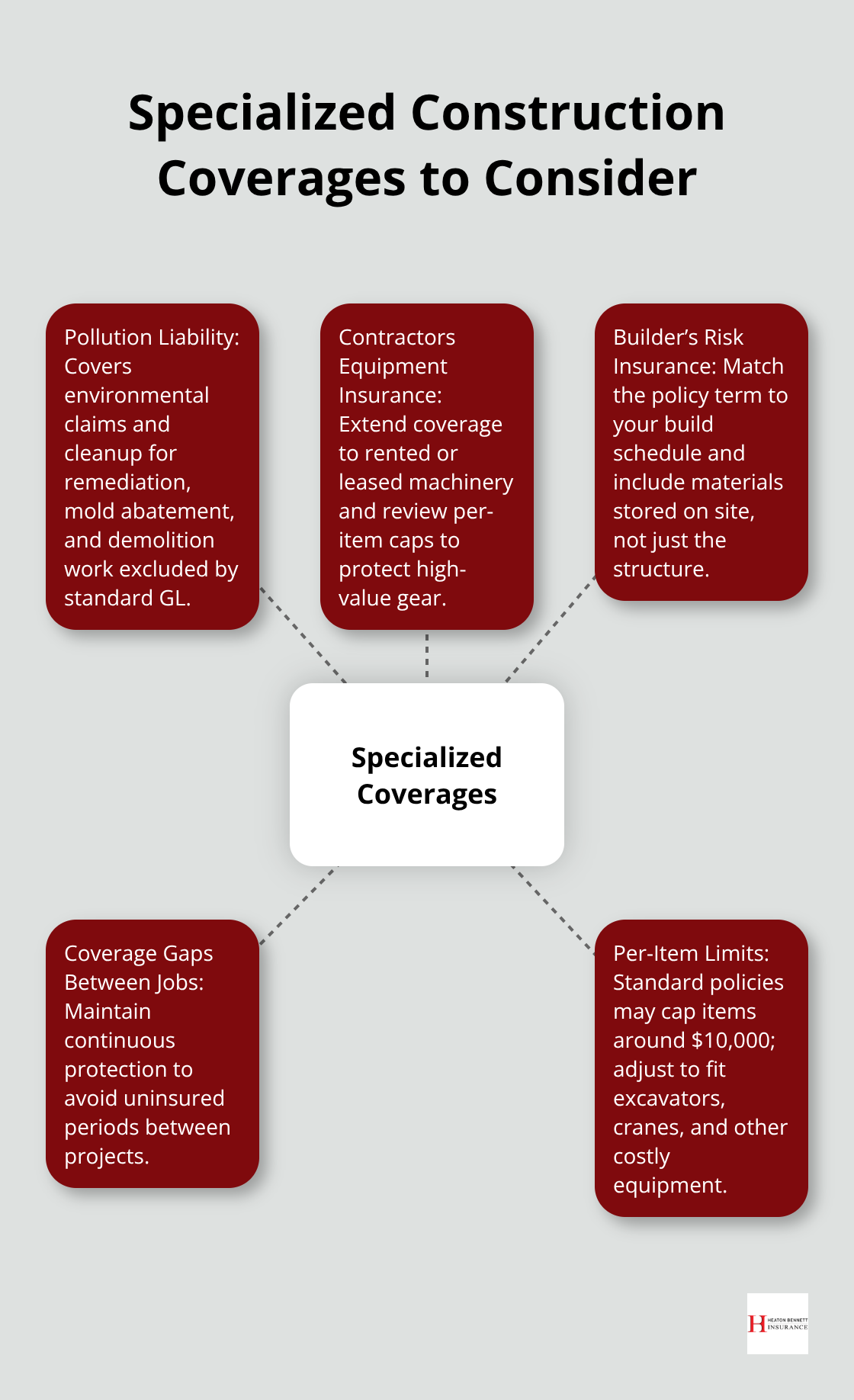
Reducing your costs requires action on three fronts. First, bundle your general liability policy with commercial property, workers’ compensation, or other coverage types to capture 10 to 15 percent savings immediately. Second, invest in documented safety programs and employee training because insurers reward businesses that prevent claims from happening-a clean five-year claims history can reduce your premium by roughly 12 percent. Third, review your coverage annually to eliminate unnecessary endorsements and adjust your deductible based on what you can actually afford in a claim.

A business owner who bundles policies, maintains a safety program, and pays annually can reduce their total insurance costs by 25 to 30 percent compared to someone purchasing individual policies with minimal risk controls. Getting a personalized quote takes roughly 15 minutes and reveals exactly what your specific situation costs. Heaton Bennett Insurance works with multiple carriers to compare rates and find coverage that matches your actual risk profile and budget.

How Much Does Vacant Property Insurance Cost?

Vacant property insurance costs vary wildly depending on where your building sits and what shape it’s in. We at Heaton Bennett Insurance see premiums swing from a few hundred dollars annually to several thousand, and the difference often comes down to factors you can actually control.

This guide breaks down the real numbers behind vacant property insurance pricing and shows you concrete ways to reduce what you’re paying.

What Really Drives Up Your Vacant Property Insurance Costs

The price you pay for vacant property insurance reflects factors that insurers view as direct risk indicators. Your property’s condition matters enormously-a well-maintained home with updated electrical systems, a solid roof, and functioning plumbing costs far less to insure than an older structure showing signs of neglect. Insurers know that deteriorating properties attract more theft and suffer faster damage from undetected leaks or pest intrusion.

Three key factors that influence vacant property insurance premiums in the United States

How Property Age and Condition Shape Your Premium

A 50-year-old house with outdated wiring will command significantly higher premiums than a 15-year-old home in comparable condition. Older homes consistently cost more to insure as vacant properties because they present genuine risk. An 80-year-old house with knob-and-tube wiring or galvanized plumbing poses fire and water damage threats that newer construction avoids. Insurers price these risks accordingly.

Properties showing visible deterioration-missing shingles, boarded windows, overgrown yards-signal to underwriters that maintenance has been neglected, making damage detection harder. A well-kept property with maintained landscaping, functioning systems, and regular inspections costs 20% to 30% less to insure than a neglected one.

Location’s Direct Impact on Your Rate

Geographic location functions as a primary cost driver. Washington state residents pay roughly $1,524 to $1,950 annually for vacant coverage, while Alabama residents face $3,297 to $3,366, according to Bankrate. These differences reflect local crime rates, building code standards, and disaster frequency.

Safe neighborhoods with strong police presence and lower theft statistics enjoy lower premiums. High-crime areas automatically cost more because the risk is statistically higher. Properties in high-crime neighborhoods face theft and vandalism rates that push premiums up by 30% to 40% compared to safe areas. Coastal regions and areas prone to wildfires add their own surcharges due to natural disaster exposure.

Your Coverage Choices Control Remaining Costs

Selecting appropriate coverage limits prevents you from overpaying for protection you don’t need. A modest home doesn’t require the same dwelling coverage limit as a luxury property. Choosing a $1,000 deductible instead of $250 can reduce your annual premium by 15% to 25%. This strategy works if you have emergency funds available to cover the deductible after a loss.

Your coverage choices directly impact what you’ll pay each month. Choosing a higher deductible-say $2,500 instead of $500-lowers your annual premium noticeably, though it means you absorb more cost if damage occurs. Coverage limits matter too; insuring a $400,000 structure costs substantially more than protecting a $200,000 property, which is simply mathematical reality based on potential loss exposure.

Understanding these three pillars-property condition, location, and coverage selections-positions you to make informed decisions about your vacant property protection. The next section reveals specific strategies that reduce what you actually pay while maintaining the coverage your property needs.

What Vacant Property Insurance Actually Costs Across America

Vacant property insurance premiums shift dramatically across state lines, and understanding regional pricing helps you anticipate what you’ll actually pay. According to Bankrate, Washington state residents spend $1,524 to $1,950 annually for vacant coverage, while Alabama residents face $3,297 to $3,366-more than double in some cases. Connecticut runs $2,053 to $2,425, Illinois ranges from $2,005 to $2,602, Kansas spans $2,570 to $5,272, and Nevada costs $1,420 to $1,567. These numbers reflect each state’s specific risk profile, from hurricane exposure in coastal regions to theft rates in urban areas.

Compact list of annual vacant property insurance cost ranges by state in the U.S.

Texas Pricing in the National Context

Texas property owners typically pay $2,200 to $3,000 annually for vacant coverage, positioning the state roughly in the middle of the national spectrum. This pricing makes Texas more affordable than northeastern states but pricier than western alternatives. If you own property across multiple states, these variations significantly impact your total insurance budget.

How Building Age Drives Premium Increases

A property’s age determines premium increases more reliably than almost any other factor. A 20-year-old vacant home costs substantially less to insure than a 70-year-old structure with the same square footage in the same neighborhood. Insurers charge more for older buildings because electrical fires, plumbing failures, and structural deterioration present genuine hazards that newer construction avoids.

An 80-year-old house with original wiring might cost 40% to 50% more annually than a 2005-built home, according to underwriting standards across major carriers. This age premium applies regardless of condition-even a meticulously maintained older property faces higher rates because the underlying systems themselves carry greater risk. Every decade beyond 50 years typically adds 8% to 12% to your annual premium.

The Financial Case for Property Updates

Property renovation before vacancy makes financial sense. Updating electrical systems, plumbing, or roofing can reduce your insurance costs by 15% to 25% and often pays for itself within three to five years through premium savings alone. These improvements lower your risk profile in the eyes of underwriters, directly translating to lower rates.

The cost differences between states and the impact of building age create a clear picture: your location and property condition control most of what you’ll pay. The next section reveals specific actions you can take right now to reduce these costs without sacrificing the protection your vacant property needs.

How to Cut Your Vacant Property Insurance Costs

Install Security Systems That Reduce Theft Risk

Security systems deliver measurable premium reductions that justify their upfront cost within months. Motion-sensor lights, burglar alarms, and security cameras signal to insurers that your property faces lower theft and vandalism risk, typically reducing premiums by 10% to 20% according to underwriting guidelines across major carriers. A $500 security system installation pays for itself in three to four months if it cuts your annual premium from $3,000 to $2,550. Water leak detection systems carry similar weight with underwriters because they catch pipe failures before they cause thousands in damage-a $200 sensor can prevent $15,000 in water damage claims. Smoke and carbon monoxide detectors cost under $100 combined but signal property awareness to insurers, making them an easy win. The most effective approach combines visible deterrents like alarm company signs with actual functioning systems; fake signs fool thieves but not insurance underwriters who verify system installation during the underwriting process.

Maintain Your Property to Lower Risk Signals

Property maintenance directly correlates with lower premiums because neglect signals higher risk. Mowing the lawn, cleaning gutters, and keeping the yard maintained makes the property appear occupied, which deters theft and vandalism. Arranging quarterly inspections by a neighbor or property manager costs $50 to $150 per visit but reduces your premium by 5% to 15% because regular monitoring catches problems early-a small roof leak discovered in week two costs far less than one discovered in month six. Setting thermostats to 55°F prevents frozen pipes during winter vacancy, eliminating a major damage source that drives premium increases.

Checklist of actions that reduce vacant property insurance costs in the U.S.

Bundle Policies to Access Hidden Discounts

Bundling your vacant property policy with auto, homeowners, or business insurance through the same carrier typically yields 10% to 25% discounts on your total premium, making it worth shopping for carriers that write multiple lines of coverage. Independent agencies specializing in assembling coverage across multiple carriers mean you access discounts that single-company policies cannot match. The combination of security investments, regular maintenance checks, and multi-policy bundling can reduce your total annual cost by 30% to 40% compared to an unprotected property with no bundling strategy.

Final Thoughts

Your vacant property insurance cost ultimately reflects three controllable factors: property condition, location, and your coverage selections. A well-maintained property with security systems in a safe neighborhood costs substantially less to insure than a neglected building in a high-crime area, and building age adds another layer since older structures command higher premiums regardless of condition. The financial gap between states is real and significant, with Alabama residents paying double what Nevada residents pay for comparable coverage.

The strategies that reduce your premiums work because they address what insurers actually fear: theft, vandalism, undetected damage, and liability exposure. Installing motion sensors and burglar alarms cuts premiums by 10% to 20%, while arranging quarterly property inspections and maintaining your yard reduces costs by another 5% to 15%. Bundling your vacant property policy with auto or homeowners coverage through the same carrier yields 10% to 25% additional savings, and combined, these actions can lower your total annual cost by 30% to 40%.

Getting an accurate quote requires contacting multiple carriers and comparing the same coverage limits and deductibles across each quote. Your current homeowners insurer may offer a vacant property endorsement that qualifies for bundling discounts, making it worth checking before shopping elsewhere, and contact us at Heaton Bennett Insurance to discuss your vacant property insurance needs and receive a personalized quote that reflects your property’s actual risk profile.