
Commercial Property Insurance Austin: A Local Guide
Austin’s business landscape is booming, but property risks are growing just as fast. Severe weather, flooding, and theft pose real threats to commercial spaces across the city.
Commercial property insurance Austin protects your business from these dangers, covering everything from your building structure to equipment and lost income. We at Heaton Bennett Insurance help local business owners find the right coverage so they can focus on what matters most.
What Your Austin Business Actually Needs to Protect
Commercial property insurance covers far more than just your building’s walls and roof. It protects your business personal property, including equipment, inventory, furniture, and fixtures essential to daily operations. If your storefront, office, or warehouse catches fire, suffers wind damage, or gets burglarized, this coverage pays to repair or replace those assets at current replacement costs. Many Austin businesses underestimate what they own, which leads to serious problems when claims happen. The Insurance Information Institute reports that coinsurance penalties reduce claim payouts by 25 percent or more if you insure property to less than 80 percent of its replacement value. That means a $500,000 property needs at least $400,000 in coverage to avoid penalties. Beyond the building and contents, commercial property insurance includes business interruption coverage, which replaces lost income when a covered event forces you to shut down temporarily. This matters enormously in Austin’s competitive market, where losing even two weeks of revenue threatens cash flow and employee retention.
Why Austin Faces Unique Property Threats
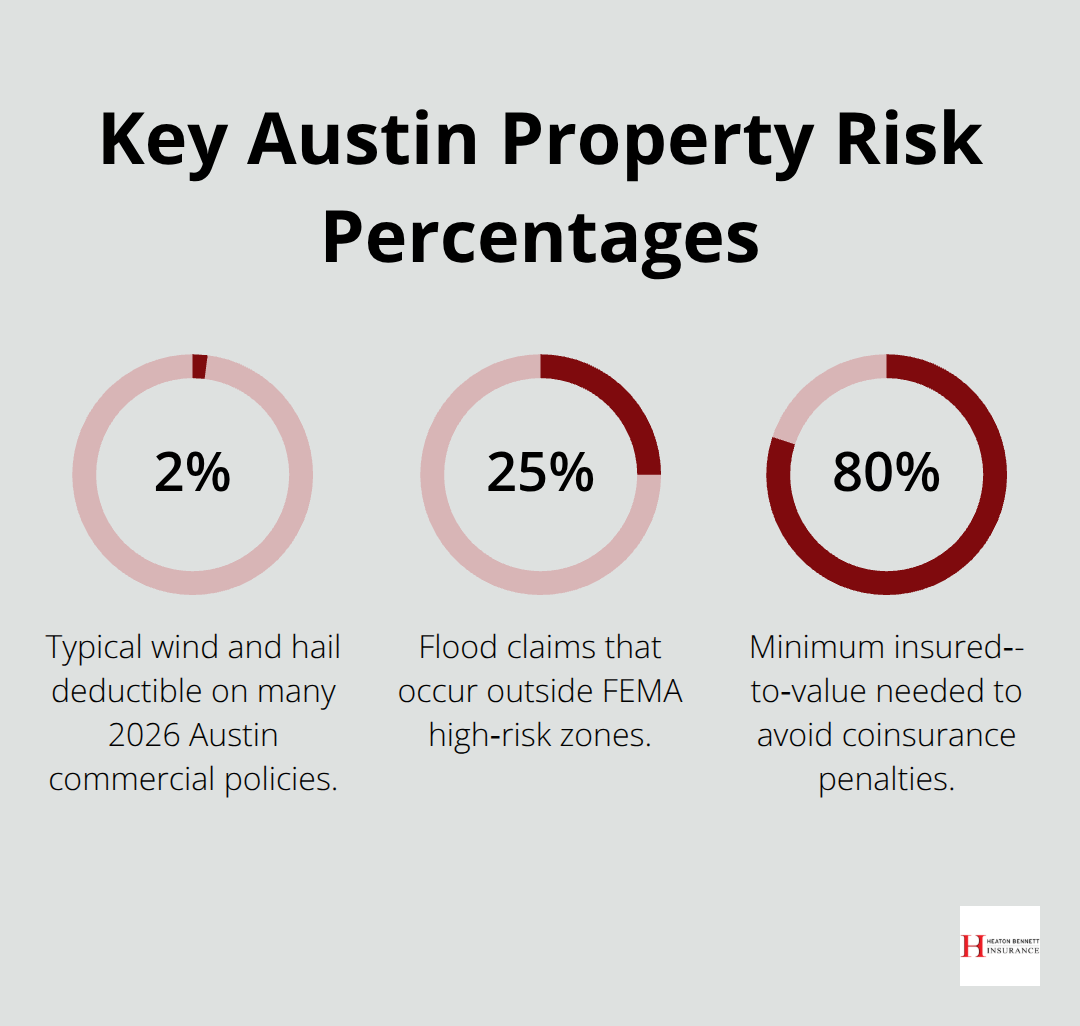
Austin sits at the intersection of multiple weather hazards that standard homeowners policies simply do not address for commercial properties. Hail damage drives a significant portion of commercial property claims across Texas, and the Hill Country surrounding Austin generates particularly severe hail events. Windstorm and hail coverage in inland Texas markets like Austin typically comes through standard market carriers, though many 2026 policies now apply a 2 percent wind and hail deductible. On a $500,000 property, you pay the first $10,000 of damage before insurance kicks in. Flood risk compounds the problem. Federal Emergency Management Agency data shows approximately 25 percent of flood claims come from properties outside designated high-risk zones, so even if your Austin location sits outside a mapped flood zone, you remain exposed.
Standard commercial property policies exclude flood damage entirely, forcing you to purchase separate coverage through the National Flood Insurance Program or private flood carriers. Wildfire risk in the Hill Country region also threatens properties, though many standard policies do cover fire damage from all sources. Theft and vandalism plague retail spaces and warehouses throughout Austin’s growing business districts, making property protection non-negotiable for inventory-heavy operations.
How Construction Costs Impact Your Coverage Limits
Austin’s construction costs have climbed steadily, and most business owners fail to update their coverage limits annually. The Texas Department of Insurance and the Insurance Information Institute both emphasize that replacement cost valuations must reflect current local construction prices. If you last appraised your property five years ago, you likely underinsured by 15 to 20 percent given Austin’s construction inflation. This gap creates two problems. First, a significant loss leaves you short of funds to rebuild. Second, coinsurance clauses penalize underinsurance by reducing your claim payout proportionally. A restaurant owner with $800,000 in actual replacement costs but only $600,000 in coverage faces not just a $200,000 shortfall, but also claim penalties that make the gap worse. Schedule regular property appraisals, especially for buildings with specialized equipment like HVAC systems, commercial kitchens, or server rooms. Newly acquired or constructed buildings should have updated valuations within 30 days of purchase or project completion to avoid coverage gaps that persist for years.
What Happens When You Underinsure
Underinsurance creates a hidden trap that catches many Austin business owners off guard. You might think partial coverage protects you partially, but coinsurance formulas work differently. If your property actually costs $1 million to replace and you insure it for only $700,000, the insurance company calculates your claim payout based on the ratio of coverage you bought to coverage you should have bought. A $100,000 fire loss becomes a $70,000 payout, leaving you to cover the remaining $30,000 out of pocket.
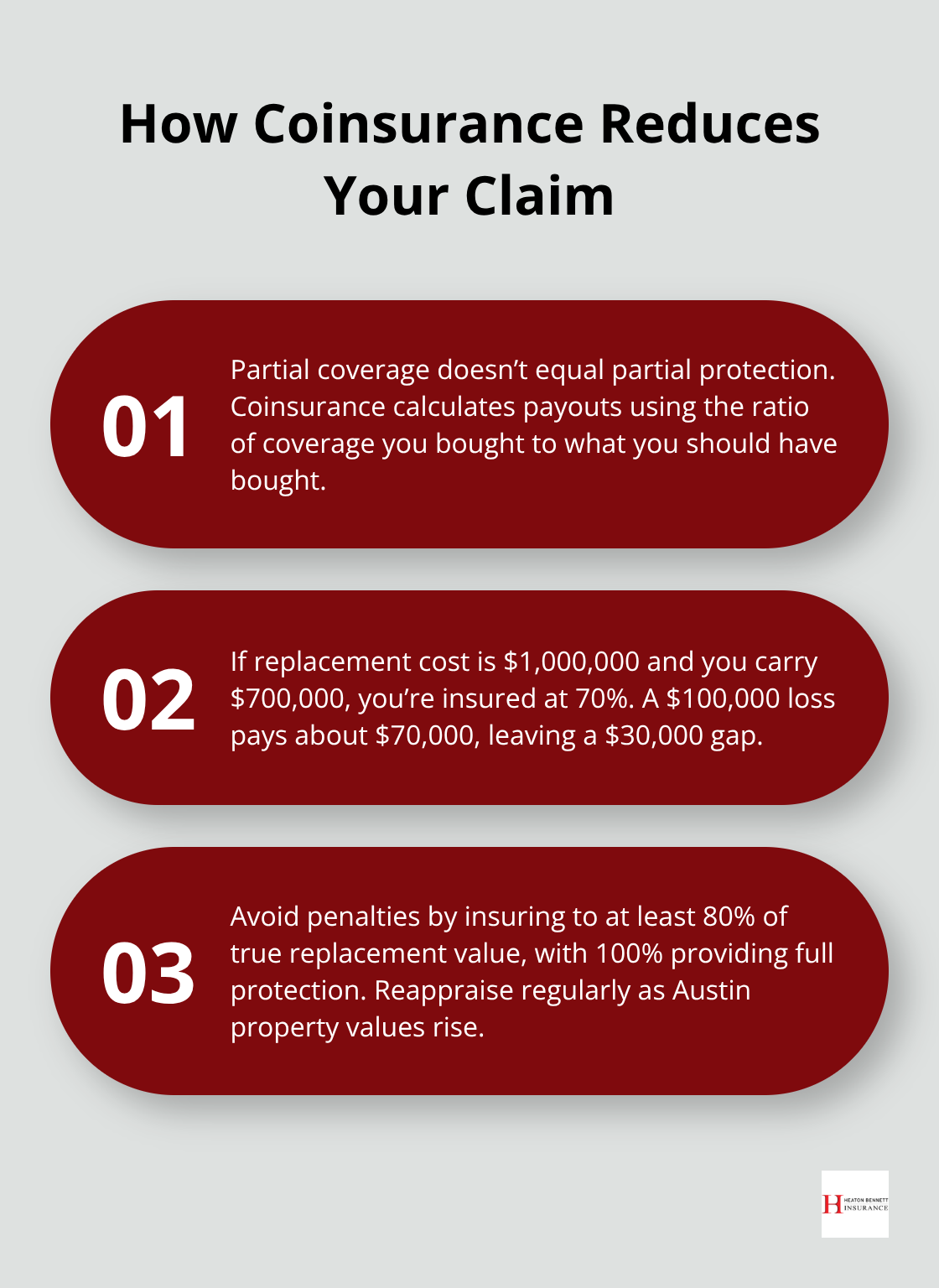
This penalty applies even if your policy limit exceeds the loss amount. The only way to avoid coinsurance penalties is to insure your property to at least 80 percent of its true replacement value, though 100 percent coverage provides complete protection. Many Austin properties have appreciated significantly since their last appraisal, making current valuations essential before the next major loss occurs.
Coverage Types That Protect Austin Commercial Properties
Building Coverage and Business Personal Property
Building coverage and business personal property coverage form the foundation of commercial property insurance, yet they work differently and require separate attention when you structure your policy. Building coverage protects the structure itself-walls, roof, foundation, built-in fixtures, and permanently installed equipment like HVAC systems and electrical panels. If you own the property, this coverage applies to the entire building. If you lease space, your landlord’s policy covers the structure, but you still need coverage for any tenant improvements you’ve made, such as custom built-ins or specialized installations.
Business personal property coverage protects movable assets essential to operations: inventory, equipment, furniture, computers, machinery, and tools. This distinction matters because a fire destroys both simultaneously, yet they require different valuation approaches. The Insurance Information Institute emphasizes that most Austin business owners underestimate their personal property values, leading to inadequate coverage limits. A retail store might own $150,000 in inventory and $80,000 in fixtures, but carry only $150,000 total coverage, creating an $80,000 gap.
Schedule your equipment and inventory annually, especially for businesses with seasonal fluctuations or rapid inventory turnover. Replacement cost coverage pays current rebuilding expenses with new materials, while actual cash value subtracts depreciation. Many 2026 renewals automatically convert roof coverage to actual cash value, so review your policy terms before storm season hits Austin.
Income Protection Through Business Interruption Coverage
Business interruption coverage and extra expense coverage address the financial devastation that follows property damage, yet many Austin business owners skip these riders entirely. Business interruption coverage replaces lost income and fixed expenses-payroll, rent, utilities, loan payments-when a covered event forces temporary closure. A restaurant shut down for three weeks due to fire damage faces $30,000 to $50,000 in lost revenue plus ongoing rent and staff costs, potentially pushing a marginally profitable operation into insolvency.
The trigger for coverage matters: some policies start coverage only after a specific waiting period, typically 24 to 72 hours, while others cover losses immediately. Confirm whether your policy covers losses if you relocate temporarily to keep operations running, since many policies limit coverage to your original location. Extra expense coverage pays additional costs to accelerate your return to normal operations-renting temporary equipment, expedited repairs, or temporary staffing to maintain customer relationships.
Calculating the Right Coverage Limits
Together, business interruption and extra expense coverage transform property insurance from a pure loss replacement tool into genuine business protection. The Texas Department of Insurance recommends that Austin businesses carrying $500,000 or more in annual revenue carry business interruption limits equal to at least three months of gross profit plus fixed operating expenses, a calculation that typically reveals significant underinsurance.
Building, personal property, interruption, and extra expense coverage work as integrated layers, not standalone decisions. Most Austin businesses purchase these through a Business Owner’s Policy, which bundles building and personal property coverage with general liability at a discounted rate, typically saving 15 to 25 percent compared to standalone policies. Understanding how these pieces fit together positions you to make informed decisions about your specific risks and financial exposure.
Choosing the Right Coverage for Your Austin Business
Build Your Property Inventory First
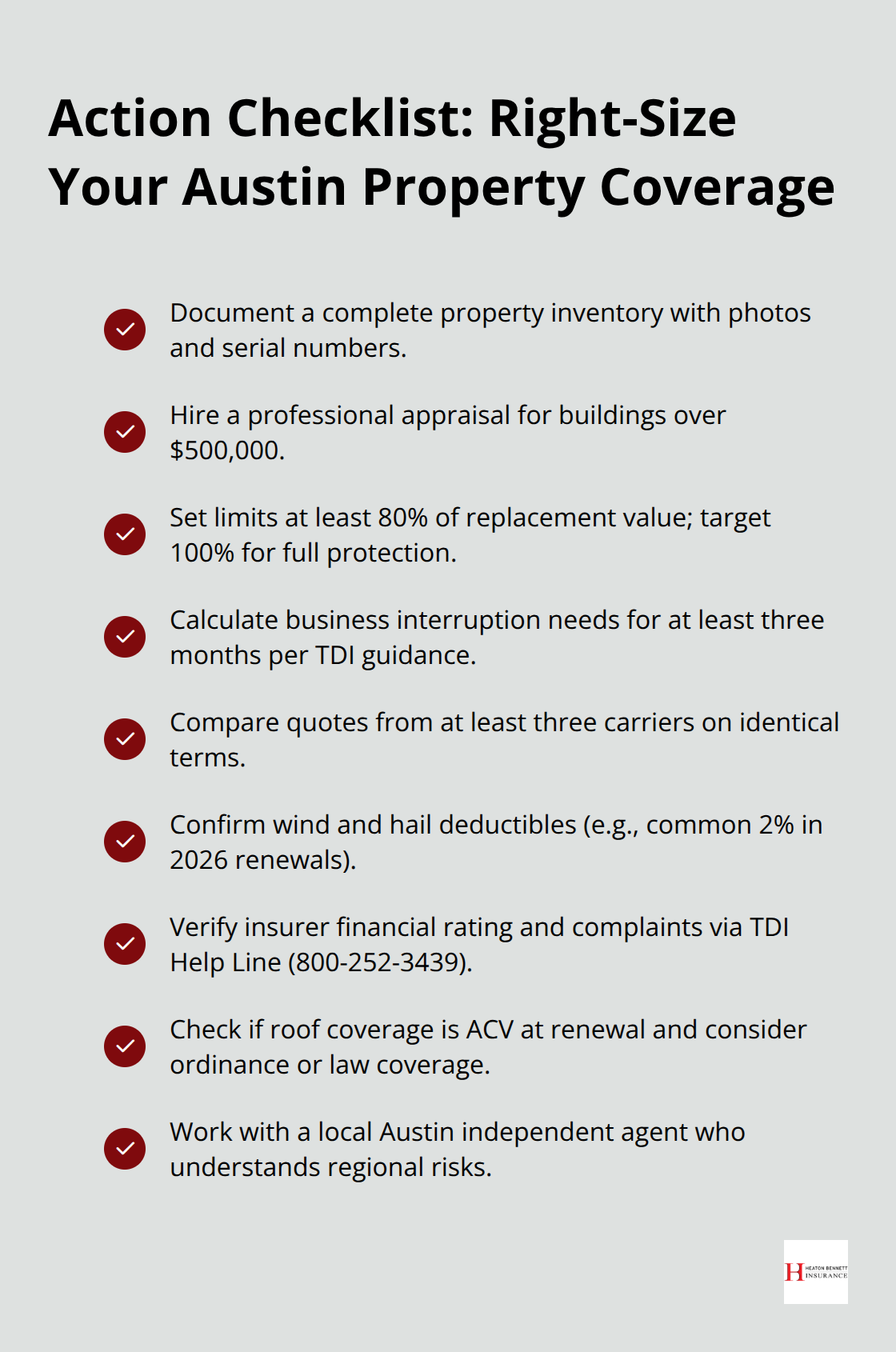
Start with a complete property inventory, not a rough estimate. Most Austin business owners guess at their replacement costs and pay the price later through underinsurance penalties. Walk through your entire space with a camera and notebook, documenting every piece of equipment, fixture, and inventory item. Note serial numbers, purchase dates, and original costs for major assets like HVAC systems, commercial kitchen equipment, or server infrastructure. This inventory becomes your foundation for accurate coverage limits.
The Texas Department of Insurance emphasizes that replacement cost valuations must reflect current Austin construction prices, which have climbed 15 to 20 percent over the past five years. Hire a professional appraiser for buildings over $500,000 in value, as the appraisal cost typically pays for itself through accurate coverage that avoids coinsurance penalties.
Calculate Your Minimum Coverage Requirements
Once you have real numbers, calculate your minimum required coverage at 80 percent of replacement value to eliminate coinsurance penalties entirely. A $600,000 property requires at least $480,000 in coverage, though $600,000 provides complete protection. Many Austin businesses carry $400,000 in coverage on $600,000 properties and face devastating claim reductions when losses occur.
The Insurance Information Institute reports that coinsurance penalties reduce payouts by 25 percent or more, turning a $100,000 loss into a $75,000 payout with a $25,000 out-of-pocket gap. This calculation changes when you add business interruption coverage, which requires a separate limit based on your monthly operating expenses plus lost profit. A restaurant with $80,000 monthly revenue and $50,000 in fixed costs needs interruption coverage of at least $130,000 for one month, but the Texas Department of Insurance recommends three months of coverage for businesses in competitive markets like Austin.
Compare Quotes on Equal Terms
Compare quotes from at least three carriers, but focus on apples-to-apples comparisons rather than lowest price. A $150 monthly premium for a Special Form policy with replacement cost coverage differs fundamentally from an $80 policy using Broad Form with actual cash value deductibles. The Texas Department of Insurance allows you to verify an insurer’s financial rating and complaint history through their Help Line at 800-252-3439, which takes five minutes and reveals whether you’re buying from a financially stable carrier.
Many Austin businesses benefit from a Business Owner’s Policy that bundles building coverage, personal property protection, and general liability at rates 15 to 25 percent lower than standalone policies, with average Texas BOPs around $877 annually. When comparing policies, confirm whether wind and hail coverage includes the standard 2 percent deductible common in 2026 renewals, which means $10,000 out-of-pocket on a $500,000 property before claims coverage begins.
Review Policy Details Before Purchase
Ask each carrier whether they automatically convert roof coverage to actual cash value during renewals, since this shift reduces your claim payout significantly if you own an aging roof. Request quotes that include ordinance or law coverage, which pays for building code upgrades during reconstruction, a major post-loss expense that standard policies do not address.
Work with a local Austin insurance agent who understands Hill Country wildfire risk, Gulf Coast windstorm patterns, and the specific flood exposure of your neighborhood, rather than relying on national call centers unfamiliar with Texas commercial property challenges. An independent agency like Heaton Bennett Insurance provides personalized coverage through a Security Snapshot process, ensuring your policy matches your actual risks and values rather than templates that leave gaps or overcharge for unnecessary coverage.
Final Thoughts
Commercial property insurance Austin protects your business from the financial devastation that follows fire, hail, flood, theft, or other covered losses. Your building and equipment represent years of investment, and losing them without adequate protection can end your business entirely. The path forward requires three concrete actions: conduct a thorough property inventory documenting every asset and current replacement cost, calculate your minimum coverage at 80 percent of replacement value to eliminate coinsurance penalties that reduce claim payouts by 25 percent or more, and compare quotes from multiple carriers on identical coverage terms while paying attention to deductibles and policy forms.
Austin’s unique risks demand coverage tailored to your specific location and business type, since Hill Country hail exposure, flood zones that extend beyond FEMA maps, wildfire threats, and rising construction costs all factor into the right coverage strategy. A restaurant owner faces different property risks than a tech startup, and a warehouse in North Austin faces different flood exposure than a retail storefront downtown. Your policy should reflect these differences rather than apply a one-size-fits-all template that leaves gaps or overcharges for unnecessary protection.
Contact Heaton Bennett Insurance today to schedule your property review and receive quotes that reflect your actual risks and values.
The information provided in this blog is for general informational purposes only and does not constitute legal, financial, or insurance advice. Coverage options, terms, and availability may vary. Please consult with a licensed professional for advice specific to your situation.

