

Contractor Business Insurance: Essentials for Growth
Contractor business insurance isn’t optional-it’s the foundation that separates thriving companies from those that collapse after a single claim. Without proper coverage, one accident or lawsuit can wipe out years of profit and damage your reputation.
At Heaton Bennett Insurance, we’ve seen contractors lose everything because they skipped coverage or carried inadequate limits. This guide walks you through the insurance types you actually need, how to calculate the right coverage amounts, and how to use insurance as a competitive advantage when bidding for larger projects.
The Three Essential Policies That Protect Your Bottom Line
Why These Three Policies Matter Most
General liability, workers’ compensation, and commercial auto insurance form the backbone of contractor coverage. These three policies address the largest financial exposures you face, and skipping any one of them leaves your business vulnerable to catastrophic loss. General liability protects you when a third party claims you damaged their property or caused them bodily injury. A single lawsuit from a homeowner who slipped on your job site or a property owner claiming faulty workmanship can cost $50,000 to $500,000 in legal fees and settlements alone.
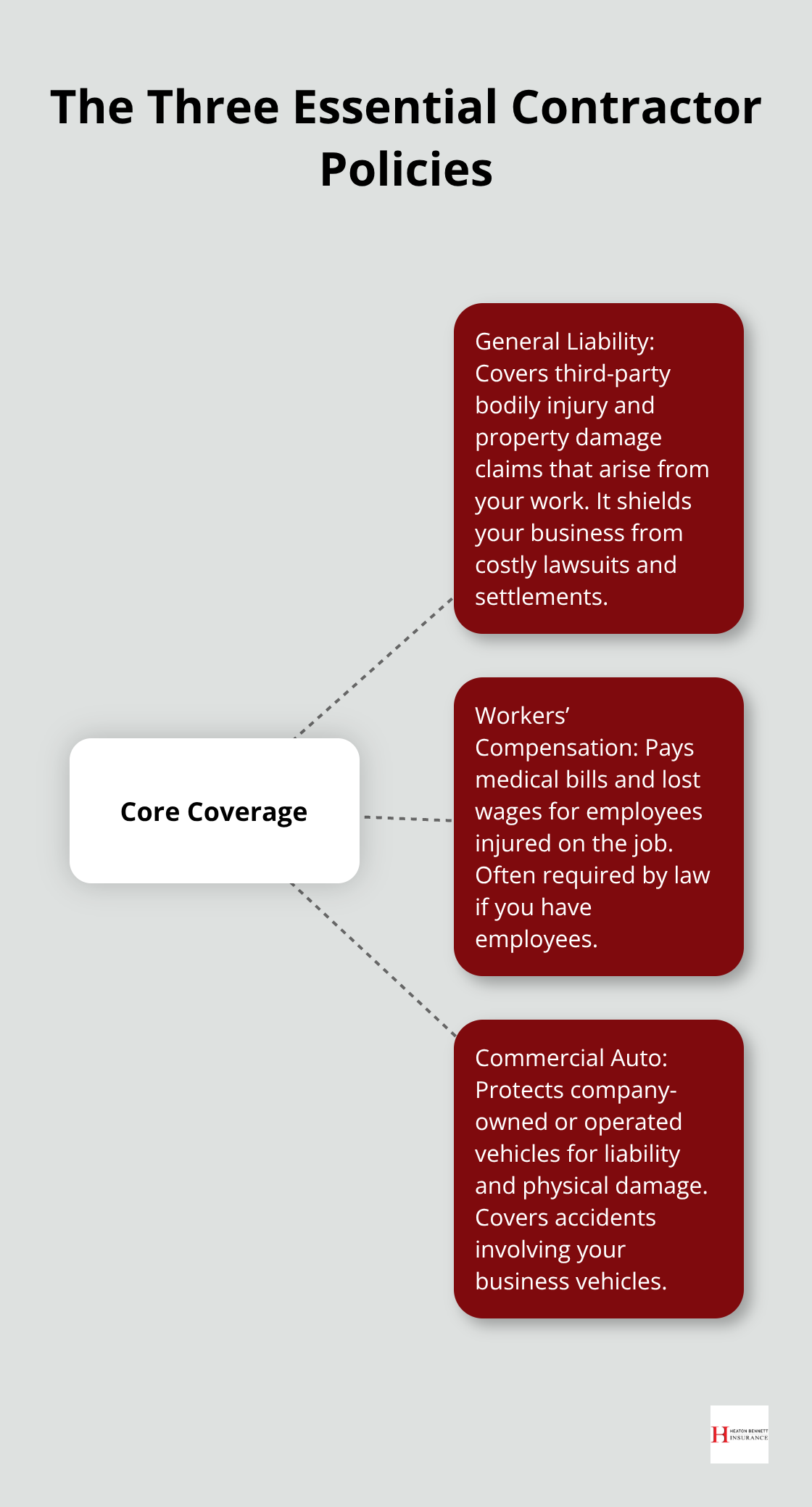
Workers’ compensation covers medical expenses and lost wages when your employees suffer injuries on the job, which most states legally require if you have employees. Commercial auto insurance covers vehicles your company owns or operates, protecting against liability claims and physical damage when accidents happen. These three policies work together to cover the scenarios that actually bankrupt contractors: someone suing for injury, an employee hurt at work, or a vehicle accident involving company property.
Understanding the Cost of Adequate Coverage
The gap between adequate coverage and inadequate coverage determines whether you survive a claim or close your doors. A general liability policy with $1 million in limits costs roughly $1,400 to $2,500 annually for small residential contractors, according to recent industry quotes, while a $2 million limit typically runs $2,000 to $3,500. Workers’ compensation premiums vary dramatically by trade and state; residential plumbing contractors pay around $4,800 annually for workers’ comp on modest payroll, while roofing contractors with the same payroll face $12,000 to $20,000 because of higher injury rates.
Commercial auto insurance for a single vehicle costs $2,000 to $5,000 per year depending on driving records and vehicle type. The real actionable insight is this: your policy limits must match your project values and contract requirements. If you bid $200,000 jobs but carry only $1 million in general liability limits, one major claim exhausts your coverage.
Meeting Contract Requirements Through Proper Endorsements
Most commercial contracts require you to name the project owner as an additional insured on your policy, which your carrier handles through endorsements like CG 2010 or CG 2037. These endorsements add the project owner to your coverage without listing every party individually, which simplifies contract compliance across multiple jobs. Work with an independent agent to verify your endorsements align with contract language before you sign anything, because mismatched paperwork creates coverage gaps that claims adjusters exploit. Your agent can also confirm whether your current limits satisfy the specific requirements in each contract you pursue, preventing costly surprises during the claims process.
What Happens When Your Coverage Doesn’t Match Your Risk
The Real Cost of Undersized Limits
Coverage gaps destroy contractor businesses faster than poor bidding or bad project management. A contractor in Texas with $50,000 annual payroll carries general liability at $1 million, workers’ comp appropriate for their crew size, and commercial auto for two vehicles. Then they land a $150,000 commercial renovation project requiring $2 million in general liability limits. If they fail to update their policy before starting work and a subcontractor damages the building’s electrical system, their $1 million limit exhausts after legal fees, leaving them personally liable for the remaining claim. This scenario plays out dozens of times yearly across the industry.
Your policy limits must align with your actual project values, not your average job size. If your typical project runs $75,000 but you occasionally bid $200,000 jobs, your coverage needs to protect against that $200,000 exposure. Small residential remodelers typically carry $1 million in general liability for $1,400 to $2,500 annually, but when they scale to larger commercial work, that limit becomes dangerously inadequate. The cost difference between $1 million and $2 million coverage is often only $500 to $1,000 per year, yet it can mean the difference between staying in business and filing for bankruptcy after a single claim.
Strategic Deductible Selection and Cash Flow
Your deductible choice directly impacts both your premium costs and your financial stability during claims. Raising your deductible from $500 to $2,500 typically reduces your general liability premium by 10 to 15 percent, but this strategy only works if you have cash reserves to cover that deductible without disrupting operations.
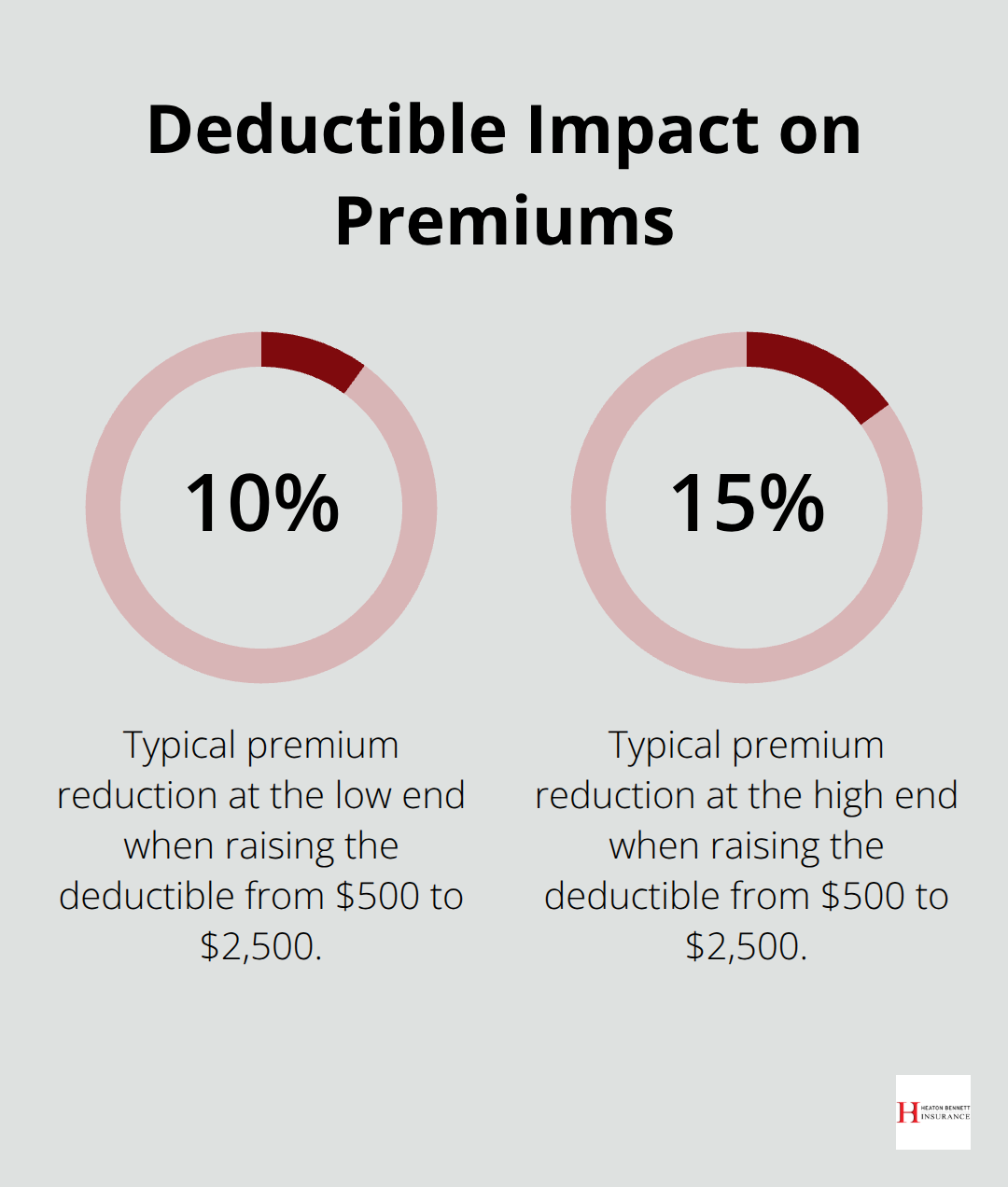
A contractor paying $2,000 annually for general liability might save $300 by increasing their deductible to $2,500, but if they face a $5,000 claim requiring them to pay the deductible upfront before the insurer covers the remainder, that $300 savings vanishes against their cash flow.
Work with an independent agent to model different deductible levels against your actual cash position, not your optimistic projections. The National Association of Insurance Commissioners recommends contractors maintain liquid reserves equal to at least three months of operating expenses, which gives you flexibility to handle higher deductibles without crisis.
Experience Modifiers and Safety Investment Returns
For workers’ compensation specifically, your experience modifier-a rating based on your claims history-directly impacts your premium. Contractors with strong safety records and effective return-to-work programs see modifiers below 1.0, meaning they pay less than the standard rate. A $500,000 payroll contractor with a 0.85 modifier pays roughly 15 percent less than one with a 1.15 modifier on the same payroll, translating to thousands of dollars annually.
Invest in documented safety training, near-miss reporting systems, and medical management protocols because these directly reduce your experience modifier over time. Your safety culture becomes a financial asset that lowers premiums while protecting your crew. As your business grows and you pursue larger contracts, these documented safety practices also strengthen your competitive position when project owners evaluate your risk profile before awarding work.
Insurance as Your Growth Advantage
Securing Larger Contracts Through Documentation
Scaling a contractor business means landing bigger projects, hiring more crew, and expanding into new service lines-all of which expose you to risks your current coverage no longer handles. The contractors who grow sustainably treat insurance as a strategic tool, not an afterthought. When you bid a $500,000 commercial project after years of $75,000 residential jobs, your existing $1 million general liability policy becomes your liability, not your asset. Project owners conduct insurance verification before awarding contracts, and missing required coverage or limits costs you the bid outright.
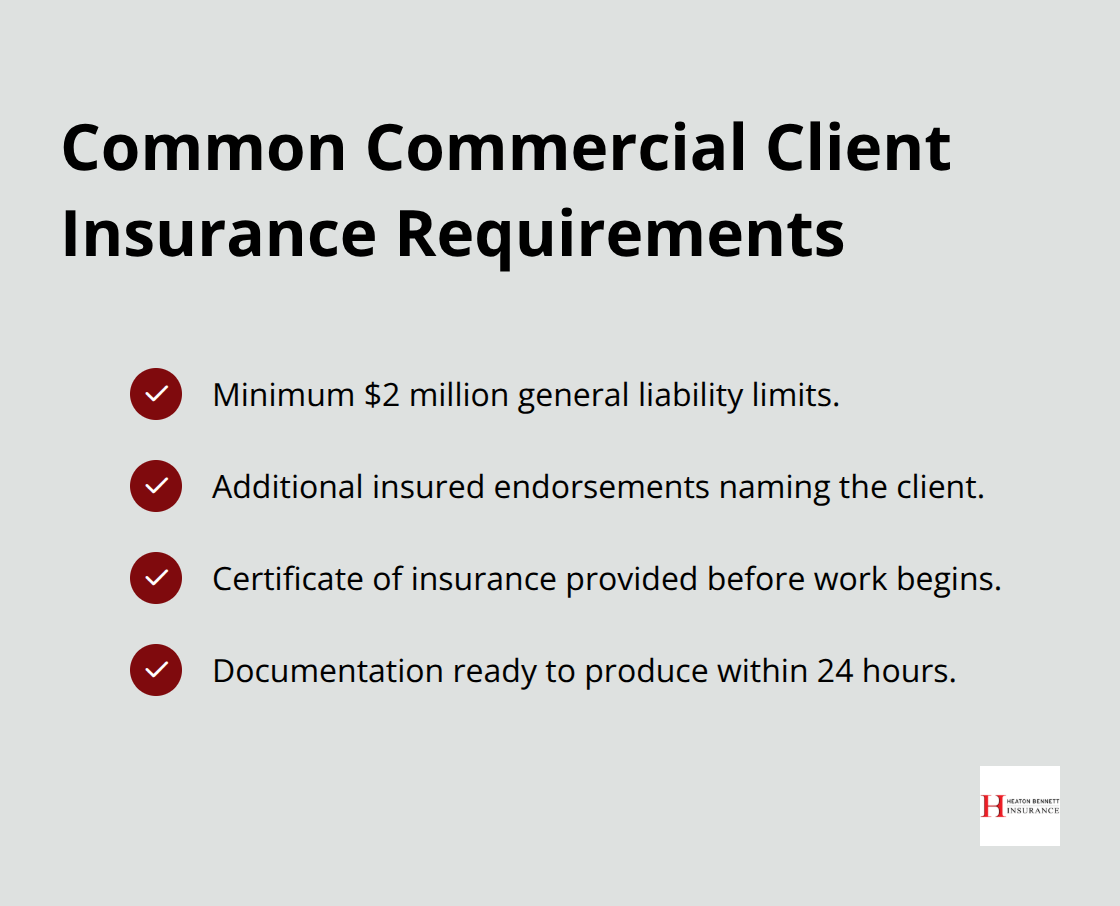
Most commercial clients require minimum $2 million in general liability, additional insured endorsements naming them specifically, and proof delivered via certificate of insurance before any work begins. This means your insurance documentation must stay current, accurate, and ready to produce within 24 hours-something many growing contractors overlook until they lose a job over paperwork delays.
An independent agent who maintains your endorsements in real time and issues updated certificates instantly when you pursue new opportunities becomes invaluable. The difference between an agent who hands you a policy once yearly and one who actively manages your coverage becomes obvious the moment a project owner requests documentation on a Friday afternoon for Monday project start.
Protecting Assets Beyond General Liability
Your asset protection strategy shifts fundamentally as your business grows beyond owner-operator status. When you hire employees, purchase equipment worth $50,000 or more, or establish a permanent office location, general liability alone no longer protects your business assets from the claims that actually threaten growth. Inland marine coverage protects tools and equipment anywhere in the United States, which matters far more than most contractors realize-a trailer theft costs $15,000 to $40,000 depending on equipment, and standard property insurance excludes mobile assets.
Commercial property insurance for owned buildings or storage facilities protects against fire, theft, and weather damage that could halt operations for weeks. These coverages work together to address the exposures that emerge as your operation expands and your asset base grows.
Experience Modifiers Drive Premium Costs at Scale
Workers’ compensation claims, even minor ones, spike your experience modifier if you lack documented safety programs and effective return-to-work protocols-and that modifier directly increases your premiums by 10 to 30 percent annually on larger payrolls. An electrician contractor with $725,000 annual payroll and a 1.2 experience modifier pays roughly $2,000 to $3,000 more annually than one with a 0.9 modifier on identical work.
The contractors who grow most profitably invest in safety culture, documentation, and proactive risk management because these directly reduce insurance costs while improving their competitive position when bidding against larger firms. Your safety record becomes quantifiable proof that you operate professionally, which project owners value more than lowest price.
Final Thoughts
Contractor business insurance protects your liability exposure when clients claim property damage or injury, your employees through workers’ compensation coverage, and your vehicles through commercial auto policies. Your specific needs depend on your project size, payroll, and the contracts you pursue-a $75,000 residential remodel requires different coverage than a $500,000 commercial renovation. Your policy limits must reflect the actual risk you carry, not your average job size.
Review your coverage annually or whenever your business changes significantly. Check whether your general liability limits match your largest projects, verify that your workers’ compensation rating reflects your current payroll and safety programs, and confirm your commercial auto coverage includes all vehicles your team operates. An experience modifier that drops from 1.2 to 0.9 saves thousands annually on workers’ compensation, which means your safety investments pay direct financial returns.
Working with an independent agent who understands contractor operations and can access multiple carriers helps you model different deductible levels against your cash reserves, explain how endorsements satisfy contract requirements, and produce certificates of insurance quickly when you bid new work. Contact us at Heaton Bennett Insurance to review your contractor business insurance policies and identify coverage gaps before they cost you a project or a claim.
The information provided in this blog is for general informational purposes only and does not constitute legal, financial, or insurance advice. Coverage options, terms, and availability may vary. Please consult with a licensed professional for advice specific to your situation.

