

Construction Contractor Insurance: A Practical Playbook
Construction contractors face real risks every day, and the wrong insurance coverage can cost you thousands when something goes wrong.
At Heaton Bennett Insurance, we’ve seen too many contractors operate without adequate protection. This playbook walks you through the coverage types you actually need, the gaps that expose your business, and how to manage costs without sacrificing protection.
What You Actually Need to Protect Your Construction Business
General liability insurance protects you when someone gets hurt or property gets damaged because of your work, and it’s non-negotiable. Most contracts demand at least $1,000,000 per occurrence and $2,000,000 in general aggregate limits, according to industry guidance from the Associated General Contractors of America. State minimum requirements are often far too low-typically $50,000 to $300,000-which leaves you exposed to claims that far exceed those thresholds. Workers’ compensation covers medical expenses, lost wages, and recovery costs for injured employees, and it’s mandatory in most states. California requires licensed contractors to carry workers’ compensation regardless of employee count as of 2026. Builder’s risk insurance covers the actual project during construction against fire, theft, vandalism, and weather damage, with premiums typically running 1 to 5 percent of the project’s completed value. Commercial auto insurance is absolutely necessary because standard personal auto policies exclude business use, and construction trucks often need cargo and downtime coverage beyond basic liability. Inland marine insurance protects your tools and equipment both on-site and in transit at replacement cost, covering everything from hand tools to leased machinery.
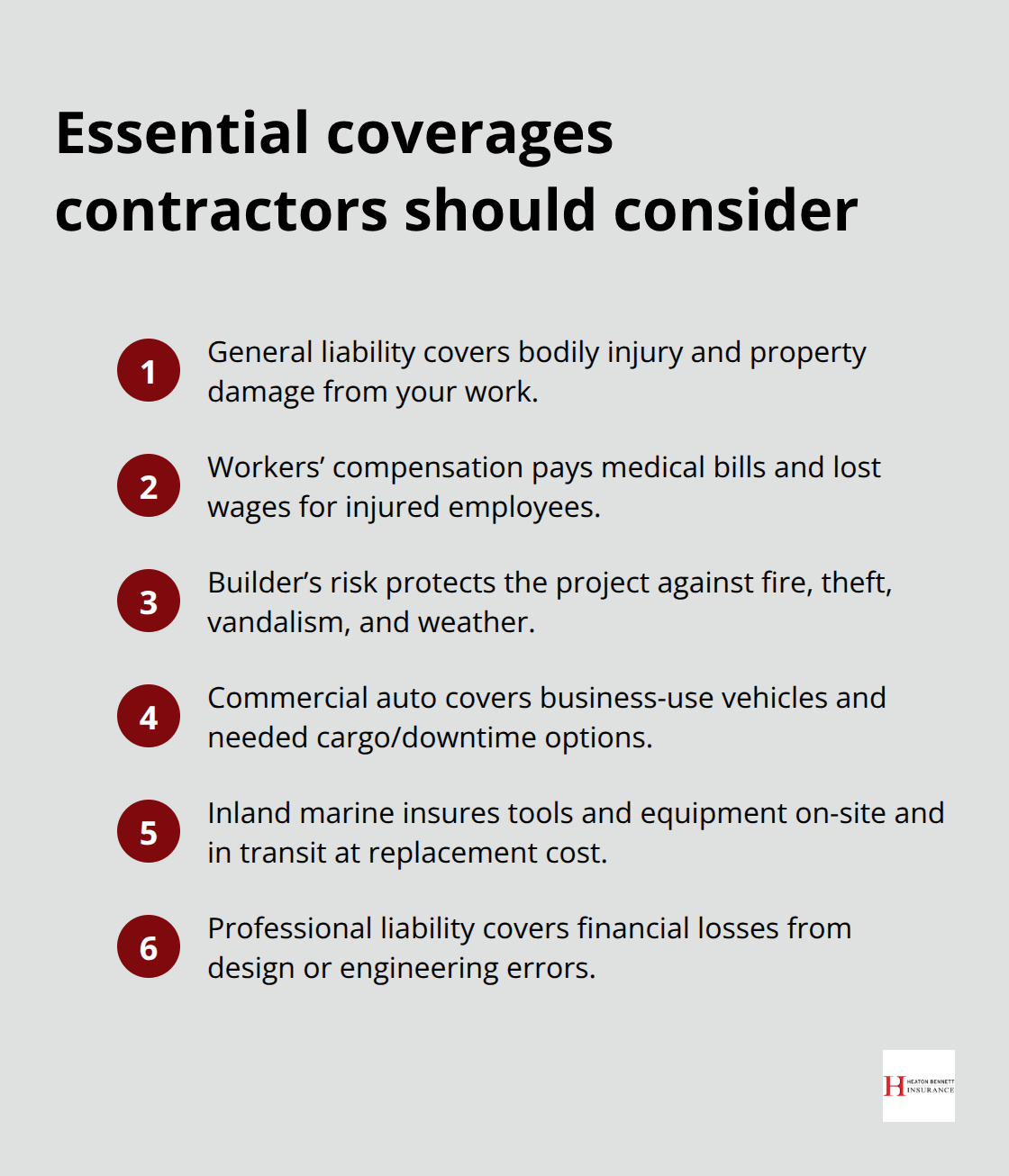
Many contractors skip professional liability insurance, which is a serious mistake on design-build projects where you’re responsible for engineering or design decisions that go wrong-this coverage protects against financial losses from mistakes in your work.
Where Coverage Actually Fails
Most contractors miss critical gaps between their policies. Subcontractors often lack proper insurance, and many general contractors fail to verify active certificates of insurance before allowing work on-site, exposing you to uninsured liability. Project-specific exclusions kill coverage when you need it most-builder’s risk policies typically exclude earthquakes and flooding unless you add them as endorsements, and general liability policies often exclude designated work like roofing or demolition. Umbrella liability policies remain unused by contractors who think $1 million per occurrence is enough, but jury verdicts in construction cases regularly exceed that amount, making an extra $1 to $5 million in umbrella coverage essential for serious work. Policy limits that don’t match your actual project value leave you dangerously underinsured. If you bid a $2 million project but only carry $500,000 in builder’s risk coverage, you’ll absorb the loss yourself. Finally, gaps between project completion and when your policy ends mean you’re unprotected against post-completion claims, which can emerge months or years after work finishes.
Why This Matters to Your Bottom Line
Insurance isn’t overhead-it’s the difference between staying in business after a problem and closing your doors. One serious injury claim without proper workers’ compensation coverage can bankrupt a small operation. One third-party property damage claim over your general liability limits forces you to pay the difference from your pocket. One project loss not covered by adequate builder’s risk wipes out your profit margin entirely. A single lawsuit naming you without professional liability coverage can cost $50,000 or more in legal fees alone, even if you ultimately win. When you don’t have the right coverage, you’re betting your company on luck, and luck doesn’t pay invoices.
Getting Your Coverage Right
The path forward requires honest assessment of your current policies and the gaps they contain. Start by pulling your existing certificates of insurance and comparing them against your typical contract requirements-most general contractors demand specific limits and endorsements that your current policies may not provide. Talk with an independent insurance agent who understands construction work, not just someone selling generic business policies. An agent with construction experience can identify the gaps between what you think you have and what you actually need, then help you build a program that protects your assets without overpaying for unnecessary coverage. Your next step involves reviewing your project pipeline and identifying which coverages apply to each job type, since a residential remodel requires different protection than a commercial build or a design-build contract.
Building Coverage That Actually Matches Your Projects
Understanding General Liability Limits and Endorsements
General liability insurance forms the foundation of any contractor’s program, but the real work happens in matching your limits to what clients actually demand and what courts award in your state. The standard $1 million per occurrence and $2 million general aggregate has become the baseline for most commercial contracts, according to industry guidance from the Associated General Contractors of America, but this number only works if your project complexity doesn’t exceed it. Many contractors treat these limits as gospel without understanding what they mean: per-occurrence limits cap what the insurer pays for a single incident, while general aggregate limits cap total claims across the entire policy period. A $1 million per-occurrence limit sounds substantial until a jury verdict exceeds it, which happens regularly in construction cases involving serious injuries or property damage.
The endorsements your policy includes matter as much as the limits themselves. Contracts routinely require additional insured status, which means the project owner or general contractor gets named on your policy for claims arising from your work. Many policies offer blanket additional insured endorsements, which cover multiple parties automatically rather than naming each one individually, saving you money and administrative headaches. Primary and noncontributory endorsements ensure your policy pays first and doesn’t seek contribution from the hiring party’s insurance, a requirement that protects general contractors from exposure to their subcontractors’ insurance gaps.
State-by-State Workers’ Compensation Obligations
Workers’ compensation requirements vary sharply by state, and assuming your current coverage meets obligations in every state where you work creates serious exposure. California mandates that licensed contractors carry workers’ compensation regardless of whether they have employees, a requirement that catches many solo operators off guard. Texas takes a different approach, allowing most contractors to opt out if they’re sole proprietors with no employees, though the risk shifts entirely to the contractor if someone gets hurt.
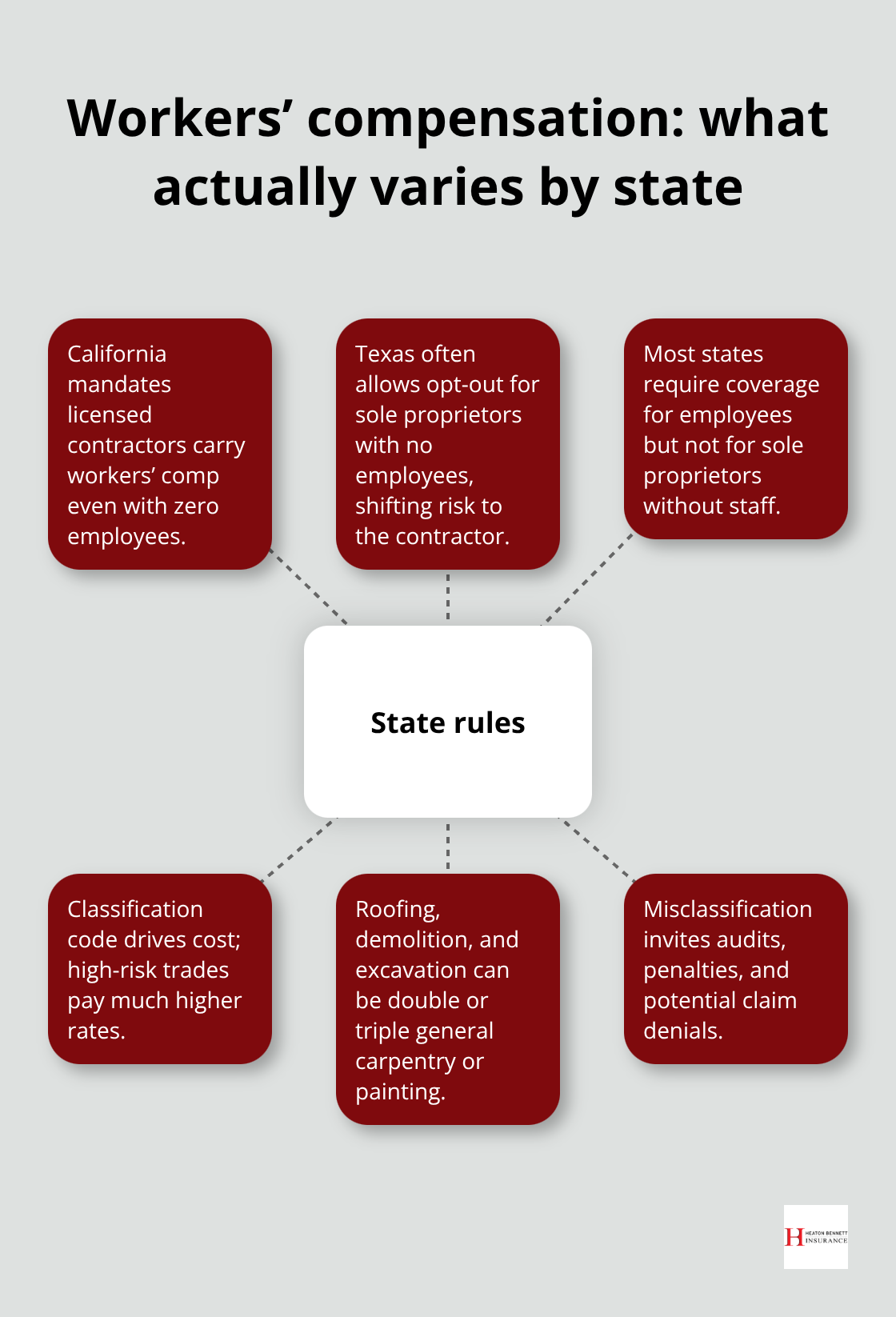
Most states fall between these extremes, requiring coverage for employees but not for sole proprietors without staff.
The cost of workers’ compensation depends heavily on your classification code, which the National Council on Compensation Insurance assigns based on your type of work. Roofing, demolition, and excavation carry much higher rates than general carpentry or painting, sometimes double or triple the cost per $100 of payroll. Misclassifying your workers to lower premiums invites audits, penalties, and coverage denials when you actually file a claim.
Protecting Tools and Equipment on Every Job
Tools and equipment coverage through inland marine insurance protects everything from hand tools to expensive machinery, whether owned or leased. Coverage applies both on-site and in transit, with replacement cost provisions that pay what it costs to replace equipment today rather than what you paid for it years ago. The premium typically runs $500 to $1,500 annually for small contractors, depending on the total value of equipment and your claims history. Many contractors overlook this coverage entirely, then absorb losses when tools get stolen from job sites or damaged in transit.
The real mistake happens when contractors assume their general liability or commercial property policies cover tools and equipment, which they typically don’t. Bundling tools and equipment coverage with your general liability and workers’ compensation into a package policy often costs less than buying coverages separately, giving you comprehensive protection without premium surprises. Your next step involves evaluating which specific equipment on your job sites needs protection and whether your current inland marine policy covers all of it, since some policies exclude certain high-value items or specialized machinery unless you add them separately.
Cutting Insurance Costs Without Cutting Protection
Contractors operate on razor-thin margins, and insurance premiums eat into profit faster than most realize. Many contractors assume premiums are fixed and non-negotiable, then discover they’ve been overpaying for years. The truth is sharper: your premium depends on decisions you control, and small changes compound into substantial savings.
How Deductibles and Policy Structure Affect Your Bottom Line
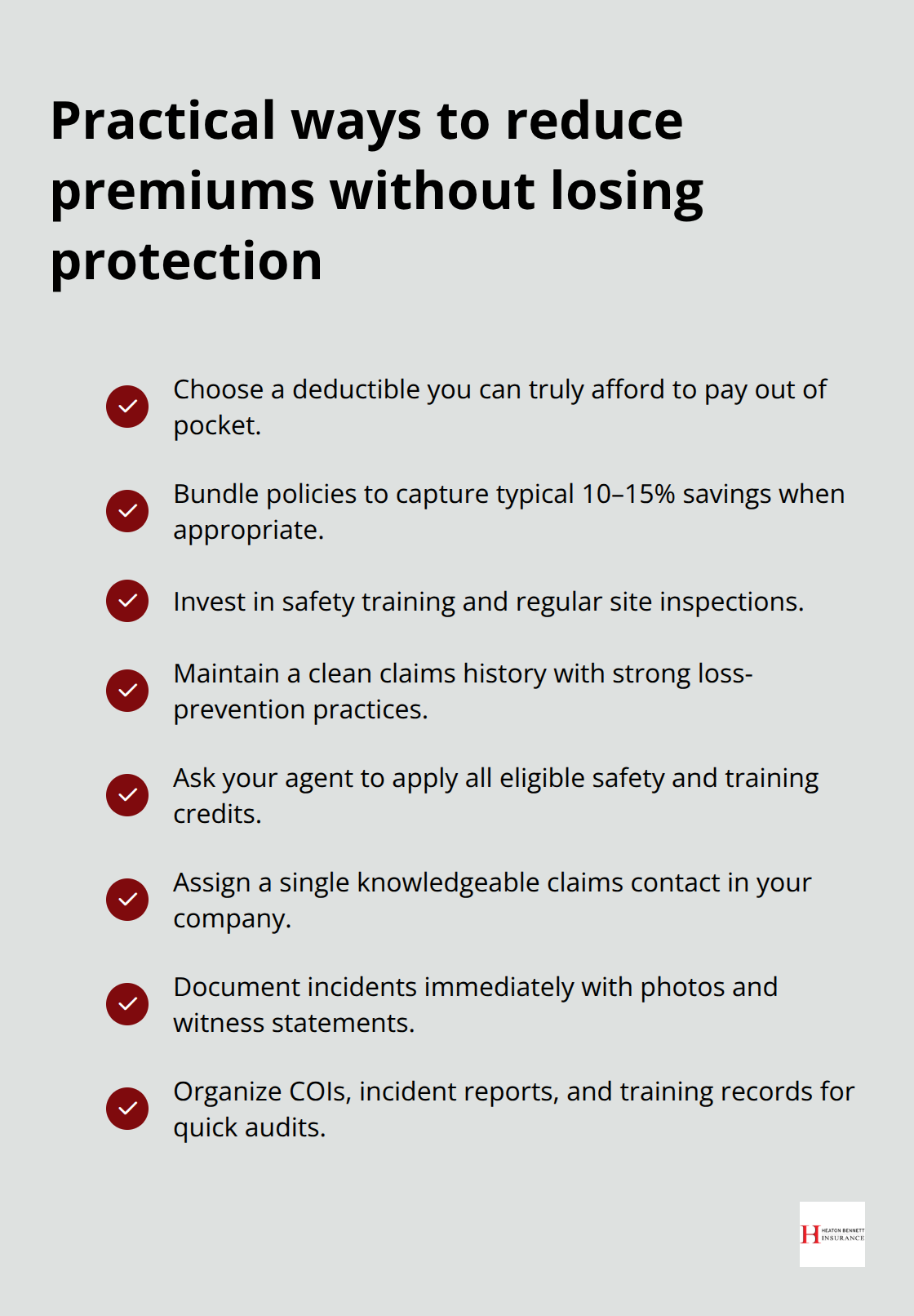
Higher deductibles lower your annual cost immediately, but only if you can actually absorb that out-of-pocket expense when a claim happens. A $2,500 deductible instead of $1,000 might save $300 annually on general liability, but if you don’t have $2,500 in reserves, that savings becomes a liability itself. Bundling policies into a package cuts costs compared with buying general liability and property separately, typically reducing premiums by 10 to 15 percent according to industry practice. The catch: bundled policies sometimes hide gaps where coverage doesn’t fully align with your actual needs.
Your claims history determines roughly 30 to 40 percent of your premium, making loss prevention your most powerful cost tool. One serious claim can lock you into higher rates for three to five years, so investing in safety training and site inspections pays back in lower premiums faster than any other strategy. Contractors with documented safety programs, OSHA certifications, or completion of construction safety courses qualify for premium credits that many agents forget to apply. Verify that your current policy includes all available credits before accepting a renewal quote.
Documenting Claims and Protecting Your Coverage
File a claim correctly and the difference between a smooth payout and months of friction with your insurer becomes obvious. Document everything immediately when an incident occurs: take photos, collect witness statements, and preserve physical evidence before cleanup begins. Report the claim to your insurer within 24 to 48 hours, not weeks later when memories fade and evidence disappears.
Provide your policy number, date of loss, detailed description of what happened, and a list of any injuries or property damage with estimated repair costs. Assign one person in your company as the claims contact who understands both policy details and project specifics, eliminating confusion when the insurer asks follow-up questions. Keep records organized by project: maintain certificates of insurance for all subcontractors, incident reports, safety training documentation, and photographs of completed work. These records protect you during audits and speed claims settlement when problems surface. Store copies digitally and in hard copy, since construction sites aren’t kind to paper documents.
The National Safety Council identifies construction as the most dangerous industry in terms of workplace deaths, which means injury claims arrive more frequently than in other sectors. Respond promptly to insurer requests for additional information, and never admit fault or apologize in writing, as those statements can be used against you in coverage disputes. If your claim gets denied, request a detailed explanation in writing and consult with your agent or an attorney before accepting that denial as final.
Final Thoughts
Construction contractor insurance protects your business only when it matches your real operations and project requirements. Pull your certificates of insurance and compare them directly to the contracts you’ve signed in the past year, looking for specific limit requirements, endorsement demands, and exclusions that your current policies may not address. If you’re carrying $1 million per occurrence in general liability but your contracts require $2 million, that gap becomes your personal liability when a claim exceeds your limits.
Schedule time with an independent insurance agent who understands construction work specifically, not someone tied to a single carrier who sells only what that carrier offers. An independent agent with access to multiple carriers builds a program around your actual needs, then finds the carriers that deliver the best combination of coverage and cost. We at Heaton Bennett Insurance guide you through the complex choices in construction contractor insurance using a personalized approach that identifies gaps before they become claims.
Construction contractor insurance costs money, but the wrong coverage or missing protection costs far more. One serious claim that exceeds your limits, one project loss not covered by adequate builder’s risk, or one injury claim denied because of a coverage gap can end your business. The contractors who stay profitable invest in proper coverage, manage claims effectively, and work with agents who understand their industry.
The information provided in this blog is for general informational purposes only and does not constitute legal, financial, or insurance advice. Coverage options, terms, and availability may vary. Please consult with a licensed professional for advice specific to your situation.

