

Workers Compensation Texas: Understanding Your Employer Obligations
Workers compensation in Texas isn’t optional-it’s a legal requirement that protects both your employees and your business. Many employers misunderstand what they’re actually required to provide, which can lead to costly penalties and compliance issues.
At Heaton Bennett Insurance, we’ve helped countless Texas employers navigate these obligations. This guide breaks down exactly what you need to know about coverage requirements, benefit types, and claims management.
What Does Texas Actually Require From Employers?
The Non-Subscriber Risk
Texas has one of the most employer-friendly workers compensation systems in the country, but that doesn’t mean you can ignore the rules. The state doesn’t mandate workers compensation insurance for most private employers, but this freedom comes with significant strings attached. If you choose not to carry coverage, you become what Texas calls a non-subscriber employer, which means you lose the liability protections that insurance provides. Instead, you face unlimited civil liability if an employee gets injured on the job.
According to the Texas Department of Insurance, approximately 25 percent of Texas employers operate as non-subscribers, which exposes them to direct lawsuits from injured workers. The moment an employee files a claim, they can sue you personally for medical costs, lost wages, and pain and suffering without the caps that workers compensation provides. This isn’t a theoretical risk.
Financial Responsibility Requirements
If you employ even one worker, the Texas Labor Code requires you to either carry workers compensation insurance or prove you have sufficient financial resources to cover potential claims. Most employers can’t meet that financial burden, which is why carrying proper coverage makes far more sense than gambling on avoiding injuries. The financial exposure grows quickly-a single serious injury can cost hundreds of thousands of dollars in medical treatment and lost wages.
Coverage Standards and Penalties
If you do carry coverage, you must follow Texas Department of Insurance rules precisely. Coverage must include medical benefits without limits on duration or amount, wage loss benefits at two-thirds of the employee’s average weekly wage, and death benefits for dependents. Failing to carry required coverage or misclassifying employees to avoid premiums triggers penalties ranging from $100 to $500 per day per violation, plus potential criminal charges for willful violations.
The state takes this seriously because the consequences affect real people. Your coverage status may have changed since you last reviewed it, as policy requirements and your business classification shift over time. Understanding what your current policy actually covers-and what gaps might exist-sets the foundation for protecting both your employees and your business operations.
What Benefits Must Your Policy Actually Cover
Medical Coverage Without Limits
Medical coverage under Texas workers compensation has no limits on duration or treatment amount, which means your policy must pay for every necessary medical expense related to a work injury indefinitely. This includes doctor visits, surgeries, medications, physical therapy, and hospital stays without caps or time restrictions. The Texas Department of Insurance enforces this strictly, and employers who try to limit medical benefits through policy language face penalties. A serious back injury requiring ongoing physical therapy for years remains your responsibility through your insurance carrier.
Wage Loss Benefits and Maximum Weekly Amounts
Wage loss benefits operate differently and come with a specific structure: employees receive two-thirds of their average weekly wage while unable to work, up to a maximum weekly benefit amount set annually by the state. For 2026, this maximum sits at approximately $1,115 per week for temporary disability, though the actual amount your employee receives depends on their pre-injury earnings. This structure protects workers while keeping employer costs predictable through insurance premiums rather than direct payments.
Death Benefits for Dependents
Death benefits for dependents represent one of the most overlooked coverage requirements, and they matter significantly when a workplace fatality occurs. Surviving spouses receive a percentage of the deceased worker’s average weekly wage for life or until remarriage, while dependent children receive benefits until age 18, or up to age 25 if they attend school full-time. These obligations extend far beyond the initial incident and require careful policy review.
Budgeting for Medical Exposure
Understanding these three benefit categories shapes how you budget for insurance costs and how you protect your workforce. Many Texas employers underestimate medical benefit exposure because they focus only on wage replacement costs, then face unexpected premium increases when claims exceed their assumptions. The key step involves reviewing your current policy documents to confirm these benefits exist without restrictions, then comparing your coverage against typical industry injury patterns for your specific business type.
Identifying Coverage Gaps
Some employers mistakenly believe workers compensation insurance covers everything, when in reality certain claims like occupational diseases or specific pre-existing condition complications require careful policy language review. An insurance provider who understands Texas-specific requirements prevents gaps that could expose your business to direct liability claims. Your next priority involves examining how your business actually reports and manages claims when injuries occur.
Protecting Your Business When Injuries Happen
Report Injuries Immediately to Your Insurance Carrier
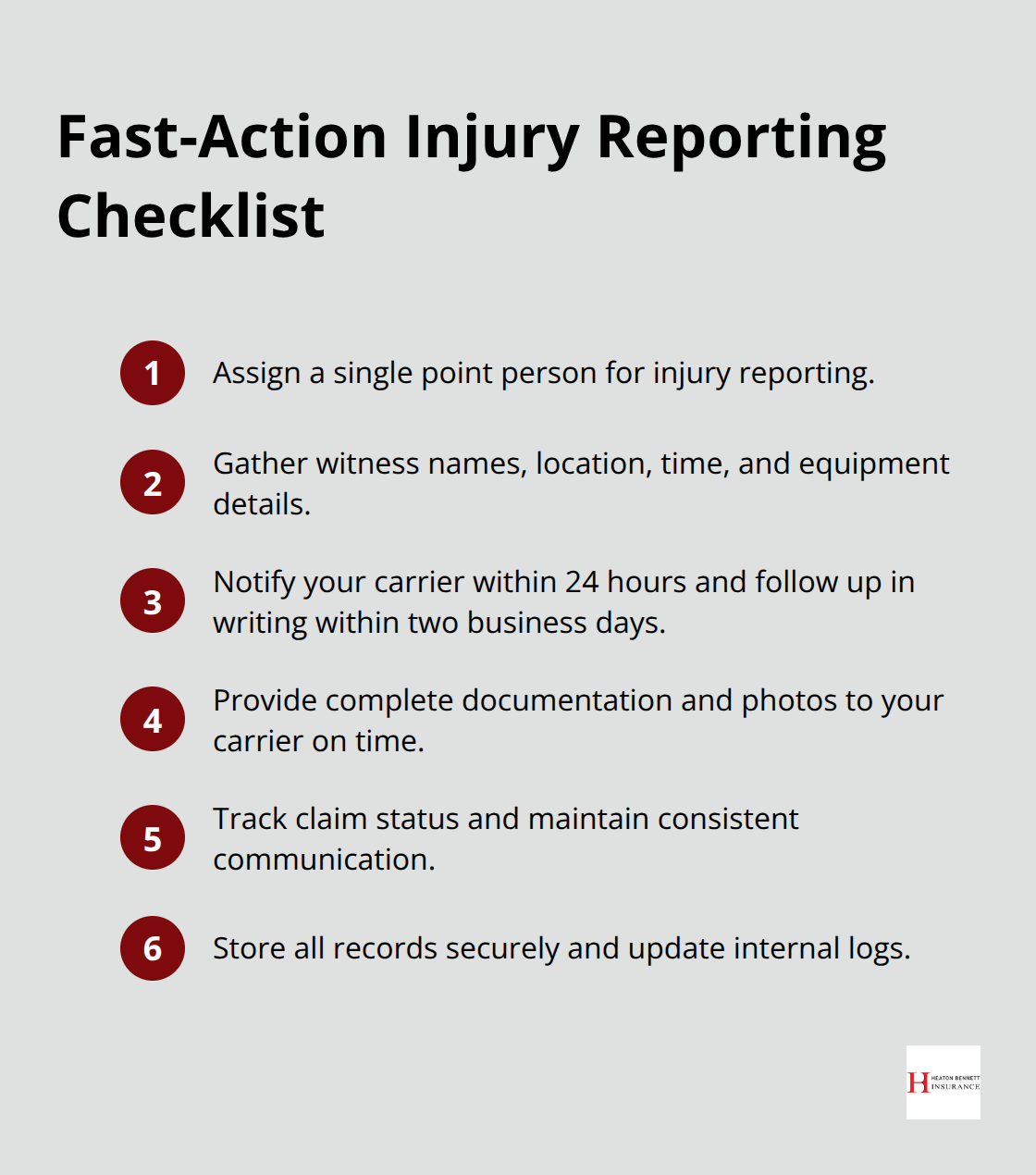
Reporting a workplace injury within 24 hours to your insurance carrier separates employers who avoid costly disputes from those who face claim denials and litigation. The Texas Department of Insurance expects prompt notification, and delays give insurance companies legitimate grounds to question claim validity or reduce benefits. Document everything at the injury scene: names of witnesses, exact location, time of day, equipment involved, and what the employee was doing when injured. Take photographs if possible.
Assign one person in your organization to handle injury reporting so procedures stay consistent and nothing falls through the cracks. When you contact your insurance carrier, have this documentation ready and provide a detailed written account within two business days. Many Texas employers wait weeks to report injuries, then struggle to explain why witness memories have faded or why details seem unclear. Your insurance carrier cannot defend a claim properly without accurate initial information, which means incomplete reporting ultimately hurts your business through higher premiums or coverage disputes.
Document Workplace Incidents With Precision
Thorough documentation protects your business and strengthens your insurance carrier’s ability to process claims fairly. Write down the employee’s account of what happened, including any equipment malfunction or environmental factors that contributed to the injury. Record the employee’s job duties at the time of the incident and whether they followed established safety procedures. Include medical information: which body part sustained injury, visible symptoms, and any first aid provided on-site.
Photograph the injury scene from multiple angles, capturing equipment, work surfaces, and hazards that may have caused the incident. Store all documentation in a secure location and provide copies to your insurance carrier within the required timeframe. This level of detail prevents disputes later when memories fade and evidence disappears.
Investigate Root Causes Within 48 Hours
Investigate the root cause of each injury within 48 hours while details remain fresh in everyone’s mind. Speak with the injured employee, witnesses, and supervisors to understand exactly what went wrong. Identify whether the injury resulted from equipment failure, inadequate training, unsafe procedures, or environmental hazards. Document your findings in writing and share them with your safety team so others learn from the incident.
This investigation process transforms individual injuries into organizational learning opportunities. When your team understands why injuries happen, they can spot similar hazards before they cause harm.
Build a Safety Program Around Your Actual Risks
Safety programs reduce injury frequency more effectively than any other single factor, yet most Texas employers treat them as compliance checkboxes rather than operational priorities. The National Safety Council reports that businesses with formal safety programs experience 35 percent fewer lost-time injuries than those without structured approaches. Start with a written safety policy specific to your actual operations, not generic templates. Identify your top three injury risks based on your industry and employee roles, then build prevention around those specific hazards.
Conduct monthly safety meetings focused on real incidents from your workplace, not theoretical scenarios. Insurance carriers notice which employers invest in genuine safety culture, and many offer premium discounts of 5 to 15 percent for documented safety programs. Your insurance provider should review your safety practices annually and recommend specific improvements for your operation.
Partner With Your Insurance Carrier on Prevention
Working with your insurance carrier transforms them from a claims processor into a business partner who helps you prevent injuries before they happen, reducing both human suffering and insurance costs. Share your safety investigation findings with your carrier and ask for their perspective on hazard prevention. Many carriers employ safety specialists who understand your industry and can identify risks you might overlook. Request that your carrier conduct a workplace safety audit and provide written recommendations tailored to your specific operations. This collaborative approach (combining your operational knowledge with your carrier’s claims experience) creates stronger injury prevention strategies than either party could develop alone.
Final Thoughts
Texas workers compensation requirements protect your employees when injuries occur and shield your business from unlimited liability exposure. A single serious injury costs hundreds of thousands of dollars without proper coverage, and non-compliance penalties accumulate quickly. You must carry the right coverage for your business size and industry classification, with no gaps in medical or wage loss benefits.
Your actual protection comes from three actions that work together. First, confirm that your coverage includes unlimited medical benefits, proper wage loss structures, and death benefits for dependents. Second, build a genuine safety program around your specific workplace hazards rather than treating safety as a compliance checkbox. Third, report injuries immediately and document them thoroughly so your insurance carrier can process claims fairly and defend your business if disputes arise.
We at Heaton Bennett Insurance understand that navigating workers compensation Texas requirements takes time and expertise. Our team can review your current policy, identify gaps, and help you understand exactly what your coverage provides. Contact us to schedule a Security Snapshot review of your workers compensation protection and confirm your business meets all Texas requirements while protecting your employees properly.
The information provided in this blog is for general informational purposes only and does not constitute legal, financial, or insurance advice. Coverage options, terms, and availability may vary. Please consult with a licensed professional for advice specific to your situation.

