

Cost of liability insurance: Questions Every Owner Should Ask
Liability insurance protects your business from financial ruin when accidents happen. Yet many owners have no idea what they’re actually paying for or whether their coverage is adequate.
At Heaton Bennett Insurance, we’ve seen firsthand how the cost of liability insurance varies wildly depending on decisions you make today. This guide walks you through the questions that matter most.
What Moves Your Liability Insurance Price
Industry Risk Determines Your Starting Point
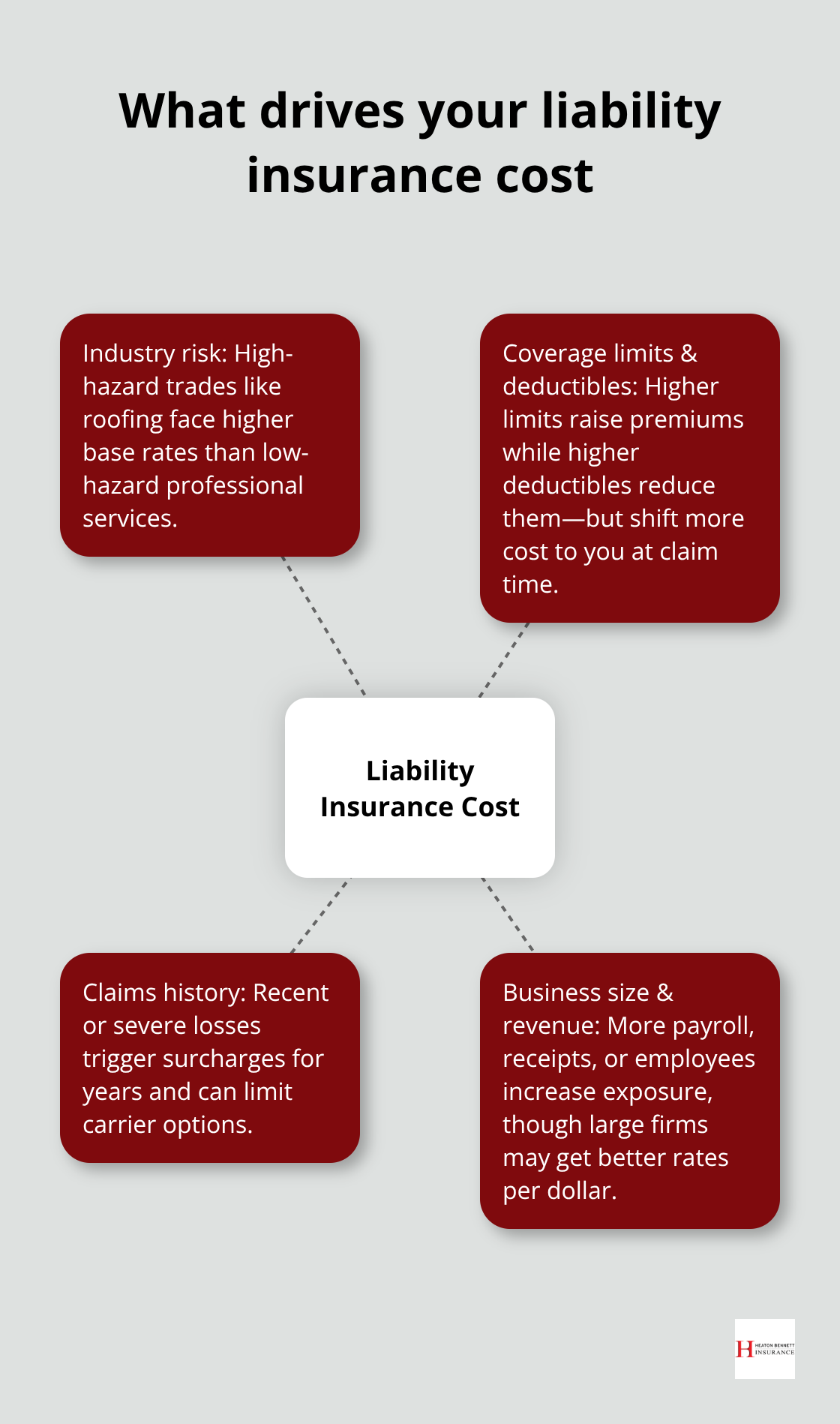
Your industry determines more than you think. A roofing contractor pays substantially more than a consulting firm because falling from heights kills people and damages property. Insurance carriers know this. They’ve analyzed decades of claims data and built pricing models around it. A construction business with 10 employees will face premiums three to five times higher than an accounting firm of the same size, simply because the risk profile is different.
Your specific industry classification sits at the foundation of every quote you receive, and there’s no negotiating around it.
Coverage Limits and Deductibles: Where You Control Costs
Coverage limits are where you actually have control. A $1 million general liability policy costs far less than a $2 million policy, but that savings disappears the moment a lawsuit exceeds your limit. Businesses that choose $500,000 limits to save a few hundred dollars annually often face six-figure uninsured losses when something goes wrong. Your deductible works the same way. Raising it from $500 to $2,500 drops your premium, but you’re gambling that small claims won’t happen. Most business owners should target limits that match their worst-case scenario, not their typical year.
Claims History: The Permanent Record
Your claims history is the second major lever insurers pull. One significant claim raises your rates for three to five years, sometimes permanently if the claim revealed systemic negligence. Two claims within three years can make you uninsurable at standard rates. This is why detailed record-keeping matters. If you can document that a claim was a one-time incident caused by external factors, some carriers will rate you more favorably than others.
Business Size and Revenue Impact
Business size directly impacts your cost. Carriers charge based on payroll, revenue, or number of employees depending on your industry. A $2 million revenue business pays more than a $500,000 business in the same industry, but the increase isn’t proportional. Larger businesses often get better rates per dollar of revenue because they can absorb losses without insurance payouts. Small businesses subsidize their own claims more frequently, which makes them riskier from the insurer’s perspective. Understanding how your company’s size affects pricing helps you anticipate what quotes will actually look like when you start comparing options.
How to Compare Quotes Without Getting Blindsided
Getting three or more quotes is non-negotiable, but most business owners compare them wrong. They look at the bottom-line premium and call it a day. That approach costs money. When you request quotes, ask each carrier the same specific questions about your operation. What payroll figure are they using? What revenue number? How many locations? Inconsistent answers mean some quotes are built on faulty assumptions and won’t hold up once you bind coverage.
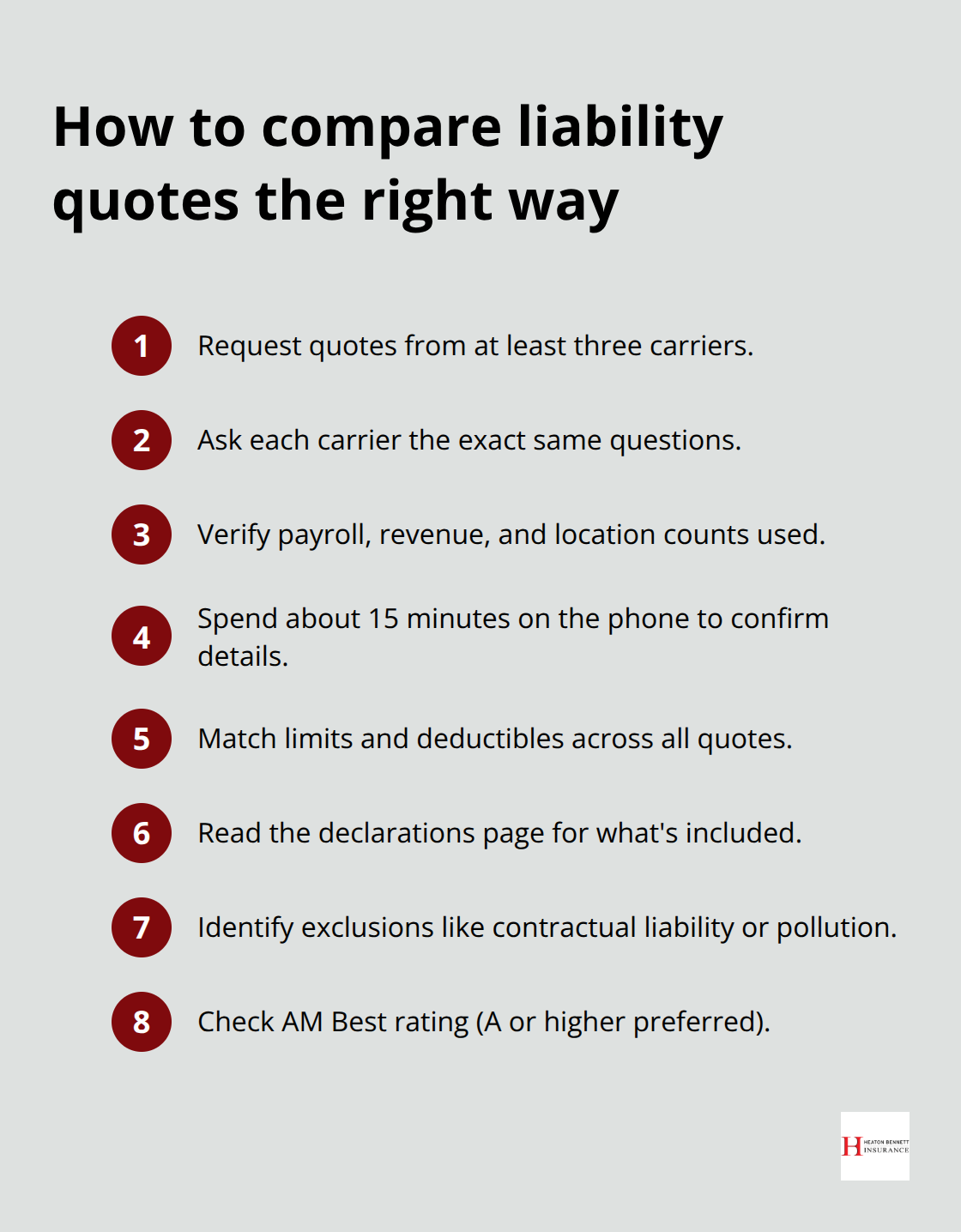
Request quotes from at least three carriers, and spend 15 minutes on the phone with each one to confirm they understand your business correctly. A quote built on wrong information is worthless the moment you need to file a claim.
What You’re Actually Comparing
Every quote includes different things, which makes direct comparison nearly impossible without digging deeper. One carrier might bundle workers’ compensation into a package price while another quotes it separately. One includes cyber liability coverage; another treats it as an add-on. Read the declarations page carefully. This page lists your coverage limits, deductibles, and what’s actually included. A $1,200 annual premium for general liability sounds cheaper until you notice the deductible is $5,000 instead of $1,000, or the coverage limit is $500,000 instead of $1 million. Compare apples to apples by ensuring every quote uses identical limits and deductibles. Ask each carrier to explain what’s excluded from their policy. Some policies exclude contractual liability; others include it. Some exclude pollution; others don’t. These exclusions matter when something goes wrong.
The Insurer’s Financial Strength Matters More Than Price
A cheap quote from an insurer that goes bankrupt leaves you unprotected. Check AM Best ratings for any carrier quoting you coverage. AM Best is the standard rating agency for insurance company financial stability. A rating of A or higher means the company can pay claims. Ratings below A mean you’re taking a gamble. Regional insurers sometimes undercut national carriers on price, but if they lack the capital reserves to handle a major claim in your industry, that discount becomes a liability. When you’re comparing quotes on your own, verify AM Best ratings before you even consider price.
Moving Forward With Confidence
You now understand what moves your premium and how to spot a quote built on faulty assumptions. The next step involves recognizing the mistakes that trap business owners into inadequate coverage or overpaying for protection they don’t need.
Common Mistakes Business Owners Make When Buying Liability Insurance
Price Becomes the Only Decision Factor
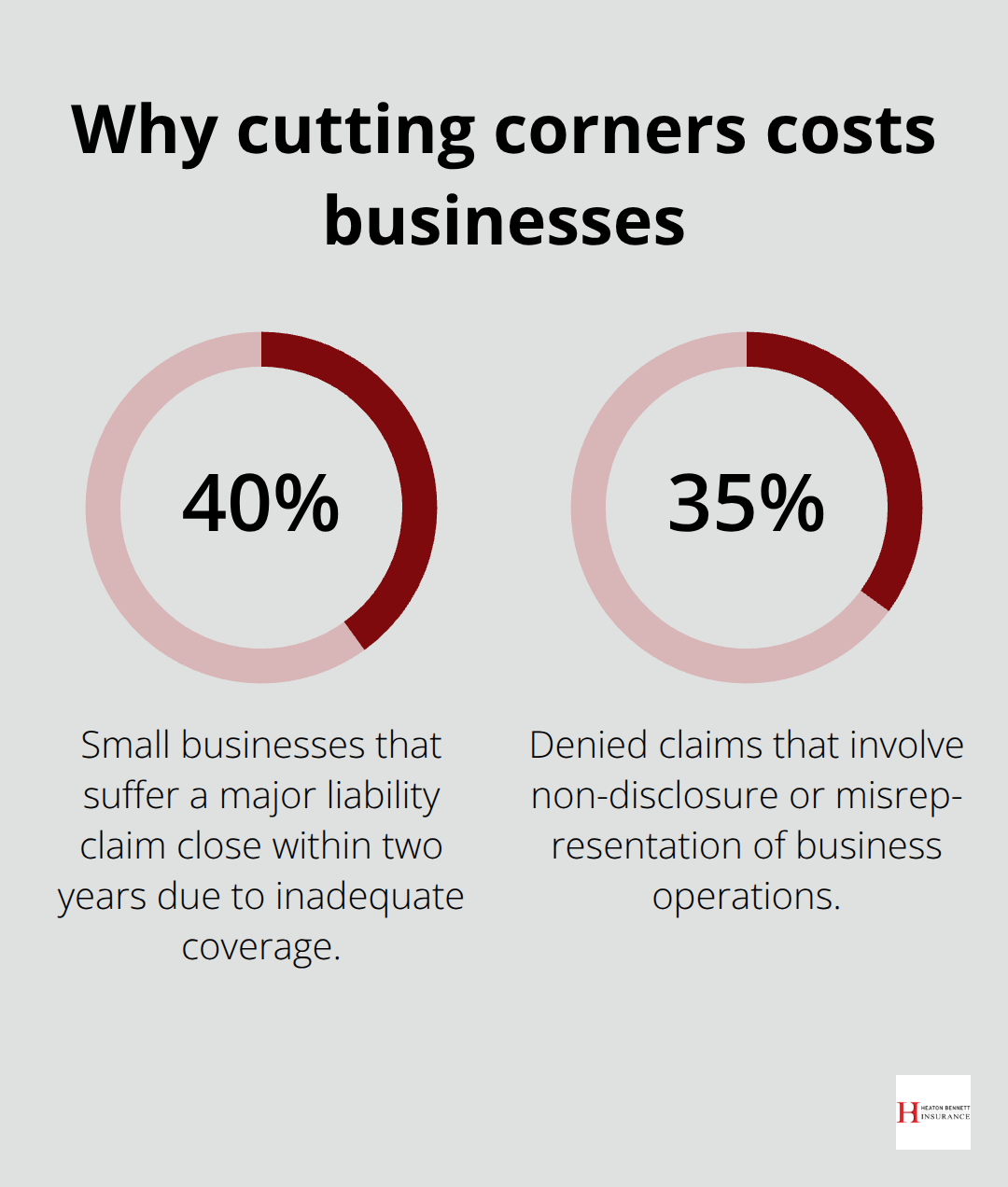
The biggest mistake we see is treating liability insurance like a commodity. Business owners call three carriers, compare the lowest premium, and sign up. This approach backfires because price never tells the full story. A $900 annual premium with a $5,000 deductible and $500,000 coverage limits is not the same as a $1,200 premium with a $1,000 deductible and $1 million limits, yet many owners pick the cheaper option without thinking through the actual protection gap. When a lawsuit arrives and your coverage maxes out at $500,000, that discount disappears into a six-figure out-of-pocket loss. The National Federation of Independent Business reports that 40% of small businesses that experience a major liability claim close within two years because they lacked adequate coverage. Price shopping alone killed those businesses. Your coverage limits must match your actual exposure, not your budget constraints.
You Stop Reading Your Policy After Purchase
The second critical mistake happens after you buy the policy. Business owners purchase liability insurance, file it away, and never look at it again until renewal. What they don’t realize is that your business evolves constantly. You hire new employees, add service lines, expand into new locations, or change how you operate. Your original policy was priced on assumptions that no longer hold true. If you fail to disclose material changes to your operations, you’ve just handed your insurer a reason to deny claims. An NFIB study found that 35% of denied claims involved non-disclosure or misrepresentation of business operations. That’s not a technicality-that’s catastrophic. Review your policy every single year with your agent, and update your coverage when your business changes. Document these conversations so you have evidence you disclosed everything accurately.
Coverage Limits Fall Short of Actual Risk
The third trap is underestimating what adequate limits actually are. Most business owners think about the worst single incident they can imagine, then pick a limit slightly above that. This math fails because lawsuits don’t stop at your coverage limit. They pile on defense costs, medical expenses, lost wages, and punitive damages. A construction company with a $1 million limit sounds protected until a fatality claim arrives with $400,000 in defense costs alone, leaving only $600,000 for actual damages and settlements. Many industries now require $2 million minimums as standard. Talk to your agent about what competitors in your space carry and what your contracts actually require.
Final Thoughts
You’ve now seen how the cost of liability insurance depends on decisions within your control and factors you cannot change. Your industry sets your baseline, your coverage limits and deductible choices determine what you actually pay, and your business size rounds out the picture. None of this matters if you pick the wrong coverage or fail to update your policy when your operations shift.
Finding the right coverage means requesting quotes from at least three carriers, confirming they understand your business correctly, and comparing identical limits and deductibles across all quotes. Verify AM Best ratings before you decide, and review your policy annually to document every change to your operations. A cheap quote that leaves you underinsured costs far more than adequate coverage at a higher premium.
We at Heaton Bennett Insurance understand that navigating liability insurance feels overwhelming, and as an independent agency in Austin, Texas, we work with multiple carriers to find coverage that matches your actual risk. Our team guides you through the process with personalized solutions tailored to your business, so you’re not locked into a single carrier or forced to accept one-size-fits-all coverage.
The information provided in this blog is for general informational purposes only and does not constitute legal, financial, or insurance advice. Coverage options, terms, and availability may vary. Please consult with a licensed professional for advice specific to your situation.

