

Umbrella Liability Policy: Elevate Your Personal Risk Coverage
A standard homeowners or auto policy typically caps liability coverage at $300,000 to $500,000. For most people, that’s not nearly enough protection if a serious accident happens on your property or you’re found liable in a major lawsuit.
An umbrella liability policy fills that gap by providing additional coverage that kicks in after your standard policies max out. At Heaton Bennett Insurance, we’ve seen firsthand how this extra layer of protection can save families from financial devastation.
How Umbrella Coverage Works
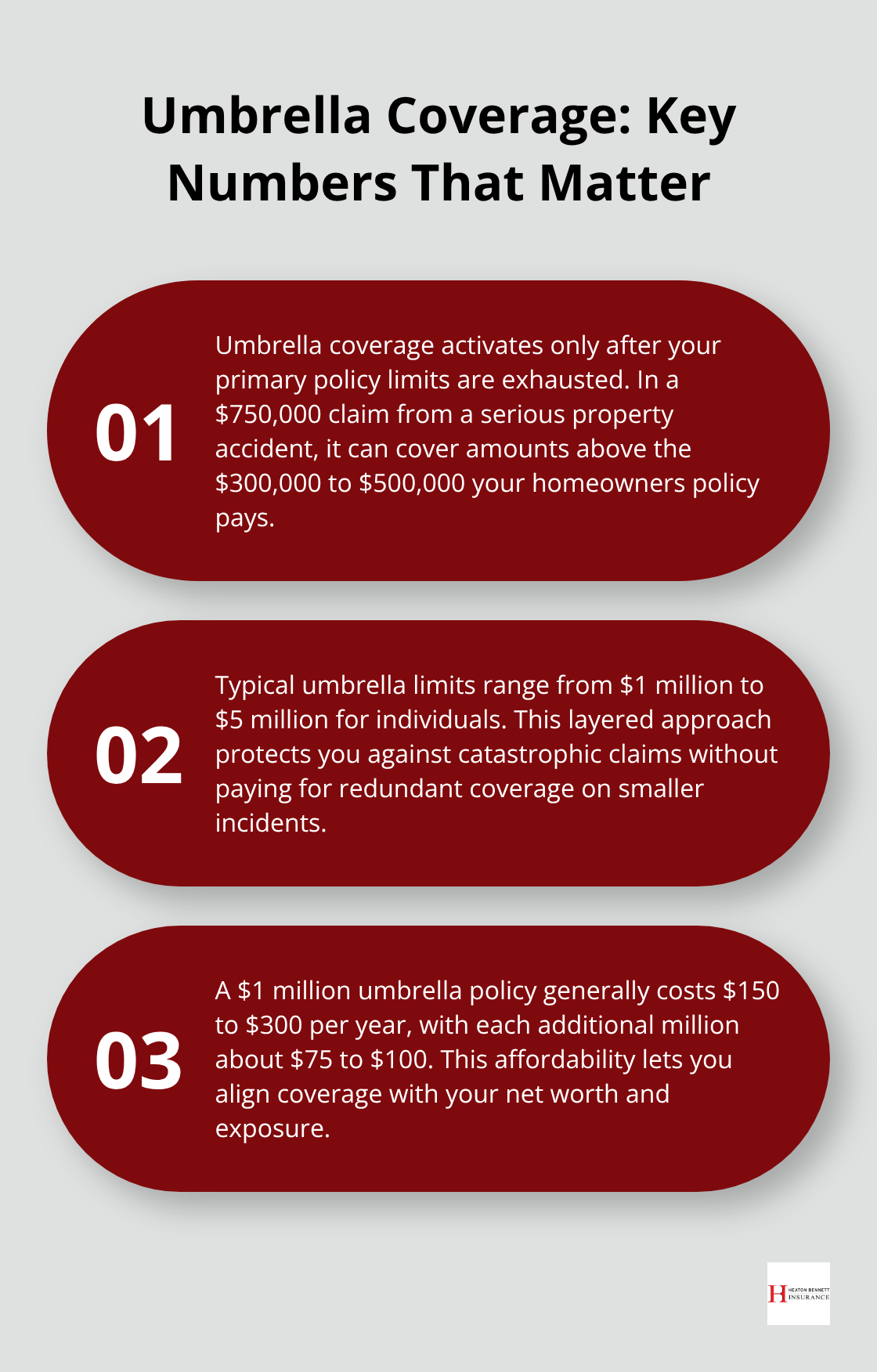
An umbrella liability policy operates as a second line of defense that activates only after your primary homeowners or auto insurance reaches its limit. When someone sues you for $750,000 after a serious accident on your property, your homeowners policy covers the first $300,000 to $500,000, and your umbrella policy covers the remaining $250,000 to $450,000. This layered approach protects you against catastrophic liability claims without paying for redundant coverage on smaller incidents. Once your underlying insurance maxes out, the umbrella kicks in and covers additional damages up to its stated limit, which typically ranges from $1 million to $5 million for individual policies.
Coverage starts where standard policies end
Most homeowners and auto policies include liability coverage, but these limits reflect what insurers consider adequate for average claims. A serious accident can generate legal costs that far exceed these thresholds. Medical bills, lost wages, pain and suffering, and punitive damages accumulate quickly in major lawsuits. A $1 million umbrella policy costs between $150 and $300 annually, depending on your risk profile and underlying coverage limits. This modest premium protects assets that could otherwise face seizure through a judgment, including savings accounts, investment portfolios, and future income. Without this coverage, you remain personally responsible for amounts exceeding your standard policy limits, which can devastate your financial security for years.
Why umbrella differs from standard liability insurance
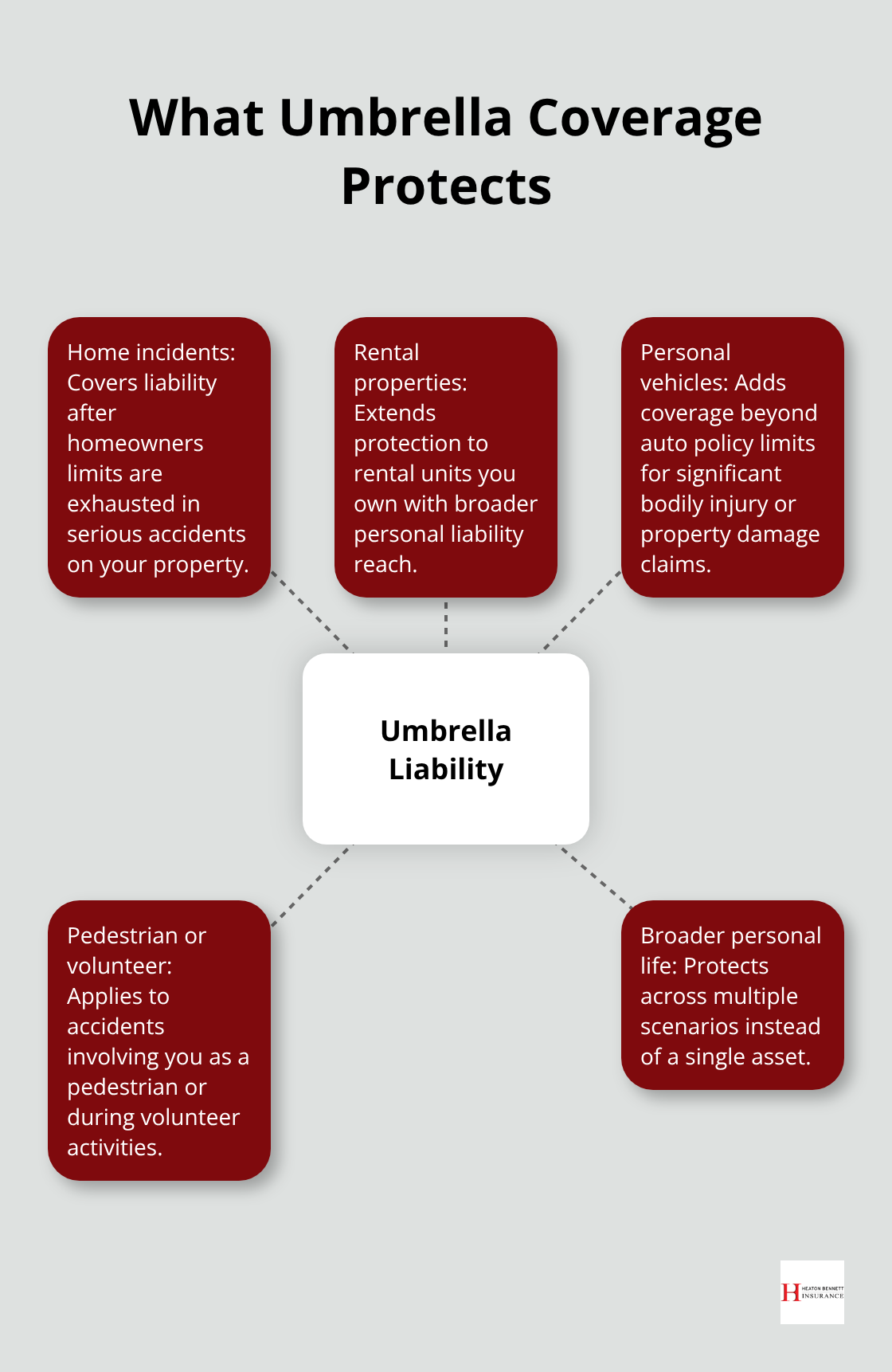
Standard liability insurance on homeowners and auto policies covers specific incidents related to that property or vehicle. Umbrella coverage, by contrast, provides broader protection across your entire personal life. It covers liability claims from your home, rental properties you own, personal vehicles, and even accidents involving you as a pedestrian or volunteer.
This comprehensive reach makes umbrella policies particularly valuable for anyone with multiple properties or complex personal circumstances. Umbrella policies require you to maintain minimum underlying coverage limits on your standard policies-typically $300,000 for homeowners and $250,000 to $300,000 per person for auto insurance. This requirement prevents you from substituting umbrella coverage for adequate primary insurance.
Understanding your actual exposure
Your liability risk extends far beyond what most people realize. A single serious incident can expose you to claims that dwarf your standard policy limits. Homeowners face particular exposure when someone suffers a major injury on their property, while vehicle owners confront risk from accidents involving significant bodily injury or property damage. High-net-worth individuals, property owners with rental units, and those with active lifestyles (coaching youth sports, hosting frequent gatherings) face elevated risk. The gap between your standard coverage and potential liability claims represents real financial exposure that umbrella policies address directly. For questions about your specific situation, get help with your insurance claims & payments or contact us to discuss your coverage needs.
Why Standard Coverage Leaves You Exposed
The limits that sound big until they aren’t
Your homeowners policy maxes out at $300,000 to $500,000 in liability protection. Your auto policy stops at similar limits. These numbers sound substantial until a serious accident happens and the damages exceed what your policies cover. A person severely injured on your property might face $1 million in medical costs, lost wages, and pain and suffering. You become personally responsible for every dollar above your policy limits, which means creditors can pursue your savings, investment accounts, and future wages to satisfy the judgment.
The National Association of Insurance Commissioners reports that liability claims exceeding standard policy limits have increased significantly over the past decade, with major judgments regularly reaching $2 million to $5 million in cases involving serious bodily injury. Without umbrella coverage, you’re betting your entire financial future on the hope that no catastrophic accident ever occurs on your property or involves your vehicle.
Hidden gaps in your existing policies
Standard policies contain gaps that most people never identify until a claim arises. Your homeowners liability might not fully cover injuries to workers on your property, legal defense costs in certain situations, or accidents where you’re partially at fault. Rental properties create additional exposure that standard homeowners coverage doesn’t address. If you volunteer, coach youth sports, or serve on a nonprofit board, your activities create liability that your basic policies may not cover adequately.
An umbrella policy eliminates these gaps by providing broader protection across your entire personal life and multiple properties. High-net-worth individuals face particular risk because judgments often reflect the defendant’s ability to pay, meaning wealthier people attract larger claims.
The affordable solution to catastrophic risk
A $1 million umbrella policy costs roughly $150 to $300 annually, making it one of the most affordable ways to protect assets that took decades to accumulate. The math is straightforward: spending a few hundred dollars annually prevents the loss of hundreds of thousands or millions in personal wealth. This modest investment addresses real financial exposure that standard policies leave unprotected.
Your specific situation-whether you own rental properties, maintain an active lifestyle, or have accumulated significant assets-determines how urgently you need this protection. Understanding your actual exposure helps you make an informed decision about coverage levels and policy features.
How to Choose the Right Umbrella Policy
Calculate your actual net worth and exposure
Start with your actual net worth, not a guess. Add up your home value, investment accounts, retirement savings, vehicles, and any other significant assets. This number determines your real exposure if someone wins a major lawsuit against you. If you’re worth $2 million, a $1 million umbrella policy leaves half your wealth vulnerable.
Most financial advisors recommend umbrella coverage equal to your net worth, though some suggest going higher if you own rental properties or have substantial income. The Insurance Information Institute data shows that umbrella policies typically cost $150 to $300 annually for $1 million in coverage, then $75 to $100 for each additional million. This pricing structure makes it affordable to match your actual exposure rather than settling for inadequate limits.
Your underlying policy limits also matter significantly. Most insurers require you to maintain $300,000 in homeowners liability and $250,000 to $300,000 per-person auto liability before they’ll sell you umbrella coverage. If your current policies fall short of these minimums, you’ll need to increase them first, which typically costs $50 to $150 annually.
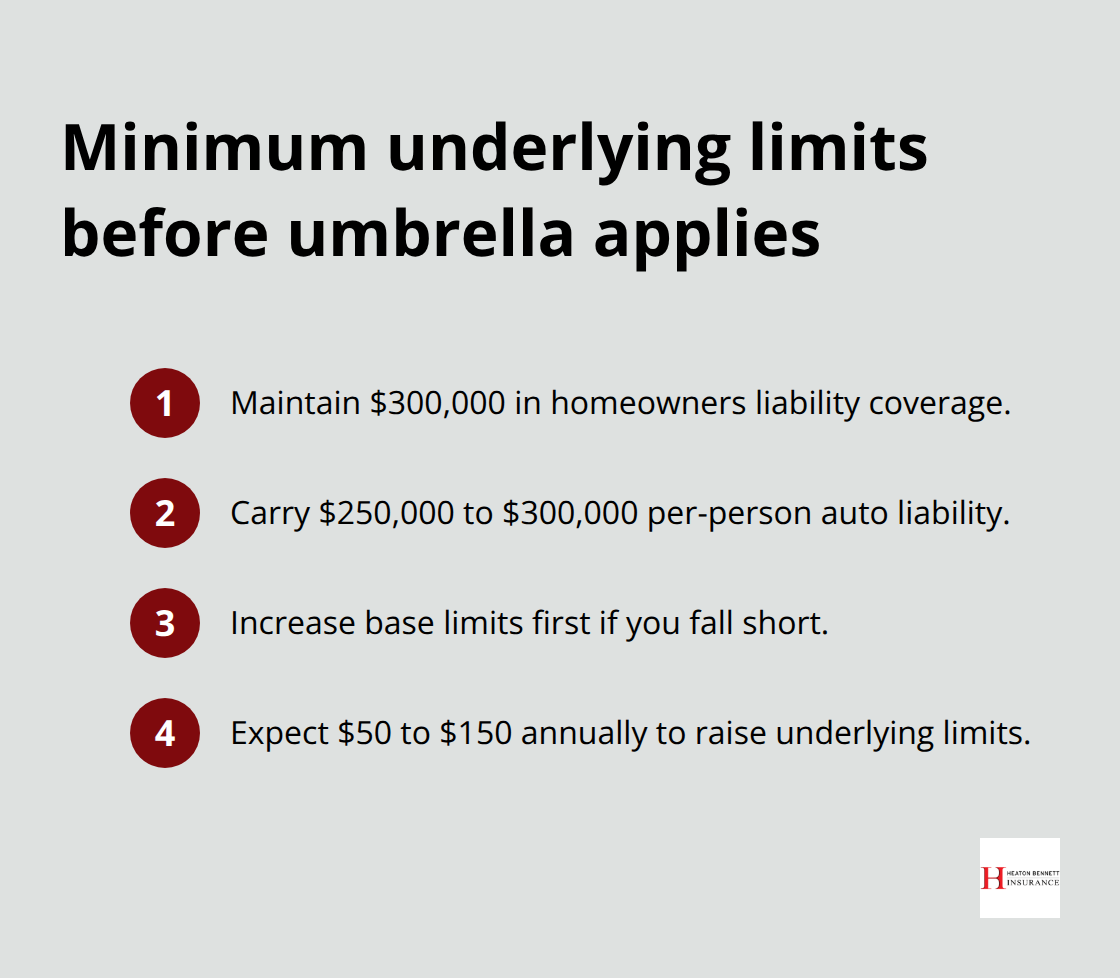
This requirement actually protects you because it ensures your primary policies handle smaller claims before umbrella coverage activates.
Assess your specific risk factors
Calculate your specific risk factors next. Do you own rental properties? That exposure typically demands $2 million to $5 million in umbrella coverage. Do you host frequent gatherings where guests might suffer injuries? Do you volunteer or coach youth sports? Each activity increases your liability risk and justifies higher coverage amounts.
High-net-worth individuals and property owners should never settle for the minimum $1 million umbrella limit-it’s simply insufficient protection for the assets they’ve accumulated. Your lifestyle and property portfolio determine whether you need $1 million, $3 million, or $5 million in coverage.
Provide complete information for accurate quotes
When you contact insurers for umbrella quotes, provide complete information about your properties, vehicles, and lifestyle activities. Underwriters use this information to assess your true risk profile and determine appropriate pricing. Incomplete applications often result in either inflated premiums or coverage denials when claims arise.
Tell them about rental properties, previous insurance claims, traffic violations, or lawsuits. Transparency upfront prevents unpleasant surprises later. Compare quotes from at least three providers because pricing varies dramatically based on how different insurers evaluate risk. One carrier might charge $200 annually for a $1 million policy while another charges $400 for identical coverage-the difference comes down to their underwriting approach and appetite for your specific risk profile.
Request detailed policy comparisons that spell out exactly what’s covered and what’s excluded. Some policies cover rental properties while others don’t. Some include coverage for incidents you’re partially at fault for, while others don’t. These differences justify paying attention during the comparison process rather than simply selecting the cheapest option.
Examine policy features and coverage details
Read the definitions section carefully because coverage hinges on precise language. Does the policy cover injuries to household employees? Does it protect you if you’re sued for defamation or invasion of privacy? Does it cover liability from rental properties you own? Standard umbrella policies cover most common liability scenarios, but features vary.
Some policies include coverage for legal defense costs before the policy limits apply, meaning your coverage goes further. Others require defense costs to count against your coverage limit, which reduces actual protection. This distinction can cost thousands of dollars in a significant lawsuit. Ask about deductibles too. Most umbrella policies carry zero deductibles, but some carriers offer higher deductibles in exchange for lower premiums. A $10,000 deductible might save you $50 annually, but it creates a gap in coverage that your underlying policies might not fill.
Request information about how the carrier handles claims and whether they provide legal representation or simply reimburse your attorney. Carriers that provide legal representation often result in better outcomes because they’re invested in your defense from the start.
Final Thoughts
An umbrella liability policy represents straightforward financial protection that costs far less than the assets it defends. You’ve calculated your net worth, identified your specific risk factors, and compared quotes from multiple carriers. The remaining step is taking action before a serious accident forces you to wish you had.
Standard homeowners and auto policies leave you exposed to catastrophic liability claims, and a $1 million umbrella liability policy costs $150 to $300 annually to fill that gap. For high-net-worth individuals and property owners, this protection becomes non-negotiable because the cost of inaction far exceeds the modest premium you’ll pay. Most carriers provide quotes within 24 hours and issue policies within a week.
We at Heaton Bennett Insurance understand that choosing the right coverage requires more than comparing prices. Our team works with multiple carriers to find policies that match your actual exposure and lifestyle, and we guide you through your umbrella liability needs without the confusion.
The information provided in this blog is for general informational purposes only and does not constitute legal, financial, or insurance advice. Coverage options, terms, and availability may vary. Please consult with a licensed professional for advice specific to your situation.

