
Commercial Liability Protection: Aligning Coverage with Risk
One wrong coverage decision can cost your business thousands in unprotected claims. At Heaton Bennett Insurance, we’ve seen too many business owners discover they’re underinsured only after liability strikes.
The gap between what you think you’re covered for and what you actually are is where most businesses get hurt. This guide walks you through commercial liability protection that matches your real risks, not just generic policies.
What Liability Exposures Actually Threaten Your Business
Slip-and-Falls, Property Damage, and Hidden Gaps
Liability exposures hide in plain sight across most business operations. A customer slips on a wet floor, your service causes property damage at a client site, or a product defect surfaces months after delivery-these incidents happen regularly, yet many business owners assume their current coverage handles them. Slip-and-fall injuries account for roughly 8 million emergency room visits annually in the United States, and a single premises liability claim costs between $15,000 and $100,000 when legal defense expenses are included. Your exposure depends entirely on how customers interact with your business, what you sell or deliver, and whether your work touches client property or data.
A contractor working on-site faces different risks than a software consultant, yet both need tailored protection. Professional service providers often overlook errors and omissions coverage, believing their work is straightforward enough to avoid mistakes. Retailers assume general liability protects them fully without realizing gaps around product liability or completed operations. Most business owners underestimate their exposure because they focus only on the most obvious scenarios.
How Claims Drain Cash Flow and Disrupt Operations
The gap between perceived coverage and actual protection widens when liability claims hit operations directly. A single lawsuit drains cash flow through legal fees that begin immediately, often before any settlement or judgment. Defense costs alone reach $5,000 to $10,000 monthly for moderate disputes, and these expenses come due regardless of claim outcome. Your business continues operating while you pay these costs from working capital, which strains payroll, vendor payments, and growth initiatives.
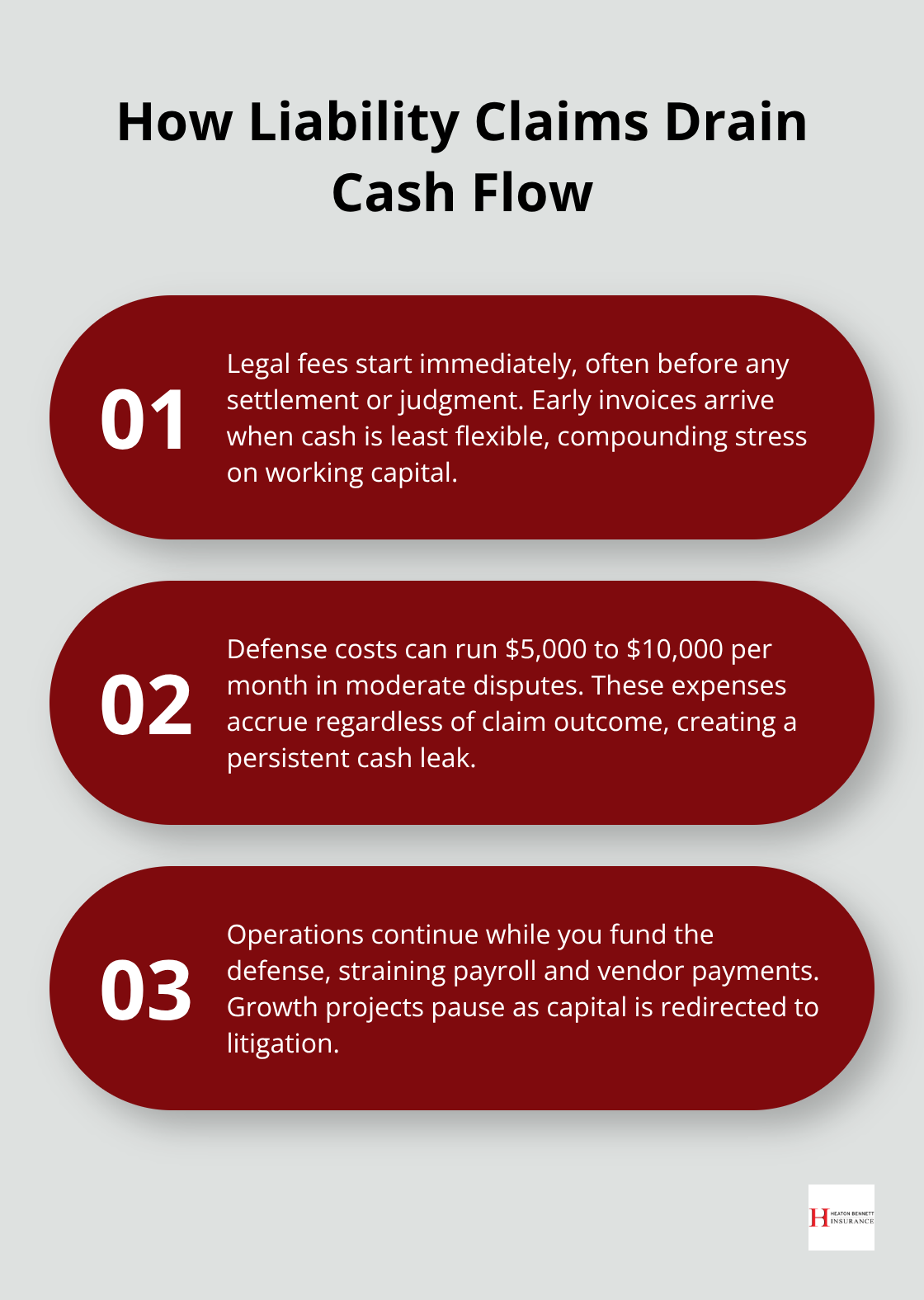
Claims also disrupt client relationships-contracts frequently require proof of active coverage, and a lapsed or inadequate policy can trigger contract violations. Staff time shifts toward incident documentation and legal coordination. Customer confidence wavers when disputes become public. Vendors and landlords may demand higher deposits or renegotiate terms if they perceive increased risk.
The Underinsurance Trap
The underinsurance problem compounds these effects significantly. Many businesses purchase coverage based on budget rather than actual exposure, selecting limits that sound adequate without performing a real risk assessment. A $1 million general liability limit might seem substantial until a serious injury claim arrives-medical costs, lost wages, and pain-and-suffering awards regularly exceed $2 million in moderate cases. When your policy maxes out, everything above that threshold comes directly from your business assets, and one inadequately covered claim can eliminate years of profit or force asset sales.
The underinsured business also faces renewal penalties. Insurers adjust premiums and terms based on claim history, and insufficient coverage at claim time signals poor risk management to underwriters. Your next renewal may bring higher deductibles, reduced limits, or coverage exclusions that make future protection even harder to obtain. These compounding effects make the initial coverage decision far more important than most business owners realize, which is why understanding liability protection strategies becomes your next critical step.
Coverage Types That Actually Protect Your Business
General Liability: The Foundation That Isn’t Enough
General liability covers the everyday incidents that land most businesses in court: a customer injured on your premises, property damage you cause at a client site, or advertising claims from your marketing materials. This coverage includes legal defense costs from day one, which matters because defense expenses often exceed $10,000 before any settlement discussion begins. However, general liability has real limits. It does not cover claims stemming from your professional advice, errors in service delivery, or defects in products you manufactured or sold.
A marketing agency protecting itself with only general liability faces exposure when a campaign strategy damages a client’s brand reputation. A construction company with general liability alone lacks protection when its completed work fails and causes property damage months later. These gaps exist because general liability assumes you’re not the expert-it protects you from accidents, not from mistakes in your core service.
Professional Liability: Protecting Your Expertise
Professional liability and errors and omissions coverage fills that gap directly. This protection covers claims when your professional judgment, advice, or service delivery causes financial loss to a client. Accountants, consultants, architects, and engineers rely on this coverage because a single mistake (missed tax deductions, faulty project specifications, or overlooked compliance issues) can trigger claims exceeding $500,000. Defense costs are included, and most policies cover the cost of defending your professional reputation in court or arbitration.
The difference between general liability and professional liability matters enormously in practice. A general contractor needs both: general liability for slip-and-falls on the jobsite, and professional liability for claims that the design or installation was defective. Service providers without professional liability are essentially self-insuring their expertise, which is precisely where underinsurance hurts most.
Product Liability and Completed Operations: Protecting Post-Sale Exposure
Product liability and completed operations coverage protects businesses after the sale or service completion. A manufacturer faces exposure when a product causes injury weeks or months after purchase. A plumber faces exposure when a water heater installation fails and floods a basement. These claims often arrive years after the work ends, yet most general liability policies exclude or severely limit post-completion coverage.
Completed operations endorsements extend protection to incidents occurring after you’ve left the job, covering legal defense and settlements. Product liability specifically addresses manufacturing defects, design flaws, and failure-to-warn claims. A single product injury claim easily reaches $250,000 to $2 million when medical costs and legal fees combine. Without explicit product liability coverage, a manufacturer defending a defect claim depletes its general liability limit rapidly, leaving nothing for unrelated slip-and-fall claims.
Layering Coverage for Real Protection
The practical strategy is straightforward: assess which coverage type matches your actual business model. If you deliver services, professional liability is not optional-it’s the difference between manageable risk and catastrophic exposure. If you sell or manufacture products, completed operations and product liability coverage must be explicit in your policy, not buried in exclusions or limited by low sublimits.
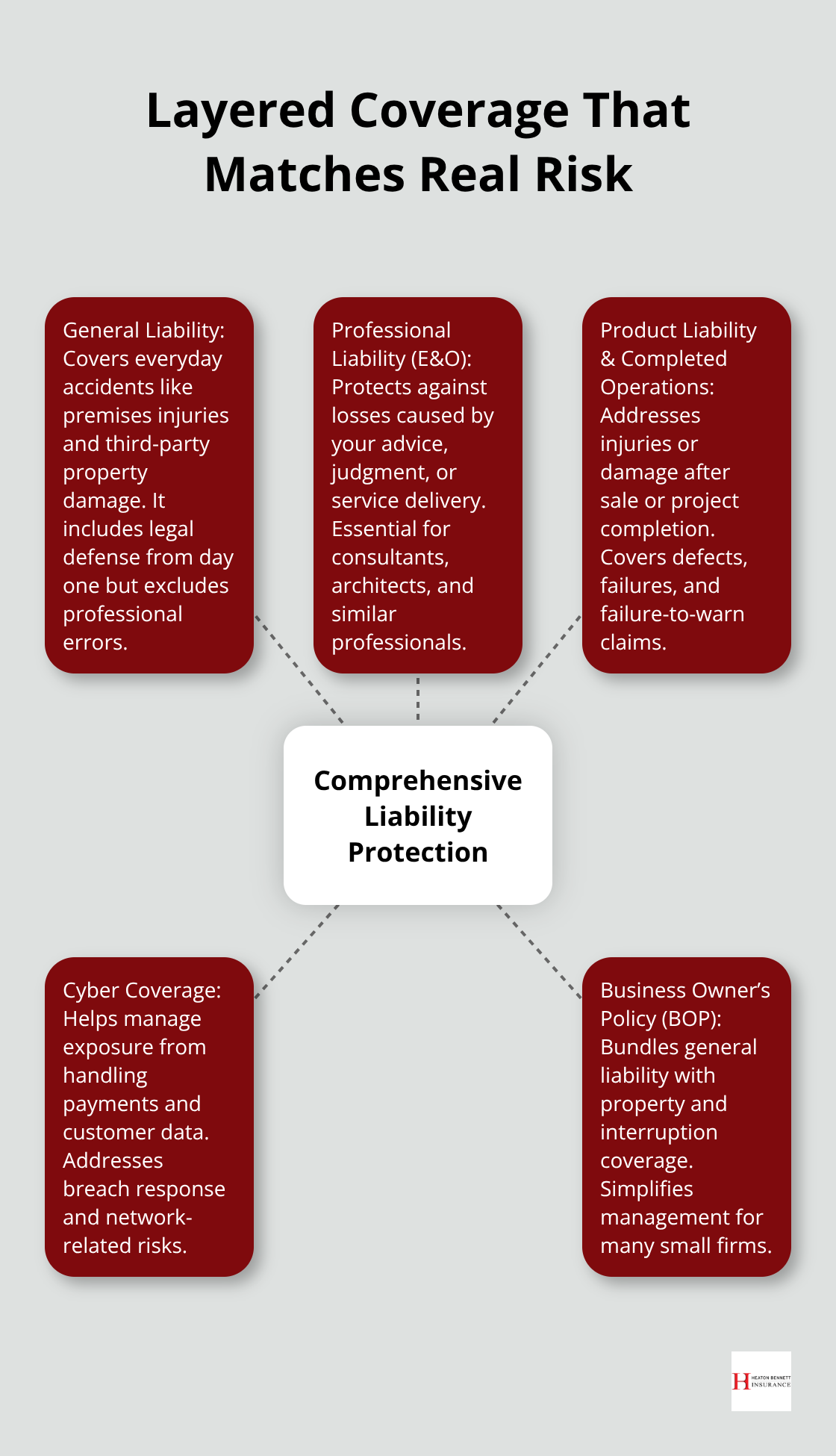
If you interact directly with customers or clients on premises, general liability remains foundational, but it should never stand alone. Most businesses benefit from layering multiple coverage types because no single policy addresses all exposures. A Business Owner’s Policy bundles general liability with commercial property and business interruption, simplifying management for small firms. Adding professional liability, product liability, or cyber coverage as endorsements or separate policies creates the comprehensive protection that actually matches business reality.
Your next step involves matching these coverage types to your specific industry and operations-a process that requires honest assessment of where your business actually creates liability exposure.
Aligning Coverage with Your Business Risk Profile
Your industry determines your liability exposure far more than your company size or revenue does. A restaurant faces slip-and-fall risks that a software firm never encounters, yet the software firm carries professional liability exposure the restaurant largely avoids. The first practical step is mapping your actual business operations against liability categories rather than assuming generic coverage fits your situation.
Map Your Operations to Liability Exposures
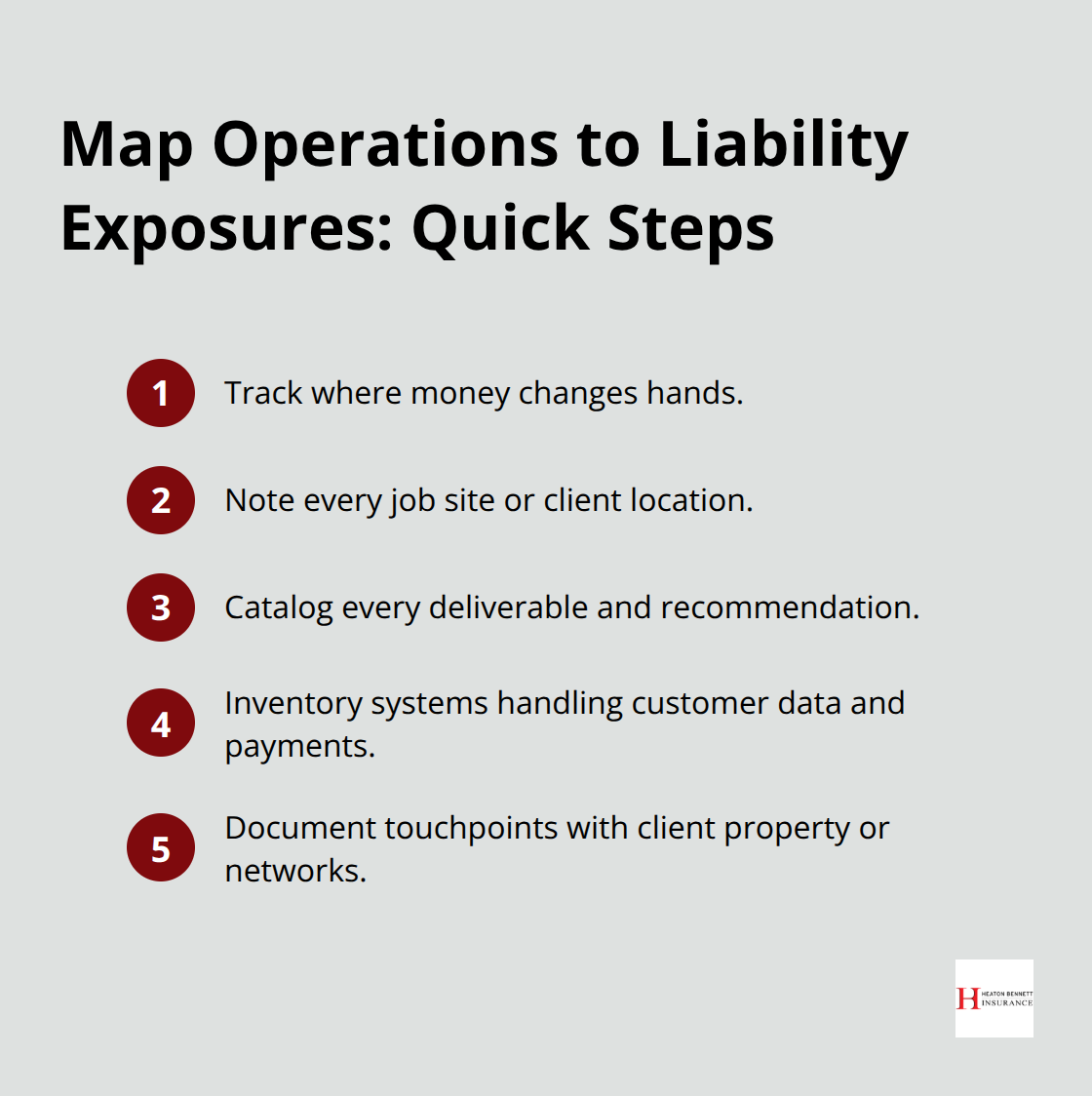
Start by identifying where money changes hands, where your work touches client property or data, and where your expertise directly influences client outcomes. A home repair contractor should document every job site visit because each location creates premises liability exposure. A consulting firm should catalog every client deliverable because each recommendation creates errors and omissions exposure. An e-commerce business should track payment processing and customer data because both create cyber and fraud exposure.
This operational mapping takes two to four hours and forms the foundation for accurate coverage decisions. Without it, you’re essentially guessing at protection. The process forces you to confront where your business actually creates risk rather than where you assume it does.
Assess Exposure Severity Against Your Financial Capacity
Once you’ve mapped operations, assess exposure severity by asking which incidents would actually threaten your business survival. A $50,000 property damage claim might be manageable for a large contractor but catastrophic for a small landscaping company. A $250,000 professional liability claim could force a solo consultant to close permanently. A $1 million product recall could eliminate a small manufacturer’s cash reserves entirely.
This severity assessment determines your coverage limits far more accurately than industry averages or broker recommendations. Your coverage limits should reflect your actual financial vulnerability, not what sounds adequate in conversation. A general liability limit of $1 million provides minimal protection if your industry commonly sees claims exceeding $2 million, yet it may be excessive if your actual exposure tops $500,000.
Identify and Close Coverage Gaps
The gap analysis step separates competent risk management from wishful thinking. Pull your current policies and list exactly what each covers, including dollar limits, deductibles, and exclusions. Then compare this list against your operational map. Does your general liability include product liability or only premises and operations? Does your professional liability have a retroactive date that excludes older client relationships? Does your cyber coverage include breach notification costs or only network security?
These exclusions are where claims go unpaid. A contractor discovering that completed operations coverage has a two-year tail after job completion faces massive exposure on multi-year projects. A consultant learning that professional liability excludes certain client types mid-claim has no recourse. These gaps cost thousands when they surface during claims, yet they take minutes to identify during policy review. Business changes create new exposures constantly-a new product line, a relocated office, or a shift toward higher-value contracts all alter your actual risk profile.
Set Limits Based on Realistic Worst-Case Scenarios
Many business owners choose coverage limits based on what competitors carry or what sounds substantial rather than what their actual exposure demands. This approach fails consistently. A better method involves calculating realistic worst-case scenarios specific to your business.
If you operate a small plumbing company, a worst-case scenario might be a botched water line installation that floods a commercial building, triggering $300,000 in water damage and business interruption claims. Your coverage limit should exceed this realistic worst case, not match it exactly. If you run a design firm, a worst-case scenario might be a branding recommendation that damages a client’s market position, triggering a $500,000 negligence claim plus defense costs exceeding $50,000. Your professional liability limit should comfortably exceed this exposure.
Setting limits below realistic worst cases is the definition of underinsurance, and it’s the decision that haunts business owners after claims arrive. Your limits should reflect what you could realistically lose, not what feels comfortable to pay in premiums today.
Final Thoughts
Commercial liability protection only works when it matches your actual business operations. The gap between what you think you’re covered for and what you actually are is where most businesses suffer financial damage. Your liability risk depends entirely on your industry, your client interactions, and your service delivery model-a contractor’s exposure differs fundamentally from a consultant’s exposure, yet both need comprehensive protection tailored to their specific operations.
Your business changes constantly, and your coverage must change with it. A new product line, an expanded service offering, or a shift toward higher-value contracts all alter your actual exposure. Your coverage limits from three years ago may be inadequate today, and exclusions that seemed irrelevant when you purchased the policy might directly impact a claim you face tomorrow. Most business owners review their liability coverage only at renewal time, which is far too infrequent.
Pull your current policies and map them against your actual business operations to identify gaps honestly. Calculate realistic worst-case scenarios specific to your industry and set coverage limits accordingly. We at Heaton Bennett Insurance work with business owners across industries to align coverage with real risk, and we can help you review your current protection and build the comprehensive commercial liability protection your business actually needs.
The information provided in this blog is for general informational purposes only and does not constitute legal, financial, or insurance advice. Coverage options, terms, and availability may vary. Please consult with a licensed professional for advice specific to your situation.

