
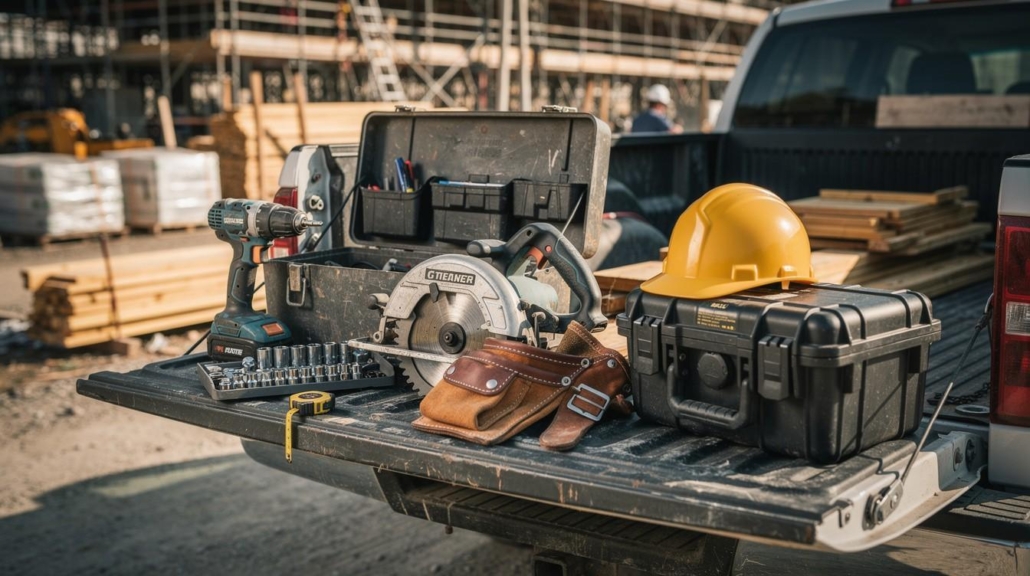
Contractor Tools Coverage: Keep Your Jobsite Ready
Your tools are your livelihood. When theft or damage strikes a jobsite, the financial hit can derail projects and drain your budget fast.
Contractor tools coverage protects your equipment investment when it matters most. At Heaton Bennett Insurance, we help construction professionals secure the right protection so you can focus on the work ahead.
What Contractor Tools Coverage Actually Protects
Contractor tools coverage is a first-party insurance policy that reimburses you directly when your hand tools, power tools, equipment, and other business property suffer damage, theft, or loss. Unlike general liability insurance, which covers injuries or damage you cause to others, tools coverage focuses on protecting your own assets. This distinction matters because a general liability policy won’t pay for your stolen circular saw or damaged compressor. The coverage works across multiple job sites, making it ideal for contractors who move between locations regularly. When a toolbox disappears from a jobsite or equipment gets damaged in a work incident, this policy covers the replacement or repair costs, keeping your projects on track.
What Gets Covered Under This Policy
Hand tools, power tools, ladders, scaffolding, and personal protective equipment all fall under standard coverage. Many policies also cover larger equipment like excavators, backhoes, and bulldozers if you schedule them separately on the policy. Items valued over $2,500 typically require individual scheduling to ensure accurate coverage amounts. The policy responds to theft, vandalism, and accidental damage from drops or impacts. However, normal wear and tear, mechanical breakdown, and equipment you lend or rent to others fall outside protection. Some carriers exclude natural disasters like earthquakes or hurricanes unless you add specific endorsements. Location matters too-many policies limit coverage to tools on your named business premises or scheduled jobsites, and tools left in unlocked vehicles overnight may be excluded entirely.
How Coverage Structure Affects Your Protection
Coverage can be structured as blanket coverage, which sets one limit for all tools combined, or as scheduled coverage, where you list individual high-value items with separate limits. Blanket coverage works for contractors with many low-to-mid-value tools, while scheduled coverage protects expensive equipment more precisely. Most contractors underinsure their equipment inventory, a mistake that leaves them exposed when losses occur. Setting your deductible higher reduces your premium but means you’ll pay more out of pocket when filing a claim. A $1,000 deductible typically costs less than a $500 deductible, so weigh your cash flow against the risk.
What Your Premium Actually Costs
Installation professionals pay roughly $14 per month for basic coverage, though your actual cost depends on the type of construction work, equipment value, your revenue, number of employees, location, claims history, and chosen deductibles. Bundling tools coverage with general liability insurance or a business owner’s policy generates meaningful savings compared to purchasing them separately. The specific factors that influence your rate-equipment value, claims history, and location-mean that two contractors in different regions or with different asset bases will pay different amounts. Understanding these cost drivers helps you make informed decisions about coverage limits and deductibles that fit your operation. Before you finalize your policy, review your specific policy language with an agent to confirm what your coverage actually includes and excludes.
Why Contractors Need Tools Coverage
Theft Costs Add Up Fast
Theft on jobsites happens constantly. The Construction Industry Safety Coalition reports that tool theft costs the construction industry hundreds of millions annually, and individual contractors often absorb losses that can exceed an entire year’s premium. A stolen power drill or missing compressor might seem manageable until you realize you need that equipment tomorrow to keep a project moving. When tools vanish or get damaged, you face two immediate problems: the replacement cost and the project delay. A two-day equipment shortage costs you thousands in lost labor hours, missed deadlines, and damaged client relationships. Contractors without tools coverage treat each loss as a business expense rather than an insurable risk.
Hidden Costs Multiply Quickly
The financial reality is brutal-uninsured equipment losses compound across multiple jobsites and seasons. One theft might cost $3,000, but five thefts in a year costs $15,000 plus cascading project delays that affect your reputation and future bids. The real damage goes deeper than the immediate replacement cost. When equipment disappears, your crew sits idle or works inefficiently with borrowed tools. According to the Association of Professional Builders’ State of Residential Construction Industry report, 27.5% of construction projects are delivered late, and equipment loss or damage contributes significantly to schedule slips. Your labor costs accelerate while productivity drops.
The Ripple Effect on Your Bottom Line
You might hire temporary workers to cover the gap or rush expensive expedited equipment rentals. These hidden costs dwarf the equipment’s replacement value. A contractor losing a $2,000 scaffolding system doesn’t just spend $2,000 on replacement-they spend thousands more on labor inefficiency, expedited shipping, and schedule penalties. Tools coverage eliminates this financial spiral. When loss occurs, you file a claim and receive reimbursement quickly, allowing you to replace equipment and resume work without bleeding cash. The policy transforms an unpredictable catastrophe into a predictable business expense.
Why Margins Matter
For contractors operating on thin margins (nearly one in four builders ends the year without a profit according to industry data), this protection separates profitable operations from struggling ones. Tools coverage isn’t optional if you want financial stability. The next step is understanding how to select the right coverage for your specific equipment and operation.
Selecting Tools Coverage That Matches Your Operation
Build Your Equipment Inventory First
Start with a complete equipment inventory before you contact any insurance provider. List every tool and piece of equipment your crew uses, including hand tools, power tools, ladders, scaffolding, and larger assets like excavators or compressors. For each item, record the make, model, serial number, and current replacement cost. This inventory becomes your foundation for accurate coverage. Many contractors skip this step and end up underinsured, discovering gaps only after a loss occurs.
Items valued over $2,500 require individual scheduling on your policy, meaning you’ll list them separately with specific coverage limits. This scheduled approach protects expensive equipment more precisely than blanket coverage, which groups all tools under a single limit. Blanket coverage works if your equipment consists mostly of low-to-mid-value items scattered across multiple jobsites, but scheduled coverage prevents the mistake of undervaluing critical assets. Once you have your inventory complete, you’ll know exactly what coverage structure makes sense for your operation.
Compare Policies Across Multiple Carriers
Compare policies from multiple carriers by examining what each one actually covers and what it excludes. Many policies limit coverage to tools on your named business premises or scheduled jobsites, leaving equipment in transit or stored at temporary locations unprotected. Some carriers exclude tools left in unlocked vehicles overnight, a common scenario on jobsites. Natural disasters like earthquakes or hurricanes typically require separate endorsements.
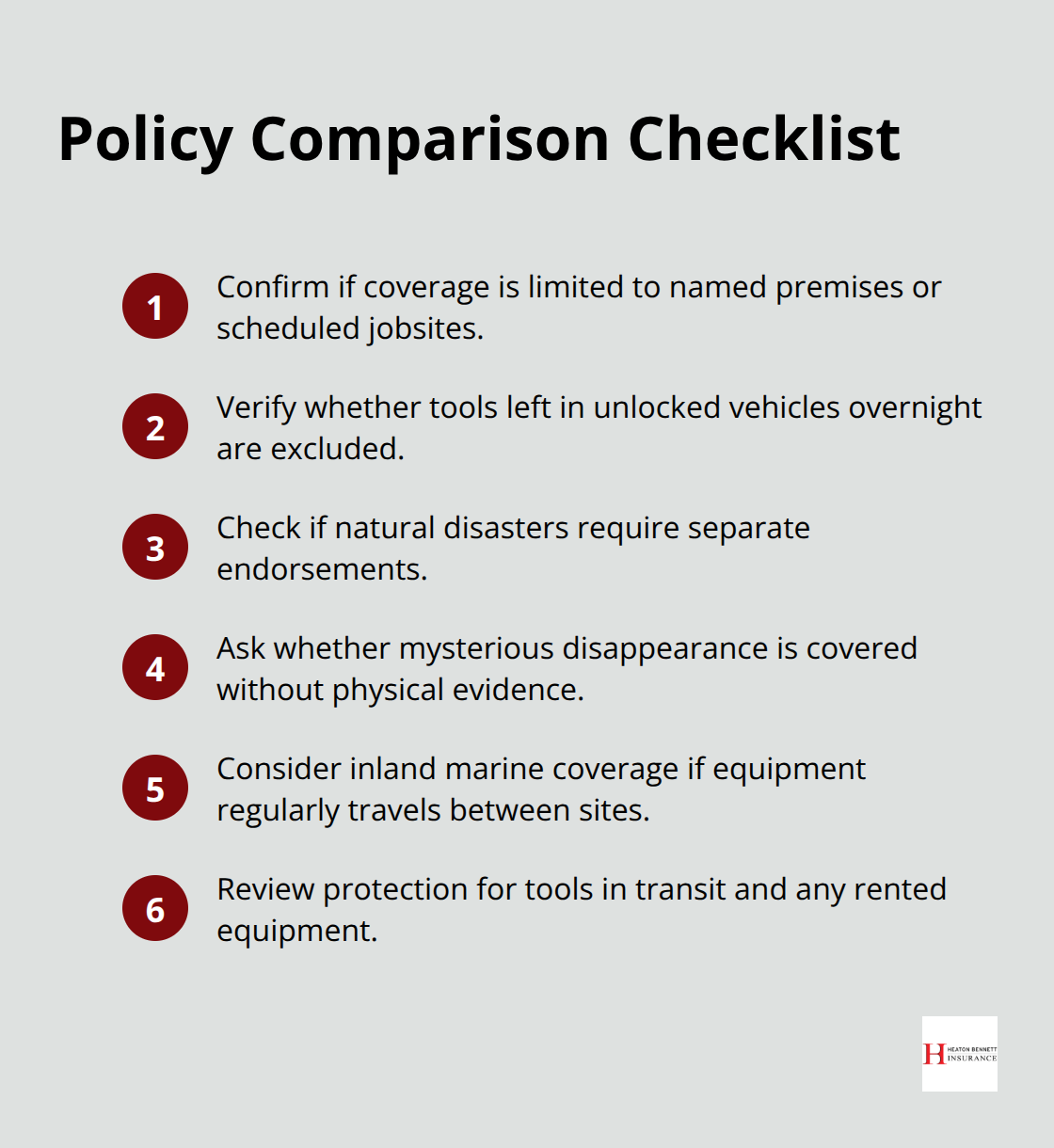
Ask each provider directly whether they cover mysterious disappearance, since some policies require physical evidence of theft and deny claims when tools simply vanish without a trace. Inland marine coverage, sometimes called a contractor’s equipment floater, follows your equipment wherever it travels between sites and often offers higher scheduled values and open-perils protection compared to standard tools coverage. This matters if your crew regularly moves heavy equipment on trailers or transports tools between distant jobsites.
Evaluate Coverage for Rented Equipment and Transit
Review whether the policy covers equipment you rent for specific projects, since rented items sometimes fall outside standard protection. Transit coverage proves essential-verify that your policy protects equipment while being transported on trailers or flatbeds between sites. Many contractors overlook this gap and face uninsured losses during equipment movement, when theft and damage risk actually increases.
Analyze Deductible Options and Premium Costs
Deductibles significantly affect your premium costs, so compare options at different levels like $500, $1,000, and $2,500. A higher deductible reduces your monthly payment but increases what you’ll pay out of pocket when filing a claim. Your claims history and location also influence pricing, so getting quotes from multiple carriers reveals the real cost differences. Installation professionals typically pay roughly $14 per month for basic coverage, though your actual rate depends on equipment value, construction work type, revenue, employee count, location, and claims history.
Final Thoughts
Contractor tools coverage protects your equipment investment and keeps your operation running when theft or damage strikes. Equipment losses compound quickly across multiple jobsites, and the financial consequences extend far beyond replacement costs-project delays, labor inefficiency, and schedule penalties drain your bottom line fast. We at Heaton Bennett Insurance understand these risks and work with multiple carriers to find tailored coverage that matches your specific equipment, operation size, and jobsite locations.
Start your protection by documenting every tool and piece of equipment your crew uses, including make, model, serial numbers, and current replacement costs. Compare policies from multiple carriers, paying close attention to what each one actually covers and what it excludes, and ask about mysterious disappearance coverage, transit protection, and whether rented equipment qualifies for reimbursement. Evaluate deductible options at different levels to find the balance between monthly premium costs and out-of-pocket expenses that fits your cash flow.
Reach out to Heaton Bennett Insurance for a quote on contractor tools coverage. Our team reviews your equipment inventory, discusses your jobsite locations and claims history, and recommends the right coverage structure for your operation. Protecting your tools protects your business.
The information provided in this blog is for general informational purposes only and does not constitute legal, financial, or insurance advice. Coverage options, terms, and availability may vary. Please consult with a licensed professional for advice specific to your situation.

