

Workers Compensation for Contractors: What You Need to Know
Contractors operate in a high-risk environment where a single workplace injury can derail both the worker’s life and your business finances. Workers compensation for contractors isn’t optional in most states-it’s a legal requirement that protects your team and your bottom line.
At Heaton Bennett Insurance, we’ve helped countless contractors navigate coverage requirements, understand their obligations, and find affordable policies that actually fit their needs. This guide walks you through everything you need to know to stay compliant and protected.
What Coverage Do You Actually Need as a Contractor?
State Requirements Vary Widely
Workers compensation requirements differ dramatically across states, and mistakes cost contractors thousands in fines or leave them exposed when injuries occur. Most states require workers compensation if you have even one employee on payroll, but some states exempt sole proprietors who work alone. California mandates coverage for almost all contractors regardless of employee count, while Texas allows employers to opt out of the traditional system entirely through alternative programs. You must know your specific state’s threshold because operating without required coverage triggers penalties ranging from $1,000 to $25,000 per violation, depending on your state. Some states add criminal liability on top of civil fines.
Why Injury Rates Matter for Your Compliance
The National Council on Compensation Insurance reports that contractors face the highest injury rates across all industries, with construction workers experiencing 5.2 injuries per 100 full-time workers compared to the overall private sector average of 3.5. This statistic explains why your state takes compliance seriously. High-risk work demands strict enforcement, and regulators penalize non-compliance aggressively because injuries affect workers’ lives and state insurance systems.
How Classification Affects Your Premiums
Classification determines what you actually pay for coverage, and most contractors misunderstand how this works. Insurance carriers assign you a classification code based on your specific job duties and the work your employees perform. A roofing contractor pays vastly different premiums than a general contractor doing office renovations because the injury risk differs. Each classification has its own base rate, and your payroll gets multiplied by this rate to calculate your premium.
Accuracy Protects Your Cash Flow
Misclassifying your workers or underreporting payroll to your carrier triggers audits and retroactive premium adjustments that devastate your cash flow. Some states impose additional penalties for intentional misclassification. Provide your carrier with accurate job descriptions and payroll information from day one. When you work with an independent agency, they help you identify the correct classifications and verify your policy reflects your actual operations, which protects you during audits and claims.
Understanding your state’s specific requirements and classification rules sets the foundation for compliant coverage. The next step involves examining what your policy actually covers and how those benefits protect both your workers and your business.
What Your Workers Compensation Policy Actually Covers
Medical Benefits and Wage Replacement
Workers compensation policies for contractors protect far more than just emergency room bills, and understanding exactly what your coverage includes prevents nasty surprises when injuries happen. Medical benefits cover all treatment related to a work injury, including emergency care, surgery, physical therapy, and ongoing medical appointments with no time limit as long as the injury stems from work. If an employee suffers a serious injury that prevents them from working, disability payments replace a portion of their lost wage-typically 60 to 70 percent of their average weekly wage depending on your state.
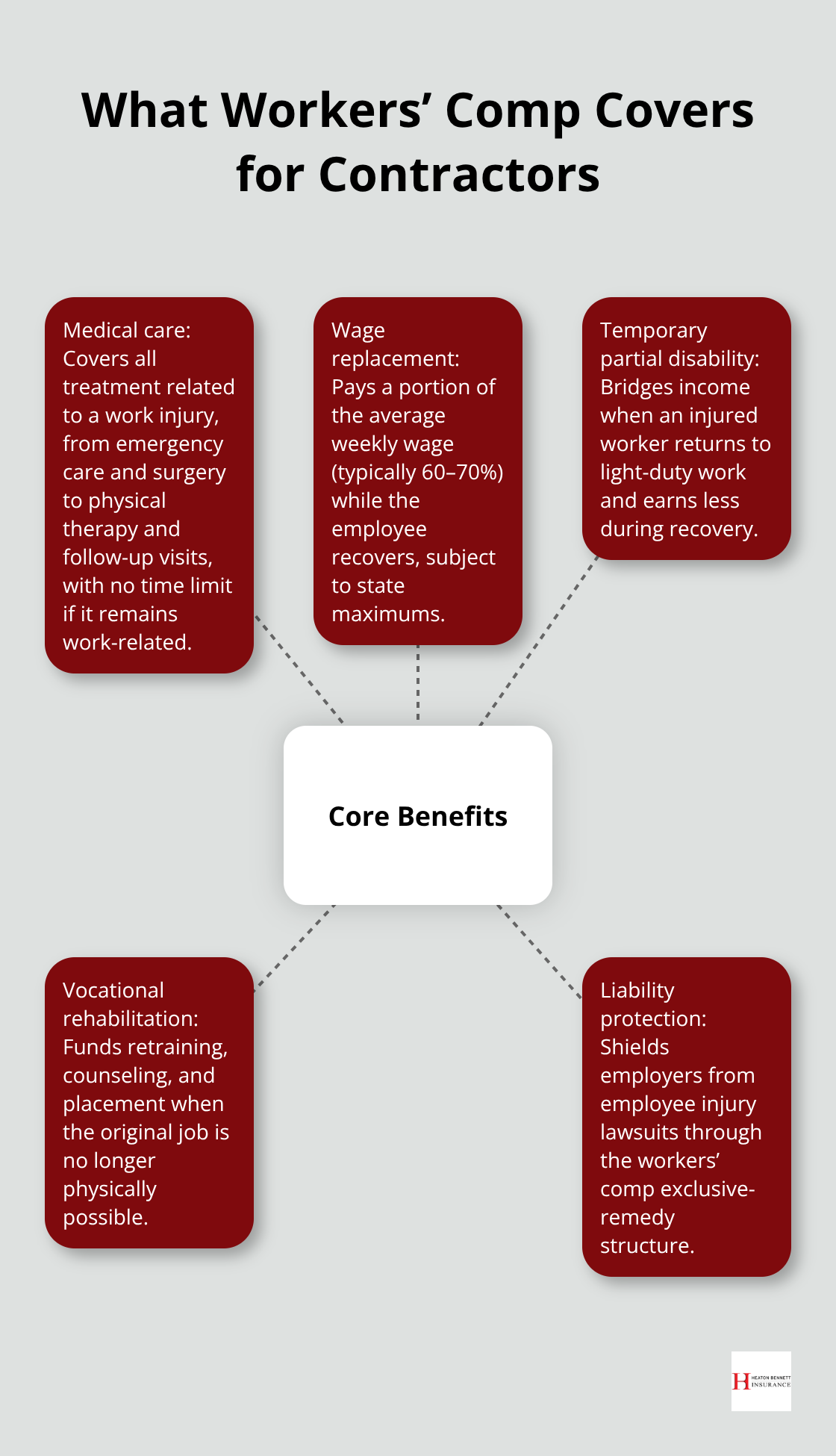
Most states cap these payments at a maximum weekly amount that ranges from $400 to over $1,200 per week, so a contractor earning $2,000 weekly might receive $700 to $900 while recovering.
Temporary partial disability benefits apply when an injured worker returns to lighter duties but earns less than before the injury, bridging that income gap during the transition back to full capacity. These wage replacement benefits matter tremendously because they keep injured workers financially stable without forcing them to drain savings or take on debt while healing.
Vocational Rehabilitation Accelerates Recovery
Vocational rehabilitation services represent one of the most underutilized benefits in workers compensation, yet they directly impact whether your injured employee returns to productive work or becomes permanently dependent on disability payments. If an injury prevents someone from performing their original job, your policy covers retraining programs, job counseling, and placement assistance to help them transition into different work they can physically handle. State agencies like the California Division of Workers Compensation report that vocational rehabilitation services reduce permanent disability costs by keeping workers engaged in the labor market rather than leaving them stranded without income prospects.
Return-to-work programs structured with modified duties allow injured employees to gradually increase their responsibilities as they heal. Research from the National Safety Council shows that this approach accelerates recovery timelines by 20 to 30 percent compared to complete time off work, which benefits both your employee and your operation.
Liability Protection Shields Your Business
Liability protection embedded in your workers compensation coverage shields you from personal injury lawsuits filed by employees for workplace injuries, which is critical because lawsuits would drain your business finances far beyond what insurance premiums cost. Workers compensation already provides this protection in exchange for the no-fault structure that prevents employees from suing their employers over covered workplace incidents. This distinction matters enormously-many contractors mistakenly believe they need separate liability insurance for employee injuries, but that coverage already exists within your workers compensation policy.
Understanding what your policy covers sets the stage for evaluating how much coverage you actually need and what factors drive your premium costs.
What Drives Your Workers Compensation Premium
Three Factors That Control Your Costs
Your premium depends on three concrete factors that most contractors underestimate: actual payroll dollars, job classification accuracy, and your loss history. The National Council on Compensation Insurance reports that a roofer pays $45 per $100 of payroll while a general contractor doing office renovations pays $15 per $100, yet many contractors fail to understand how their specific work activities slot into these classifications. Your payroll multiplies directly by your classification rate, so a contractor with $500,000 annual payroll in a $20 per $100 classification pays $100,000 annually before any adjustments.
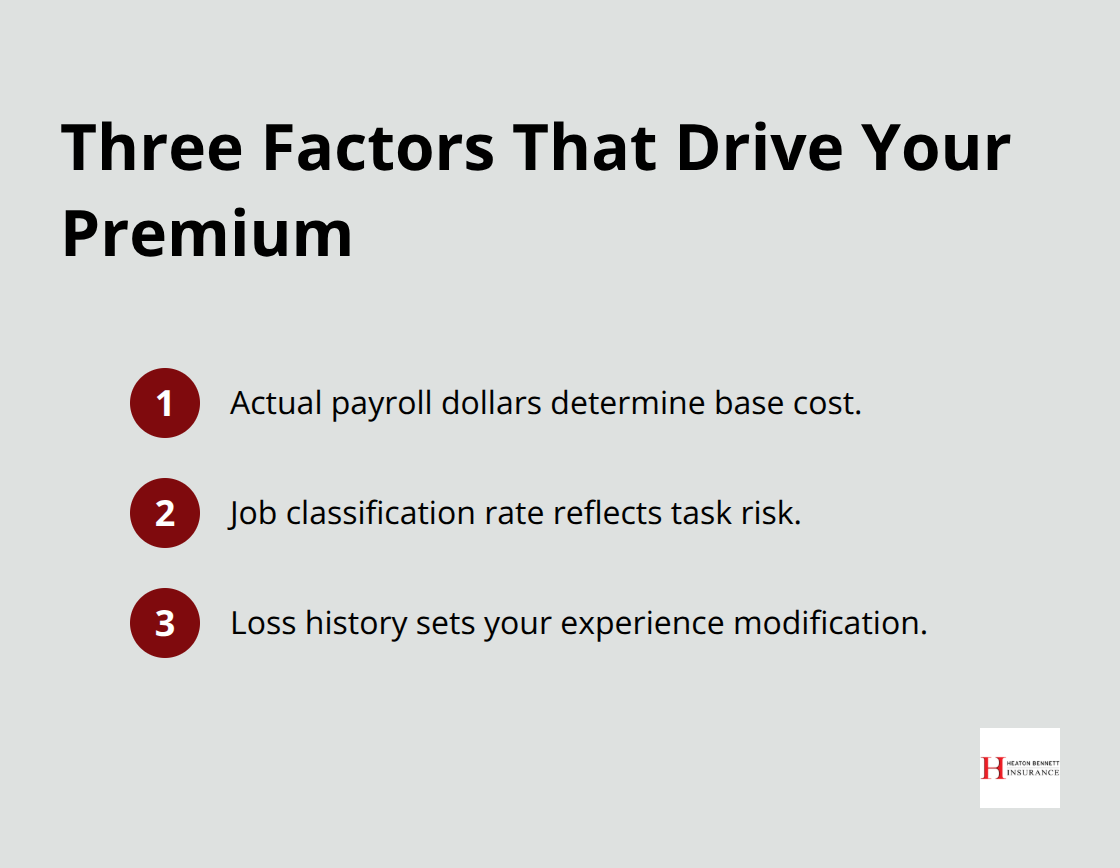
This calculation means that even small payroll increases or classification changes impact your bottom line significantly.
Misclassification Creates Real Exposure
When you misclassify employees to lower premiums, you risk audit penalties and coverage denial that far exceed any short-term savings. Insurance carriers can deny claims when they discover you’ve misrepresented your operations, leaving you personally liable for medical bills and wage replacement costs that can easily exceed $100,000 for a serious injury. Accurate job descriptions and payroll information protect you during audits and claims investigations. An independent agency can verify your policy reflects your actual operations and help you identify correct classifications from the start.
Loss History Determines Your Modification Rate
Your actual loss history matters more than most contractors realize, and this is where you gain leverage with carriers. If your company goes three to five years without claims, many carriers offer experience modifications that reduce your base rate by 10 to 25 percent, translating to real savings on your renewal premium. Conversely, multiple claims push your modification rate up, sometimes by 40 percent or more, making injury prevention genuinely profitable. When you shop quotes from multiple carriers, you’re not just comparing prices-you’re comparing how each carrier views your risk profile and loss history. Some carriers specialize in contractors with claims history and offer better rates than standard carriers, while others focus on clean-record businesses.
Getting Multiple Quotes Reveals Hidden Savings
Getting three to five quotes takes roughly two hours but often reveals $5,000 to $15,000 annual differences for identical coverage. Request quotes that break down the base rate, your modification factor, and any available discounts so you can actually compare apples to apples. Many contractors accept the first quote without realizing competitors offer substantially better terms for the same risk profile.
Safety Programs Lower Your Rates
Safety programs that document your injury prevention efforts can lower your modification rate during the next rating period, and some carriers offer 5 to 15 percent premium discounts when you implement formal safety training, equipment maintenance logs, or incident reporting systems. Installing fall protection equipment, enforcing hard hat requirements, or conducting regular toolbox safety meetings creates documented evidence that reduces your insurer’s perceived risk.
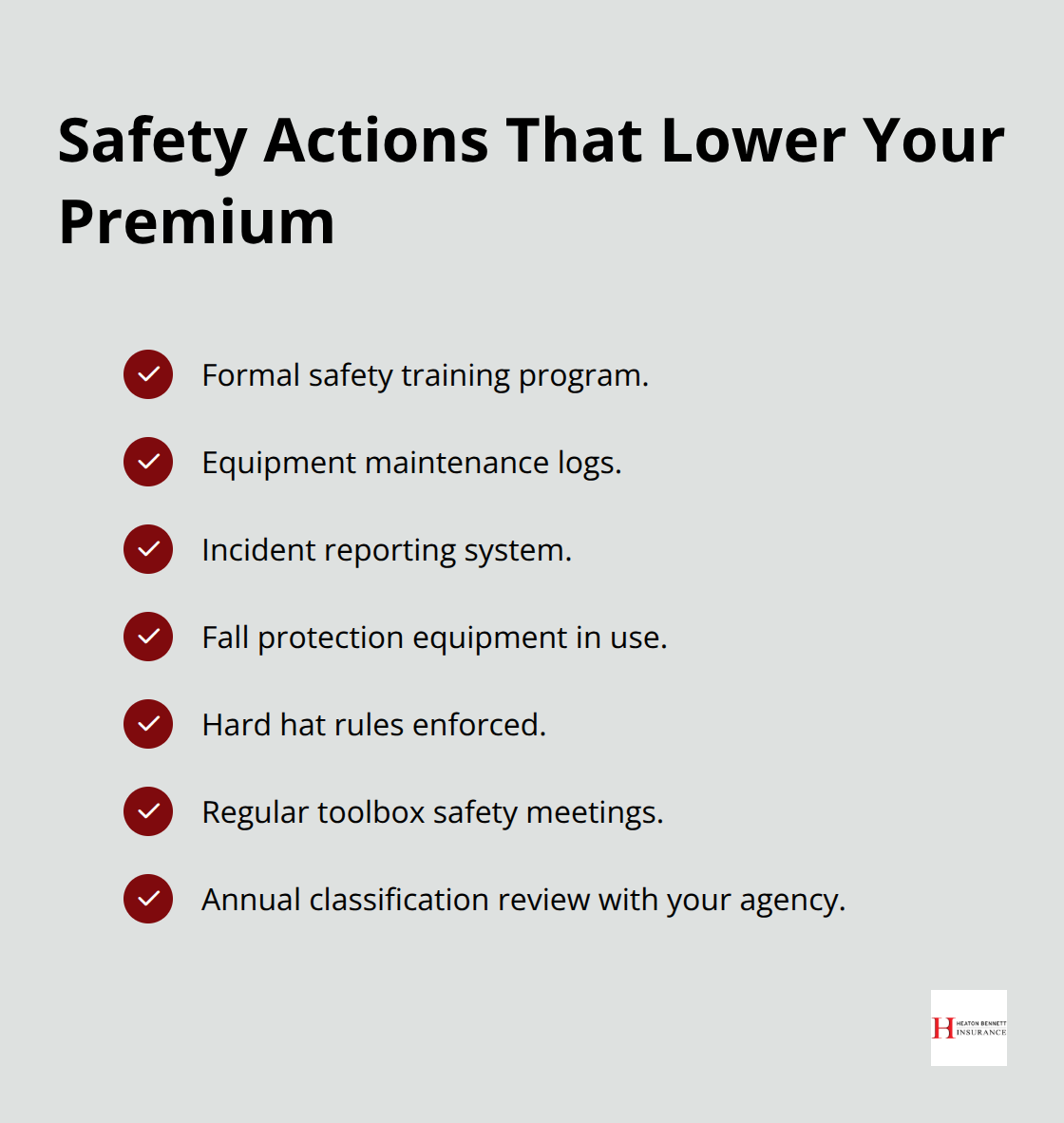
Work with an independent agency to review your classification annually because job scope creep often happens without deliberate reclassification. If your team starts performing tasks outside your original classification, your premium should adjust accordingly, and agencies catch these changes before your carrier audits you and demands retroactive premiums.
Final Thoughts
Workers compensation for contractors protects your team when injuries happen and shields your business from financial devastation. The requirements vary by state, your classification determines your premium, and your loss history directly impacts what you pay. Getting this right means understanding your specific state’s mandates, accurately reporting your payroll and job duties, and shopping multiple carriers to find rates that match your risk profile.
An independent agency gives you access to multiple carriers instead of locking you into one company’s rates and underwriting decisions. Your agency reviews your classification annually, catches job scope changes before audits happen, and identifies discounts you might otherwise miss. They handle the comparison shopping, verify your policy matches your operations, and guide you through claims when injuries occur.
Contact Heaton Bennett Insurance to discuss your workers compensation for contractors needs and get a personalized quote that reflects your actual risk profile. We work with multiple carriers to find coverage that protects your team and fits your budget. Our team helps you navigate state requirements, verify your classifications, and secure the right protection for your business.
The information provided in this blog is for general informational purposes only and does not constitute legal, financial, or insurance advice. Coverage options, terms, and availability may vary. Please consult with a licensed professional for advice specific to your situation.

